
Juno Beach Centre, Courseulles-sur-Mer, Normandy, France, on its twentieth anniversary.

He does makes a strong case for the pro-slavery views and support for the Confederacy of more than a few prominent Canadians. But I thought the series a little one-sided (as an editor titled it: "The American Civil War was Canada's Fight Too. And We Were on the Wrong Side." It did seem to skimp on coverage of serious reasons why British North America had concerns about a heavily-armed United States with strong and enduring annexationist views regarding the provinces to the north. (He does acknowledge there were abundant Canadian supporters of the Northern cause, if briefly.)
So I was pleased to see a couple of letters to the editor making precisely this point, one signed by Alan McCullough of Ottawa, a friend of this blog.
Sher's most vivid story of a Canadian Confederate ally concerns prominent Torontonian George Denison, who spared no effort to support the south and the cause of slavery. Good to see the DBC Denison entry has this covered well, and notes that Denison's southern loyalties ruined his chances for military preferment in Canada. (There's still a Denison Avenue in downtown Toronto.)


The plan was to reduce Finland to a Soviet satellite state, as had just been done to Estonia, Latvia, and Lithuania. In this case, however, the Finns did not surrender, and an invasion was required. Ten to twelve days were allotted to the task: five Soviet armies attacking across an 800-mile frontier.
It went much like Putin's strike at Kyiv in February 2022: "the ingenious Finns were slaughtering the Russians." By mid-December Stalin had lost about 25,000 men. His divisions ran out of food and ammunition, and either scattered or froze where they were. Finally in March 1940, a truce was reached in which the Finns conceded territory but preserved their independence. The Soviet Union lost over 125,000 troops. "The Red Army was good for nothing," Stalin later told Churchill and Roosevelt.
Remember all those senior advisors to Putin, who died by "falling out of windows" after the strike on Kyiv collapsed? During the "Winter War" in Finland, Stalin had a similar response but was more direct about it.
Mekhlis arrived in Suomussalmi to find chaotic scenes which he made worse. He confirmed the losses and shot the whole command. The sentence of shooting was performed publicly.
This is the horrifying part of Montefiore's book: the scale of Stalin's endless slaughter, which does indeed seem to put Putin's killings in the shade. And Stalin's went on for decades, in peace as in war. Montefiore makes the case that it was a matter of policy for Stalin that executing vast numbers of people really did motivate the survivors. Even with the German army at the gates of Moscow, Stalin was killing his own troops almost as fast as the Germans were.
There is a myth that the only time Stalin ceased the war against his own people was during 1941 and 1942, but during this period 994,000 servicemen were condemned, and 157,000 shot, more than fifteen divisions.
By 1942, Stalin began to grasp he should leave military and logistical planning to his generals, and the Soviet Union began to turn the tide against Germany. There's not much evidence for Putin and Pregoryn having learned this, but it might yet start to happen. But unlike Putin, Stalin had an enormous flow of American armaments on his side, not against him.

No matter how small the community, anywhere, the lists of names from the First World War are always long, and the one here includes a notable number of Odjigs and Migwans and other names from Manitoulin's substantial Anishnaabe communities.

But when war actually started, the barons of the London financial world blanched at the prospect of having to close down most of the system that they lived on. They convinced the government the financial system was too important to be risked in war. So Britain sent an expeditionary force to be annihilated in Flanders instead.
Is it knowledge of the slaughter of the trenches, or awareness of the nuclear threat, that permitted the Euro-American financial system to be marshalled against Russia in 2022, instead of NATO's air forces and armoured divisions?
Here's the original post from 2015. I never read much of Lambert's book, but it comes back to me now.
 |
| Still flying! Slava Ukraini! |
Now I wonder if a Russian failure to speedily subdue Ukraine -- or dare one hope, fail entirely -- will bring the same result even more speedily.
Also, it does feel like the first Twitter war, doesn't it? I don't follow Twitter very extensively, but what it offers seems more immediate that anything the news networks have been offering. (Not that I follow them too closely either, so could be wrong all round)
Update, February 28: Is this crisis also becoming a win for President Biden?
In February the White House did three things very loudly. One, it began declaring that Russia was absolutely about to invade Ukraine. Two, it declared no American troops would be involved. Three, it declared the US would support Ukraine.
All three exposed Biden to criticism. One: Nonsense, Putin ain't crazy, and armoured divisions don't roll across Europe any more. Two: Weakness! Biden's unilateral disarmament represents American weakness! Three: Ineffectual. All aid short of help, typical.
All three policies now look good. One: 'nuff said. Two: Americans reasonably appreciate their troops not being thrown into every war. Also: thermonuclear war is worth avoiding. Also, looks like American troops may not be needed. Three: the support that the American-led coalition is giving Ukraine is really helping Ukraine, is really devastating Russia, and is really uniting and toughening the western alliance.
Of course, all three successes are built on the successes of Ukraine in mounting such effective and inspirational resistance to the invasion. (Though it's not over!) Still, the Biden administration seems to have read the situation accurately, anticipated wisely, and publicly placed itself in all the right positions.
Isn't it reassuring that there seems to be a non-crazy person in the White House, calmly executing a long strategy that actually works? (Caveat: American politics/media being what it is, don't expect this analysis to become widely held in the United States!)
Update, March 4. I saw a Twitter -- unsaved, now gone -- that said, more or less: "Can't believe it's taken me six year to get a Ph.D and now everyone on twitter has got one in Eastern European geopolitics in four days." After I stopped laughing, I thought it was worth remembering.
Image:
Ancestry.ca announces that until Remembrance Day it is making available free substantial collections of Canadian Second World War records, images, and newsreels.
Leading up to Remembrance Day, Ancestry Canada is providing free access to new and existing Canadian World War II record collections. These new collections include 2,500 images and more than 100 newsreels depicting scenes from combat and routine life during WWII.
For the first time, the collections are indexed, making it easier for Canadians to directly search visual war footage by name and connect these visual records to family trees on Ancestry. The footage in the collections provides a unique perspective into how our ancestors lived and experienced the war.
They will doubtless want some kind of trial membership in exchange for the access, and then they will market subscriptions to you mercilessly. I admit I have become hooked on the ease of researching the basic life details of just about anybody through Ancestry, but it can be accessed via public or academic libraries for occasional use.
Update, same day: Also, the Canadian War Museum has a lot of online and onsite Remembrance Day programming to offer. No subscription there.

In some sense, the real answer here is probably unknowable. Two events happened at nearly the same time, and they were closely followed by a third. Figuring out conclusively what caused what may simply not be possible.
Something not often drawn into this discussion is the long-term impact of Hiroshima and Nagasaki. In August 1945, there was still some sense, even in the Japanese high command, that the destruction of Hiroshima was not much different in kind that the destruction of Dresden or Tokyo by conventional bombing. It took, maybe, gradual understanding of and empathy for the actual horrors of nuclear warfare, and the experience of the Japanese cities and their survivors, to create a global reluctance to actually use nuclear weapons again -- a reluctance that has lasted 75 years so far.
Assume no atom bombing and a quick Japanese surrender ending the war. Without the image of Hiroshima and Nagasaki, how much greater the likelihood that some Cold War Strangelove would have gone ahead with use of tactical nuclear weaponry, or the hydrogen bomb, or the Doomsday Machine?
Is it acceptable to think that the destruction of those cities spared the rest of us from unknowable horrors? Deep waters.
[T]he assertion that the cenotaph symbolizes all Canadians who have sacrificed “in the cause of peace and freedom—past, present, and future,” serves to legitimate not just Canadian participation in World War One, but all Canadian military actions since then. Accordingly, it behooves us to think critically about the notion that the over 66,000 Canadians and Newfoundlanders who died in the Great War sacrificed themselves for the cause of freedom.Whatever you are remembering, take a moment at 11:00 this morning.
 |
| Mostly swamp once, and the battlefield was off to the left, somehow |
Chris, you are, alas, not alone in not realizing how many Rebellion battles were fought along the Upper Canada/United States border in 1838, that is after defeats of December 1837. Navy Island set the pattern for several incursions that followed that winter/spring- invade an Upper Canadian island in order to establish a base on British territory that could be fairly easily defended and also fairly easily supplied from the US.
In addition to Navy Island in the Niagara River there were invasions of Bois Blank and Fighting Island in the Detroit River, Hickory Island in the St. Lawrence, and, as you noted, Pelee Island. They were not fighting to create "new land" but to establish launching points for larger battles on the mainland. All failed and the next wave of invasions (summer and fall of 1838) were full land invasions - Short Hill (Niagara Peninsula), the Windmill (near Brockville), and Windsor - all intended to stir up the local population and re-ignite the fires of Rebellion.
All these border incursions - dubbed "Patriot Wars" by their participants and sympathizers - were disastrous, largely because they were not supported, but were firmly discouraged, by the American government that had no interest in another war with Great Britain. They did, however, demonstrate that, in the border states of Michigan, Ohio, New York and Vermont, there was strong American support for the Canadian cause. You undoubtedly know that many rebellion participants were sentenced to be transported to Van Diemen's Land. You may not know that of those who actually made the full trip - that is, who did not escape or be legally released en route - none were December 1837 rebels but rather men captured in failed 1838 raids - and most of these were not Upper Canadians, but Americans. Thanks, Chris, for reminding us all that there is much more to the whole Rebellion story than the debacle at Montgomery's Tavern.

Armistice night hysteria did not touch our camp much, though some of the Canadians stationed there went down to Rhyl to celebrate in true overseas style. The news sent me out walking alone along the dyke above the marshes of Rhuddlan (an ancient battlefield, the Flodden of Wales), cursing and sobbing and thinking of the dead
--- from Goodbye to All That.

Any attempt to put Canada's effort in the Great War in modern perspective runs headlong into the uncomfortable question of whether we still retain that apparently boundless capacity for suffering and commitment we displayed from 1914 to 1918. Would Canadians today answer a call to duty for a national project the size, scope, and duration of the Great War?Kids today!
Judging by what appeared in the Calgary Herald in August 1914, the opening of World War I elicited horror in a substantial part of the population. The Herald published poetry (a literary form long missing from opinion pages) with the most evocative titles and texts. The poem "The Wail of the Mothers" repeated the line, "Oh, give me back my son!" Elsewhere in the Herald's August pages, another poem — titled "Peace!" — began with these lines:
Great God of Peace and Love, how long shall man
Shed blood of man for paltry pomp of power,
And earth be rife with warfare, and the land
Filled with the tears of widowed hearts, that cry
To Thee in bitter agony for aid?
The paper also printed the brooding "War From Its Inglorious Side." It contained lines such as: "I was conceived in passion, hatred, envy and greed, born in the morning of antiquity, and have a genealogy whose every page drips with the red blood of murdered innocence. I lay waste the green fields and still the hand of industry."...
Remember that these clear-sighted cris de coeur were published before the reality of
slaughter became apparent. How many of us would be that perceptive and passionate
today?
 |
| Canadian artillery at Vimy (Wikipedia: Vimy Ridge) |
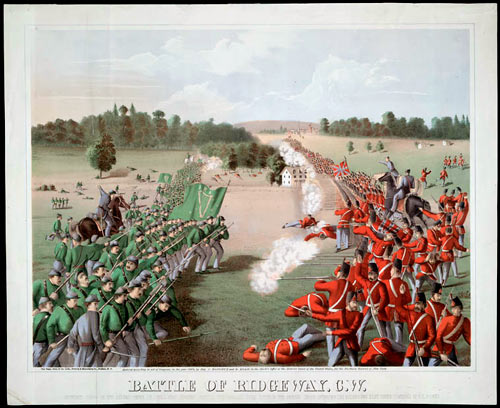
The next step is to now see to it that the 31 Canadians who fell in defending Canada against a hostile invasion, are recognized for their service by enrolling their names into the National Books of Remembrance, identifying their current resting places, and securing their graves National War Grave status in perpetuity.
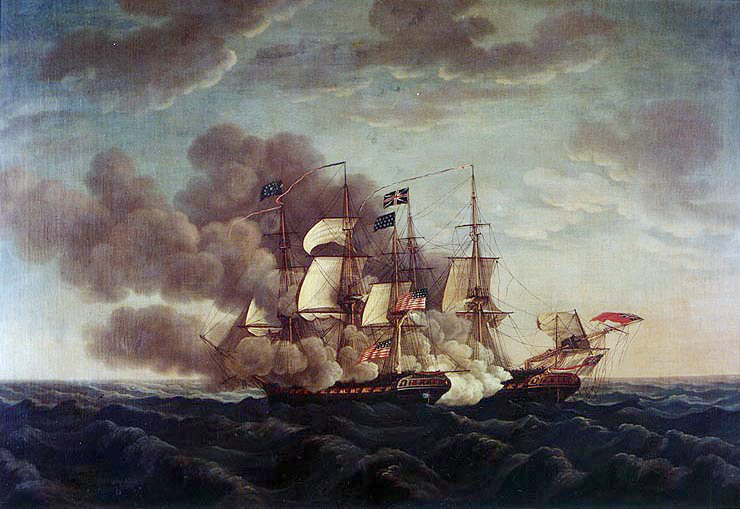
Over the next three years, a team of undergraduates working under my direction will be live tweeting the War of 1812, plus 200. Events will be reported exactly 200 years to the day after they took place…. Our tweets will include links to digitised primary sources related to the event being discussed. (For instance, on 18 June 2012 we will send out a tweet to a scanned image of President Madison’s formal declaration of war against Britain). The aim is to get readers to explore that vast number of primary sources that have been placed online in the last decade. Most of the online primary sources we will link to are materials from US, British, and Canadian archives.
