Showing posts with label history on film. Show all posts

Friday, August 15, 2025

History (sort of) on film: Malone on Confederation again


New documentary film on Canadian history launching on TV? Oughta be a good thing, right? But this one is "Don't Tell the Newfoundlanders" ("the true story of Newfoundland's Less than Constitutional Confederation with Canada')  based on a lurid conspiracy-theory book by Greg Malone of the remarkable, now long-gone Codco comedy troupe). 

"Don't Tell The Newfoundlanders" the 2012 book, argued that Newfoundland was shanghaied into confederation in 1949 by fraud, trickery, and connivance, all plotted secretly by dastardly Brits and Canadians and foisted on greedy gullible outport Newfoundlanders who ensured the confederation referendum passed when they should have heeded the advice of the wiser folk in St. John's.  

Here is a let-us-say sceptical review of the book from the Literary Review of Canada by Jeff Webb, professor of history at Memorial University, a Newfoundlander who has written widely about Newfoundland history and archaeology.

Malone constantly uses words such as “subverted,” “treason,” “criminal,” “conspirators,” “plot,” “connivance,” “duplicity,” “mendacity,” “abuse” and “fraudulently.” Historians have an understanding of our past that has more nuance and sophistication than this inflammatory choice of language implies—but this book is informed by the feeling that Canada has been unfair to Newfoundland since 1949 as much as by the evidence from the 1940s.

For a history with more nuance and sophistication, you might read Raymond Blake, another Newfoundlander historian of Newfoundland. His book Where Once They Stood is a much more serious and credible account of why Newfoundland rejected confederation in 1869 and endorsed it in 1949 (wisely in both cases, he argues). 

Blake dismisses Malone briefly in his introduction as "an actor and television personality who is convinced that the British and Canadian governments conspired to railroad Newfoundland into Confederation and that Britain fixed the vote..." Look for Malone to feature prominently in the new film series promoting that theory.  

Webb and Blake, may be seen not so much in it.  

The film is showing on The Bell Fibe TV1 channel and the Fibe app.

I can't help but note that after most of a century in confederation, Newfoundland has the writers, actors, producers, and publishing and film-making infrastructure that has generated so much artistic and creative work of national statute. Does Alberta's cultural community produce conspiracy-theory documents on this scale to support its grievances against confederation?  

Update, August 20: Charles Levi comments:

How many conspiracy films does Newfoundland need? Or do they need one every generation? Your story reminded me of a fun little film from the 1990s entitled "Secret Nation".

https://en.wikipedia.org/wiki/Secret_Nation
Same idea, different angle.

Meanwhile, I've yet to see any good conspiracy films about Ontario politics.


Friday, May 30, 2025

Moving pictures from Canada a century ago


We get mail, in this case from David Sobel:  

I wanted to share my website The Moving Past which has been in operation for a few months now.

Canada was the first country in the world to have a government-sponsored motion picture bureau. In 1917, Ontario formed its own motion picture bureau. The following year the Government of Canada created the Exhibits and Publicity Bureau, renaming it the Canadian Government Motion Picture Bureau in 1923. The reasons for their formation are discussed on the website. These two bureaus left behind a remarkable legacy of an estimated one thousand films, most of which are unknown and difficult to access.

My website hopes to change that. Seeking to capture the attention of academic historians and educators, the goal of the site is to make some of these productions available through streaming. Fifteen films are available right now, with plans to add six more by the Fall. More than 2,000 historians, from over 40 countries have watched the films so far. The site relies on small donations to function.

I invite you to take a look. There's a brief description of each of the films, which vary in length from three to 14 minutes. Some historiographical research has also been added. These productions are a mix of what I call "industrial documentaries" and "narratives of instruction". They have been edited slightly for more contemporary pacing and each film features either period or commissioned music to cater to classroom use. Silent film is somewhat of a misnomer anyway. Films were usually accompanied with live music.


Tuesday, April 29, 2025

History of Basketball and Resistance


Took in this documentary, Saints and Sinners, about the remarkable history of the Skidegate Saints, perennial champions of the All Native Basketball Tournament of the British Columbia Coast.  A sports documentary, but really also the story of how basketball became a question of pride and resilience for the Haida Nation fifty years ago or more, and how basketball prowess, community-building, and political action have gone hand in hand every since. Some great B-ball footage too! 

It has been playing at the HotDocs documentary festival currently on in Toronto.  National distribution possible.  And slated for streaming on Crave next winter.

Monday, May 08, 2023

Obituary: Mathews, Reid, McKenna RIP

Brian McKenna, historical filmmaker

Haven't done any obits for historians for a while, but time catches up on us all eventually, and suddenly there's a few. These three are all more "adjacents" that straight-up historians, but still...

Robin Mathews (1931-2023) was an English prof, poet, playwright, and theatrical impresario, but he's historical for his campaigns in the 1960s and 1970s for "the Canadianization movement" -- the idea that there should be some preference for Canadian academics in Canadian universities, rather than just having American deans hiring all their American proteges to come up north for a while. "He was a distinctive Canadian icon and is regarded as a Canadian nationalist par excellence," says his obituary, which rather suggests his heyday passed quite a while ago, doesn't it. Tant pis.

Dennis Reid (1943-2023), starting about the same time as Robin Mathews, was a great and pioneering historian of Canadian art at the National Gallery and the Art Gallery of Ontario, and later taught art history at the University of Toronto. The catalogue he produced for the fiftieth anniversary exhibition of the Group of Seven remains a standard reference, as does his Concise History of Canadian Painting, never out of print since 1973. His 1984 AGO exhibition "From the Four Quarters: Native and European Art in Ontario, 5000 BC to 1867 AD" was "the first time two artistic traditions, Native and European, can be seen integrating and influencing one another."

Brian McKenna (c1945-2023) is the only one of these I knew personally (a little). He was a longtime CBC documentary producer based in Montreal, and made many investigative programs for The Fifth Estate and other series. He was perhaps most committed to the big, elegantly-filmed historical documentaries he made on moments in Canadian history. Of those, the most remembered is surely "The Valour and the Horror" from 1992, a three-part series on Canadians in the Second World War that was seriously hated by many prominent veterans of that war, many Canadian Senators, and too many of the country's military historians, who formed common cause in what I thought was a disgraceful attempt to have the film permanently erased from memory. He confronted that attack gracefully and rather successfully: in 2007 he received the Pierre Berton Award in Popular History.

I wrote one of my early columns for The Beaver, now Canada's History, in defence of McKenna and his team and "The Valour and The Horror," and actually got one academic to say, "Well, these artsy-craftsy types get very concerned with their freedom of speech...," which I thought pretty much typified the quality of the opposition to the film. McKenna got in touch, and we talked a time or two in Montreal about some of his pending historical film projects.  I admired him greatly, but I think what we mostly learned from some thoughts I drafted for him was that I don't seem to think like a film maker.

Photo: Montreal Gazette

Saturday, November 05, 2022

History of Jackie Shane and the Minutes

Historica, the foundation launched by the Bronfman estate and Red Wilson's Nortel fortune, gets public funding for some of its endeavours, and this hasn't always been of the no-strings arts council sort.  During the Harper years, it seemed every single new Heritage Minute Historica launched was about either war or hockey or the Fathers of Confederation. 

That's changed. I don't know who's making the choices now, but recent Minutes are a lot more diverse. But a Heritage Minute on pioneering transgender soul singer Jackie Shane -- amazing. And it comes in at 59 seconds, too.  "Got a new way of lovin' [history], baby"  

Wednesday, February 02, 2022

History of Black Canadians on film


"John Ware Reclaimed," an NFB film by Cheryl Foggo about the Black Albertan pioneer, is one of the films in the "For Viola" series that Hot Docs, the Toronto-based documentary film site, is running this month.  During February, Black History month, Hot Docs is streaming all the "For Viola" films from its website at no charge. 

From an Avenue Calgary profile:

Foggo laid bare her direct connection to Black history on the prairies in her family memoir Pourin’ Down Rain: A Black Woman Claims Her Place in the Canadian West. A 30th anniversary edition of her landmark work was released last year by Edmonton-based publisher Brush Education. The book weaves a tale of a life changed and marvellously impacted by community, family and an unwavering dedication to recording Black history in Alberta.

John Ware Reclaimed continues to make the film circuit (for the time being, virtually) across the country and with a rise in attention to the perspectives and voices of young Black lives in Canada, this history that Foggo has been sharing for decades seems to be even more timely. “[I’m] searching for a way to make this history widely available to everyone and especially to the young Black people who really need it,” says Foggo.

Wednesday, June 23, 2021

Saving Canada (A People's History)


A couple of weeks ago I was asked to sign a letter urging the CBC to save the documentary "Canada: A People's History" from being discarded over some unexplained rights-licensing issue. When filmmaker elephants battle, it's rarely us in the grass who have much at stake, so I hesitated. But with a little more information about the licensing matter, I accepted that the point seemed valid and offered my support, for what it was worth.

The battle is now going public, as in this opinion piece in the Globe and Mail

I had no significant role in the making of the film, and no doubt a 2020s version would look quite different, but I support its availability because I remember the enthusiasm it kindled in my then adolescent children when it was first broadcast a couple of decades ago.  

Thoughts?    

Wednesday, March 03, 2021

History of um, invented video

Students tell you you need to provide more film in your history classes? Allan Levine has posted an oddity:  a video of Prime Minister Mackenzie King from 1943.

Except it's actually a still photograph. A new version of deepfake technology turns it into a sort of animation: subjects turns their heads, give a sort of smile, repeat. It comes from the "Deep Nostalgia" project of a DNA genealogy company called My Heritage.  People who have been dead for decades or centuries -- your relatives or celebrities, anyone you have a still photo of -- can now be turned into little home-movie GIFs  

I find most of the examples I have seen, King included, deeply creepy in that "uncanny valley" sort of way, but there seems to be a fair amount of enthusiasm for the technique. Whadda you think?  

I'm having some trouble posting the King "video" here. You can see examples from MyHeritage here. And even Allan's King video post on Twitter seems to be resist being copied here, but try the link and decide if you love or hate it. 


Friday, February 26, 2021

History of the streets of Paris (shorter than you'd think)

Since there's not much else going on, and you haven't been going anywhere lately, how about a short tour of historical Paris in just eight minutes. The boulevards, the monuments, the people, the pigeons -- everyone loves Paris, non? This one is just speeded up a little:

 (Claude Lelouch, "C'etait un rendez-vous" (1972)

And a little background, si tu le veux.

Monday, June 29, 2020

Pandemic in the streets: history of Covid-19, history of Vancouver


This beautiful 5 minute film from the National Film Board is a document of what the pandemic and lockdown did to our communities this spring. It's also a moving tribute to the beauties of a momentarily unpeopled Vancouver.  Enjoy.

Tuesday, January 14, 2020

Prize Watch: Pierre Berton Prize to Sylvia D. Hamilton


Sylvia Hamilton
Note:  These prize-givings are part of Canada's History's annual History Forum in Ottawa, which is open to the public at the Canadian Museum of History on Sunday, January 19, from 10.00 am to 3.30 pm local time, and can also be followed online.  Details and registration here. 

The Afro-Nova Scotian documentary filmmaker Sylvia D. Hamilton is the 2020 recipient of the Pierre Berton Award for Popular History, Canada's National History Society has announced.

Hamilton has been making films, mostly rooted in the black experience in Nova Scotia, since the late 1980sThe Little Black Schoolhouse (2007) examines the history of segregated schooling in Ontario and Nova Scotia. Portia White (2000) is a biography of the great Nova Scotia-born operatic contralto. Hamilton also teaches at King's College in Halifax.

The Berton Award is presented by the Governor-General along with awards for excellence in teaching history, and the award for scholarly research for Shirley Tillotson for her income-tax history, Give and Take: The Citizen Taxpayer and the Rise of Canadian Democracy, previously announced at the CHA AGM last spring

Monday, September 17, 2018

History of Indigenous film and television


I'm not an aficionado of the Toronto International Film Festival much, but the other day we did get to a showing of Edge of the Knife, or Sgaaway K'uuna, the first feature film made entirely in the Haida language. It is co-directed by Gwaii Edenshaw, who is Haida, and Helen Haig-Brown, who is Tsilhquo'tin, and they had the assistance of the film team that made the terrific Atanarjuat: The Fast Runner. There must be a good chance it will be seen this winter in major cities and specialty cinema venues.

Edge of the Knife and Atanarjuat are powerful demonstrations why cultural appropriation is a problem.  Oh, says defenders of the practice, a good novelist (or film-maker) will grasp the truth of the culture, because that is what artists do, that is how an artist works. Watch Edge of the Knife or (even more so) Atanarjuat and you quickly become sure no Euro-Canadian would have made it.  Worth the price for that alone.

Edge of the Knife presents a traditional story of a man who becomes a gaagiid, a wildman, how he flees society for a violent and degraded life in the deep woods, and how his relatives attempt to redeem him,  It's less dramatic than Atanarjuat, perhaps, and in some ways more comfortable with mainstream film tropes and naturalistic acting styles. But it is beautifully filmed, simply designed  (with rather less of 19th century Haida splendour than I might have expected), and gracefully acted by a mostly amateur Haida cast speaking their ancestral tongue as a second language.

Meanwhile APTN, the indigenous TV network, has First Contact. This is not a drama about indigenous people confronting Cabot or Champlain. It's a reality show. Over a string of episodes, it takes a group of ordinary Canadians and takes them where ordinary Canadians never go:  Indian country.

The participants are quick to describe themselves as average Canadians. Which is to say they are atrociously ignorant and horribly prejudiced about all things indigenous.When they are taken to Kimmirut in Nunavut, or Muskrat Falls, Ontario, or the Samson Cree reserve south of Edmonton, the confrontations are, well, they are visceral. Sure there are lots of reality-show conventions being observed here, and maybe the encounters are set up, reality show style, to favour the hosts over the guests. But this one is worth watching (even if you want to put your fingers over your eyes a lot of the time).  Ouch. 


Wednesday, September 06, 2017

History of the Ken Burns Effect


You know that technique you see in every historical documentary, with the camera slowly panning across a historical photograph (or painting) to create the illusion of movement? Is that just something that would obviously be used, or was it invented, something with a first example to be cited?  

In "Dawson City: Frozen Time," the recent documentary based on the cache of silent movies found there in the 1970s -- it's playing this month at Hot Docs in Toronto, and no doubt elsewhere too --the claim is made that the original use of the pan-and-zoom technique with still photographs was by National Film Board of Canada stalwarts Wolf Koenig and Roman Kroiter, in the Oscar-nominated 1957 documentary City of Gold, written and presented by Pierre Berton.

It seemed somehow implausible that something that seems so obvious actually had to be invented.  But the current New Yorker has a profile of the American documentarian Ken Burns, who made the technique his own in his hugely influential Civil War series for PBS in 1990. -- to such an extent that the method is now named for him.  Burns specifically credits "City of Gold" for showing him the possibilities.
He recalled two documentaries that had inspired him. One, a portrait of Gertrude Stein, by Perry Miller Adato, from 1970, used actors, reading quotations, alongside a narrator. The other was “City of Gold,” a Canadian short from 1957: the camera moved across archival photographs of the Klondike gold rush of the eighteen-nineties, and transitioned, almost imperceptibly, to near-motionless contemporary footage. On his first viewing, Burns said to himself, “Oh, I know where to go with that.” He spent much of his twenties and thirties in photography archives, with a camera pointed at photos attached, with magnets, to an easel. (He could pan and tilt, but zooms were too unsteady. These had to be done by a specialist, expensively, at an animation table, frame by frame.) Burns wasn’t alone in treating photographs this way—one thinks of the opening titles for “Cheers”—but the technique came to be associated with his work, and was later named for him. In 2002, Steve Jobs invited Burns to visit Apple, and demonstrated a new iMovie feature that engineers were calling the Ken Burns Effect. Jobs asked if Apple could keep the name, and Burns agreed, as long as the company supplied equipment to some nonprofit groups and to his own office. The two men became friends.

Sunday, May 21, 2017

Short history of everything


"History of the entire world, I guess" goes from a bit before the big bang (so much more than the entire world, therefore) to tomorrow, in less than twenty minutes. I was amused, and I get usually bored with three-minute Youtubes.

Canadians, Canada gets... about one blink of an eye, and an image of a beaver.

Friday, October 07, 2016

Who will play you in your biopic?


Actor left, historian right
In the newly released movie Denial, American historian Deborah Lipstadt gets Rachel Weisz playing her.

Denial dramatises the 2000 libel trial in London, England, in which Holocaust denier David Irving sued Lipstadt for libel over statements about him in her book Denying the Holocaust: The Growing Assault on Truth and Memory. David Irving lost, and Lipstadt, vindicated, wrote a second book History on Trial: My Day in Court with a Holocaust Denier. This second book is the source material for the courtroom drama now in wide release.

In a Washington Post interview, Lipstadt acknowledges that one theme of the film is the frustration of a historian having to work with lawyers. (She does not say filmmakers):
I’m an academic. I decide what I want to teach. I decide what I’m going to write about. I work by myself in my study. The movie is very accurate in its depiction of my frustration.
Reviews of Denial seem to be kinda ho-hum.  Historians, right? Or maybe the book was better.


Thursday, June 30, 2016

"Best war documentary ever" on CBC-TV tonight?


"Newfoundland at Armageddon," Brian McKenna's two-hour documentary reenactment of Newfoundlanders at the Battle of the Somme (July 1 1916)  is showing on CBC-TV tonight, Thursday June 30 at 8 pm.
To commemorate the one hundredth anniversary, Brian McKenna’s latest feature documentary film Newfoundland at Armageddon tells the story of this epic tragedy. Using a technique he perfected during his 2007 project, The Great War, 21 descendants of soldiers who fought with the Newfoundland Regiment were recruited. They were offered a unique opportunity to relive the experience of their ancestors in trenches built specifically for this event, on a National Defence of Canada rifle range near St. John’s in Newfoundland. Four of the descendants travelled to Europe to follow in their ancestors’ footsteps from landing in England, training in Scotland and finally marching on the field of Beaumont Hamel.
McKenna is not modest about the film:
"On every level, we are going to make the best war documentary, I think, that's ever been made."

Friday, October 02, 2015

Bring me the head of Christopher Moore


In the thoughtful and well-stocked exhibit "1867: Rebellion and Confederation" that the Canadian Museum of History opened last winter, the talking heads of Eric Bédard, Charlotte Gray, and me are featured on screens distributed through the hall, offering brief comments on the thirty year period 1837-67 that are featured. The Museum has started posting bit of these on its blog, starting with this, in which the still above suggests poor Charlotte is physically pained by the question "Who was the most important of the founding fathers?"

Wednesday, April 30, 2014

Shameless Propaganda


... is the title the National Film Board has given to the film that marks its 75th anniversary this year.. It examines the NFB of the Second World War years, under John Grierson, "the messages within the films produced in 1939-45, how they defined Canada at the time and what they say to us now."

The director, Robert Lower, considers the specific flavour of National Film Board propaganda:
It’s nice, it’s Canadian. The tone is friendly, reasonable and persuasive, neither the hectoring of Nazi newsreels nor the over-the-top breathless hype of US series like The March of Time. (This is not just my opinion; it was expressed by many Americans who watched both.) The flavour is achieved by an unrelenting positivism and a selection of topics intended to instruct and inform but never to criticize anyone but the enemy. And the tone is almost always reasonable. Examples of unreasonable tone are few and most of them are in my film.

Lower thinks Grierson's vision for public film-making carried the NFB into peacetime, even though Grierson himself did not last at the film board:
Both the Americans and the British focused almost exclusively on the drama of war and “our” virtue versus “their” monstrous perfidy. Grierson never wanted to be that filmmaker. He did it as a necessary element, but his motto was, “We must make peace as exciting as war,” so it was the business of peaceful life that drew him, the challenge of the quotidian. Those other units disappeared with the end of the war. The NFB—Grierson’s NFB—had made a connection with the lives of all Canadians, and that gave it legs. 
Shameless Propaganda debuts at Vancouver's DOXA festival this weekend, and airs on Documentary Channel May 13.

Image source: NFB

Friday, March 14, 2014

More on Solomon Northup's Canadian connections


David Fiske, co-author of a new biography of the hero of 12 Years a Slave, saw the recent post here and has sent along a link to his own report on Samuel Bass, the Canadian carpenter played by Brad Pitt in the film.

Fiske's piece on Samuel Bass notes that the last known public appearance made by Northup was to have been an anti-slavery address in Streetsville (now Mississauga, Ont) in 1857 ... but it was prevented by rioting.

Solomon Northup: The Complete Story is published by Praeger and available here.

Fiske Eakin previously worked with Sue Eakin, the Louisiana historian whose 1968 edition of Northup's memoir, did much to revive interest in Northup. Eakin died in 2009 at the age of 90.

Saturday, March 01, 2014

Coming out of "12 Years a Slave"


Robert Everett-Green, in the Globe and Mail today, riffs on 12 Years A Slave, its Canadian connections, and the history of slavery in Canada.  He's worked in a lot of valuable information, but somehow he himself is enslaved .. to that journalistic trope: none of this crucial part of Canadian history has been known before. It has been kept from us!
We’ve all heard that Canada’s only role in the slave trade was to hasten its end; but long before the underground railroad got started, colonial Canada was a safe place to buy, sell and own slaves.
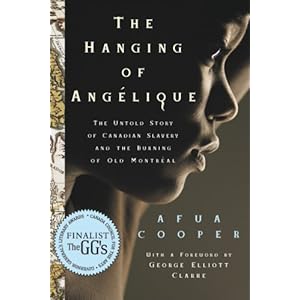
I don't think one has to be that culturally aware to have read, say Afua Cooper's The Hanging of Angelique, subtitled The Untold Story of Slavery in Canada  and nominated for the Governor General's Award a few years ago. Information about slaves and slavery in early Canada is all over the school texts and the kid's books and yes, even the adult histories of Canada. But somehow none of that counts.

Everett-Green is probably aware of a good deal of that history but there is a kind of willed amnesia in a lot of discourse about Canadian history, in which people claim to have been denied knowledge of aspects of Canadian history they actually know pretty well.  (He's right that Marcel Trudel, who wrote the history of slavery in New France in the 1960s, left Quebec for Ontario, but I'm pretty sure it wasn't because he wrote about slavery. Trudel wrote a lot of controversial history long before he left Quebec, but it was over his commitment to a secular society and secularized universities that he left clerically-run Laval (and he did not join the University of Ottawa until it was laicized.)

I came out of 12 Years a Slave the other day wondering about the Canadian experiences of Solomon Northup and Mr Bass, the Canadian who saves him.The dialogue seemed a little suspect, but I took a quick look at the book text online, and see the film script copied the book almost verbatim. The coda to the film says that Solomon Northup's later life is entirely unknown -- which sounds like laying down a gauntlet to the geneaologists.  His children probably lived into the 20th century -- one would thinks someone is traceable.

Quick search, and it turns out they are traceable indeed.  Seen the movie? Meet the descendants of Solomon Northup

I mostly came out thinking that a black audience coming out of 12 Years a Slave would be in a mood to killing someone over the treatment of their forbears. Hell, I was thinking of killing someone.  Good movie, I think, not that I'm predicting for the Oscars.
 
Follow @CmedMoore