Showing posts with label Holocaust. Show all posts

Thursday, November 09, 2023

Professor Jan Grabowski on historians' responsibilities


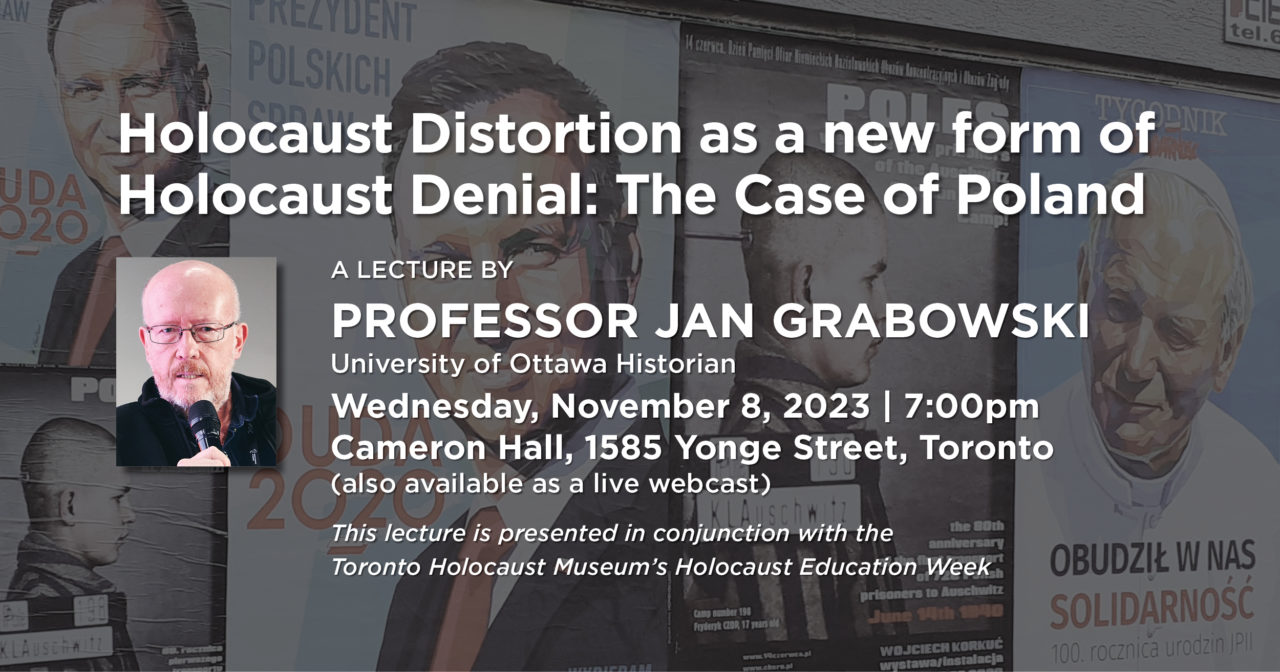
Went last night to the Yorkminster Park lecture series here in Toronto, to hear Jan Grabowski, a University of Ottawa historian, talk about state-sponsored Holocaust distortion in Poland. He spoke via an internet link from Warsaw.

I was a little disappointed not to have him in the room with us but pleased to learn he could live and work in Warsaw. I had known that he and other scholars of Polish history had recently faced trial for causing "offense to the national dignity" in scholarly works that took note of instances of Polish complicity with the Nazi Holocaust. Details in this 2021 Masha Gessen article in New Yorker -- possibly paywalled.) 

Given the Polish laws to control historical speech, I had imagined that Professor Grabowski would not be able to live in Poland at all (even though in the end the case against him was unsuccessful). So after he spoke, I asked how safe he was to research and write and speak in Poland.

He said little about how safe or unsafe he actually was.  He spoke instead about the duty of historians to do their work and affirm the truth, no matter what the state and its supporters might do or threaten to do. I found it quite impressive. You can hear my question and his reply here near the end of the video at about 1.01.30.

In response to the second part of my question -- whether the results of the recent national elections in Poland might change the situation he described -- he did not give a lot of cause for hope. Effectively, the belief that Poles generally tried to protect Jews, and that ethnic Poles suffered more than Jews did during the Second World War, is very widely held in Poland. And defending "the national dignity," he says, has been about the only policy on which the new victorious democrats have usually voted in lockstep with the (probably) outgoing nationalists. 


Thursday, January 20, 2022

Rosemary Sullivan and Anne Frank

Rosemary Sullivan

Rosemary Sullivan is a terrific nonfiction writer; indeed, a jury I was part of once gave her a Governor General's Literary Award in Nonfiction for her biography of the poet Gwendolyn MacEwan. In recent years she has moved her scope well beyond Canada to Europe and particularly moments of the Second World War.

So I'm sure her book The Betrayal of Anne Frank will be well written and deeply thought out. But it may be getting a rough ride from historians of Second World War holocaust matters.

It's a hybrid book, it seems. The book is by Sullivan, who is a former English prof and author of several literary biographies, but the research she writes about -- into who might have sent the Germans into the hiding place of the Frank family in 1944 -- was organized by a media producer and run by a retired FBI officer and a cold-case team of a dozen crime investigators.

Laurien Vastenhout, a researcher at the NIOD Institute for War, Holocaust and Genocide Studies, says she is concerned about errors and misunderstandings in the book. And Emile Schrijver, the director of Amsterdam’s Jewish Cultural Quarter, has historically-rooted reservations about the study's conclusions. He said, according to the New York Times:

he did not doubt the good intentions of the team. “In a book like this, after so many years of work, I would have expected some sort of critical reflection about what this teaches us about betrayal,” he said. “There’s a total lack of historical thinking and context that really bothers me. And that’s the big difference between forensic and historical research.”

Update, January 29:  Allan Levine has a substantial article in today's Globe and Mail, better sourced and with much more context, and reinforcing the doubts expressed above about the persuasiveness of this investigation's conclusions. 

Friday, October 07, 2016

Who will play you in your biopic?


Actor left, historian right
In the newly released movie Denial, American historian Deborah Lipstadt gets Rachel Weisz playing her.

Denial dramatises the 2000 libel trial in London, England, in which Holocaust denier David Irving sued Lipstadt for libel over statements about him in her book Denying the Holocaust: The Growing Assault on Truth and Memory. David Irving lost, and Lipstadt, vindicated, wrote a second book History on Trial: My Day in Court with a Holocaust Denier. This second book is the source material for the courtroom drama now in wide release.

In a Washington Post interview, Lipstadt acknowledges that one theme of the film is the frustration of a historian having to work with lawyers. (She does not say filmmakers):
I’m an academic. I decide what I want to teach. I decide what I’m going to write about. I work by myself in my study. The movie is very accurate in its depiction of my frustration.
Reviews of Denial seem to be kinda ho-hum.  Historians, right? Or maybe the book was better.


Wednesday, December 15, 2010

Embrace the political


Dan Lett of the Winnipeg Free Press is one of the most intelligent of Canadian journalists.


His column yesterday is as thoughtful and thought provoking as anyone could hope for. That said, I have some issues with it (natch, or I wouldn't be blogging about it.)


First, "Fighting over exhibit size is no way to advance debate" is not the most eye-catching of headlines. I blame the editor, not the author, but it's a shame, because it means the column will probably be under the radar for all but those looking for something historical to blog about.


Secondly, as a conclusion, it's just plain wrong. Lett's musings on the nastiness of the competition between Ukrainians and Jews for equality or primacy of recognition for the horrors of Holomodor versus those of the Holocaust as measured in space in the future Canadian Museum for Human Rights, are brilliant in raising questions which are have intrigued me for many years.


Lett writes:

For dispassionate observers, the debate over which is the worst atrocity, or
even whether one atrocity has been given too much emphasis while others have
been marginalized, is awkward, even discomforting. It is, in essence, an attempt
to measure and compare human suffering. For Ukrainians, this is about being
marginalized, adding an insult to the injury inflicted on them in the early
1930s. For many Jews, the debate itself is anti-Semitic, a bid to diminish the
importance of the Holocaust as part of an ongoing war against the Jewish people.


How do we, as historians, and as citizens, measure historical evil and victimhood? Is the perception of the holocaust as the ultimate historical evil in the mind of much of the Western World the product of inherited guilt and/or superior organization, commitment, historical consciousness on the part of the Jewish diaspora, or is there some additional degree of evil inherent in the intentionality of genocide by the Nazis which transcends any quantitative measurement of lives lost and terror and suffering undergone?

There is, of course no definitive answer. I tend to favour the latter explanation, but it is a question that cannot be dodged, and should not be dodged. Yes, this is presentism. Or may the reverse: pastism. Everything is present, and everything is political (in the largest sense of the word.) As William Faulkner put it, in my fave quotation about history :"The past is not dead. In fact, it's not even past."

Communities exist in time. They are backward looking and forward looking. The debate is nasty, because people care. A lot. And if they didn't, there would be no debate to advance.


Follow @CmedMoore