Showing posts with label First Nations. Show all posts

Tuesday, June 16, 2026

The Globe and the Tk’emlúps "anomalies"

I was slow in giving a close read to the long story by Patrick White and Willow Fiddler about the Tk’emlúps Residential School and residential school denialism that the Globe and Mail published on May 22.  I think I was mostly put off by the Globe’s editorial on the matter, which seemed like straight-up encouragement to denialism.

But in the end it is a good piece of journalism. 

White and Fiddler make clear enough that apart from a few ill-chosen words, the Tk’emlúps leaders mostly spoke carefully in June 2021 about how the ground-penetrating radar showed anomalies that were suggestive of graves. The article also states clearly that there is no doubt about substantial numbers of children dying at residential schools (and their remains being undocumented). It cites Canadian government documentation back to the 1920s confirming the death rates. It notes cases like the Dunbow school in Alberta where flooding in 1996 exposed (and carried away) many skeletal remains.

That is, the story makes it plain there is very good reason to assume that the “anomalies” at the Kamloops site are exactly what everyone in 2021 assumed they were.  Journalists who understood that the anomalies could be taken as gravesites were not failing us when they drew plausible conclusions.

The article might have been more clear about a point of view I remember hearing in 2022:  that the Tk’emlúps people, while making it clear that they had no doubt what the anomalies meant, had no great need or inclination to dig up what they assumed to be the remains of their small friends and relatives for scientists to stick on a shelf in some research lab for a century or so, in the name of research. (It does at least cite one person calling such demands "morbid and unnecessary.")

The story makes it clear enough that Tk’emlúps provides no serious basis for denying or minimizing the crimes and tragedies of the residential school system, despite the denialists “bones or nothing happened” approach to reconciliation. As is said in the article:

“I think a lot of denialism’s roots go back to the fact that lots of these folks don’t want to acknowledge or face the fact that atrocities happened to children,” said Manny Jules, chief of Tk’emlúps through much of the 1980s and nineties.

The Globe’s editorial and self-criticism has given new fodder for denialists everywhere in their campaign to stop progress towards reconciliation. There is no reconciliation without truth, as the editorial says. But the fundamental truth remains: residential school kids died and were buried in unmarked graves at residential schools across the country.      

Monday, November 03, 2025

History of how not to reconcile


Charlie Angus's Ring of Fire Youtube ad --  cause you may be sick of Ontario's one.

Okay, Donald Trump hates the Reagan ad.  The widely circulating Ontario ad that makes me mad is the one endlessly proclaiming that the Ring of Fire is going to save us all: Give us $22 billion, give us 77,000 jobs. Rebuild the Canadian economy by digging up more minerals for the USA. 

The Reagan ad was legal, honest, and fair. The Ring of Fire ad is fake news all the way.

Happily, the antidote is found in Riley Yesno's article in the Toronto Star this weekend "The Truth about Ontario's Ring of Fire ads."  Here's the essential takedown of this miracle project in two sentences:

"So why hasn’t this project started already?

"The biggest problem: The province doesn’t have the right to the land."

That's the truth we need to start with. Treaty 9, which covers the so-called Ring of Fire  (a marketing slogan, recently coined; Yesno prefers "Mammamattawa") and most of northern Ontario, was an agreement to share the land.  The chiefs consistently refused to make treaty until they were told "the land will always be yours," "you may hunt and fish forever," "reserves are only places no white man can disturb up" over and over again.  

It is true Ottawa's official text of Treaty 9 uses words like "cede, yield, release, and surrender" and "the Crown may "take up" Treaty 9 where and when it choses to.  But the treaty text was written and printed up in Ottawa before the treaty commissioners ever set out for the Severn River. No commissioner dared to say these words aloud or allow them to be translated for the chief.  The real Treaty 9, the one actually negotiated on the land by the authorized parties on both side, was absolutely an agreement to share the land.

This reality behind Treaty 9 is unusually well documented, perhaps because it was one of the last made (in 1905). But the basis on which all the Canadian treaties were made and ratified is the same: an agreement to share the land.   There really is no legal basis for Ontario to develop extractive projects in Mammamattawa unless and until the two sides negotiate agreements as to how the wealth will be shared.  Ontario really has not even started bargaining.

Harold Johnson, the Cree lawyer and writer, used to say the settlers of Canada have an absolute right to be here. That absolute right comes with the treaties they made with First Nations. 

And to validate that right, he would then say, all the settlers have to do is to live up to the commitments made in the treaties.

Maybe there has to be one BIG court case.  The Supreme Court has been begging Canada and the provinces to negotiate treaty rights and land claims , and not to force all the decisions into the courts.  But there is a lot of jurisprudence to suggest which way the courts will find if pushed to it.  

Why do so many people find it hard to articulate these realities.   As they say, it's hard to see the truth if your livelihood depends on not seeing it.

Vital Reading:  John Long: Treaty 9: The Agreement to Share the Land in Far Northern Ontario (McGill-Queen's UP).

Cheater version:  "George McMartin's Big Canoe Trip" from CBC Radio Ideas .Online


Monday, August 18, 2025

History of Treaties in the Globe and Mail

Ogoki/Marten Falls in northern Ontario

Reading Saturday's Globe and Mail, I thought of adding a new headline to my (imaginary) collection of dumb Globe and Mail headlines. This one was about the recent BC court decision on Cowichan indigenous title to a chunk of suburban Vancouver (maybe paywalled), and it read:

  "Court ruling on Indigenous claim creates uncertainty around land ownership"

Should it not read "the ruling creates certainty around landownership"??? In the absence of treaties, indigenous title endures, and it should be certain that indigenous title can no longer be ignored and dismissed. 

Happily, I turned a few more (digital) pages, and found the Globe's own columnist Andrew Coyne, saying what their headline writer could not imagine. Coyne sees clearly the situation to which our governments and a depressingly large number of commentators, including academics who should know better, still seem oblivious.  Title matters, and treaties (and their absence) matter. Deal with it, is Coyne's much needed message.

We are inundated with talk of -- and legislation for! -- blithely overriding indigenous consultation and consent in order to rush through energy corridors, resource developments, and other magical solutions to the American threat. A case in point: a recent Globe op-ed by Northern historian Ken Coates and Charles Cirtwell of the Northern Policy Institute.

Coates and Cirtwell's sentiments are admirable:

If Prime Minister Mark Carney’s ambitious and still ill-defined plan for national economic renewal has a chance of success, the next decade will clearly be shaped by the development of the Provincial North. The people of the Provincial North should be clear winners in this endeavour, or Canada will be the loser.

Indeed. But their solution seems extraordinarily blinkered:

Many communities in the Provincial North have substandard internet, water services, fire protection and roads, to say nothing of the most serious shortcoming in the region: housing. While not a traditional megaproject, a collective commitment of this nature could well form part of a “grand bargain” that secures Indigenous support for resource and infrastructure plans.

Surely the time has long since passed for the idea that some new charitable contribution to northern living standards  -- better internet, say -- will suffice.  The grand bargain already exists: a treaty. And it should not be left unmentioned.  

What northern Ontario  -- the main area of Coates and Cirtwell's "Provincial North" -- requires is treaty implementation. Treaty 9 (I mean the real treaty, negotiated on the land as the Royal Proclamation requires, not the fraudulent written-in-advance version in Ottawa's archives) established a sharing of the land between the Indigenous owners and the Crown, with mutual agreement on how it is used, and negotiated divisions of the benefits.  Read John Long on Treaty 9 for the details.

The Cowichan ruling applies where there is no treaty. And where treaties already do exist, as in the Provincial North, they ha veto be taken seriously: adhered to, not ignored. Maybe that will have to be the next big court ruling. 

Ottawa's gift of a few new houses and better internet isn't going to cut it. That's a certainty.


Friday, July 18, 2025

Hugh Brody talks

NiCHE has just posted a terrific interview with Hugh Brody.  Originally a British anthropology student, Brody made himself into an embedded observer and recorder of how Indigenous and Arctic Canada dealt with government and industry interventions into the north from the 1960s to the recent past. He wrote much of the crucial volume of the Berger Report that helped stop pipeline development in the Mackenzie Valley fifty years ago. Very early among scholars and bureaucrats, he realized that the essential voices that had to be hear were not those of people like him but the people of the north.  To capture some of that he became a filmmaker.  Altogether an amazing career.

I began to realize that there had to be a completely different kind of voice in this, and it wasn’t the voice of people like me; it wasn’t the voice even of people like Tom Berger. The voice had to come from elders and leadership in the communities. 

... I came to be caught up in the courts: some of the important questions being raised by First Nations were being resolved not by Inquiries but by legal cases. [...]  where I could be an under-labourer to actions that came from the people themselves.

His book Maps and Dreams remains part of my essential Canadian books collection.

Friday, December 20, 2024

History of residential school denialism

The TVOntario blog TVO Today, which carries historical essays from time to time, has a recent post by broadcaster Steve Paikin on a Toronto event of the newish culture-wars organization CIHE

It featured American political commentator David Frum discussing settler colonialism, defined as a term "often used as an accusation against Canada." 

According to Paikin, Frum drew attention to doubts about alleged deaths at residential schools:

“The allegation that hundreds and thousands were done to death has been accepted as a fact,” Frum said, adding that the House of Commons unanimously passed a resolution equating the residential-school system with genocide.

... To be clear, Frum isn’t justifying “the horrifying numbers” in which Indigenous people died after first contact with “European colonial settlers.” He pointed out that, throughout history, different groups have conquered lands, then redrawn borders and redistributed the wealth, as they felt entitled to do.

Paikin reports that Frum called for "a battlefield of ideas." However, no indigenous spokespeople seem to have been invited to join in this discussion, nor anyone familiar with the Truth and Reconciliation Commission report or its statistics on death rates at residential schools.

American residential school children

Update, December 22:  Meanwhile more material to rationalize away somehow: the Washington Post conducted its own count of indigenous burials at residential schools in the United States: 3100 and counting. 

I don't have a Post subscription, so I'm linking to a summary and long quotation at Lawyers, Guns and Money.

Monday, November 25, 2024

History of the monarchy in Yukon

No king in Dawson City

Recently, the world had a little giggle over the oddity that is the "Canadian" monarchy from this story. (It seemed to get rather less coverage in Canada, judging by search links.)  This is The Guardian's lead on the story:

The council of a town in Canada’s Yukon territory has been locked for weeks in bureaucratic standstill after its members refused to swear a mandatory oath of allegiance to King Charles ....

I'm all in favour of Canadians declining to swear allegiance to foreign monarchs and I do support using Canada's constitutional power to rid itself of the whole thing. But I'm less keen on the reason why the Dawson City councillors have taken this stand at this time. They are doing it: 

citing the crown’s tarnished relations with Indigenous peoples in the region.

I can understand councillors' wish to stand in solidarity with the one indigenous member of the council, who first raised this concern. They mean well, no doubt.

But, you know, for more than a century and a half, deep back into Queen Victoria's reign at least, kings and queens have been purely figureheads in Canadian governance. All that has been done to indigenous peoples and their rights and titles was done by Canadian governments and officials accountable to Canadian parliaments themselves accountable to Canadian voters.  

I'm not enthusiastic for this effort to blame Canada's own failings on oblivious and disempowered foreigners long since (and quite properly) stripped of any real policy-making ability.  Let's stop swearing allegiance to Charles for good reasons, and take responsibility for our own problems at the same time.  In Canada the "Crown" is really us. The Dawsonians and all of us should swear allegiance to us.

Friday, November 08, 2024

Monday, November 04, 2024

Murray Sinclair

Mizanay Gheezhik, (Murray Sinclair) 1951-2024

Never met him. But I can't think of anyone who did more to change the sense of what indigenous history and culture mean and have meant and should mean.  Not just as the prime mover of the Truth and Reconciliation report (2015); in everything I heard of or from him

Tuesday, July 30, 2024

Treaty History

The black letter of the Huron-Robinson Treaty covering parts of south-central Ontario is pretty plain: there will be annual payments in exchange for a land settlement, and the amount would be adjusted "from time to time." Since it has not been adjusted since 1875, there's a lot of back money owing. Taking 150 years to sort this out --- really? That's the gist of the recent Supreme Court of Canada ruling.

But as far as I can tell from reading contemporary thinking about treaty implementation, the more promising solution is to assume that all these treaties were and are agreements to share the land. On that basis, First Nations should be able to draw revenues from their share of taxation and other land revenues sufficient to cover their own self-government and administration. That seems in all ways better than simply enlarging the payouts from Mother Ottawa.

But it still feels that Canada is a long way from that understanding -- the recent Haida land title agreement notwithstanding. Pending it, there will be bills like these to be paid.


Monday, July 22, 2024

History of the St Lawrence Iroquoians

Who knew the fate of the St Lawrence Iroquoians -- the people whom Jacques Cartier was welcomed by in 1535 at Stadacona and Hochelaga and who were not there when Champlain et al began arriving in the early 1600s -- was news?

The Globe and Mail recently had a long story by Deborah Baic about new techniques and new ideas in archaeology, and how they are reshaping this question. I must admit I don't see the debate being advanced far from when Bruce Trigger and others were discussing this question in the 1970s, but I like seeing public attention to complicated historical questions, so....  Great photos in the digital version of the story -- if it is available to you


Friday, June 21, 2024

Solstice, and National Indigenous Peoples Day


Happy solstice --tho' technically it arrived yesterday afternoon, this being a leap year. Enjoy the daylight. 

It is also National Indigenous Day which falls on the solstice every year  And of course it's been National Indigenous History month throughout June.

The Toronto Star has an article this morning entitled "Liberals lose steam on reconciliation."  It might be about how the Star, and indeed the country, have lost steam on reconciliation. As reconciliation priorities, the story lists federal action to end boil-water advisories in reserve communities, and action on missing and murdered women and on residential schools issues. 

Worthwhile goals, sure, but there is no awareness here that reconciliation is about more than such things as local waterworks. As long as the Minister of Indigenous Affairs has to be the waterworks manager for every reserve in the country, and also the director of the local school board, and the manager of the local clinic and.... there is going to be little progress either on these specific concerns or on the larger matter of reconciliation.

Reconciliation has to come from treaty implementation,* and treaty implementation means adequate indigenous self-government and a secure source of revenues (presumably from adequate indigenous ownership and control of land and resources) so that indigenous communities can run their own water systems and school systems and medical services and cultural activities -- as every other community in the country does.  

The story does quote indigenous leaders arguing there has been more progress in the last nine years "than we have ever had in our history." and fear of "going backwards" under a new government. But we have a long way to go -- even to get started, it sometimes seems.

___

* By treaty implementation, I mean not the "cede, yield, surrender" texts filed in Ottawa, but the treaties as they were actually settled between the parties on the land, as agreements to share the land.  Surely it is one of the great achievements of Canadian historical research in recent decades to have established pretty conclusively the real intent of treaties-as-sharing-agreements when they were being negotiated. But the message has not travelled very far.

Tuesday, April 09, 2024

Book Notes: The Slow Rush of Colonization


I have been meaning to take a deep dive into Thomas Peace's big new book The Slow Rush of Colonization: Spaces of Power in the Maritime Peninsula 1680-1790.  But it's a book that demands quite a bit of undivided attention -- and I have not had a whole lot of that recently. (More on that tomorrow.)

But I'm already impressed. Peace is covering a period that starts when there has already been a century of so of contact between Europeans and the indigenous peoples and nations of what is now eastern Canada.  It ends another century later, in what is still the remote past of Canadian history, but when colonial states were beginning to be able to operate with a much reduced need to give respect or attention to indigenous needs and requirements.  That I guess is the ""slow rush."

Peace documents all this in meticulous detail. But the conclusions are large. He's arguing, I think, that what happened in this time period set a template that still defines the deep constitutional underpinnings of Canada and of indigenous-newcomer relations. The book's way of getting inside indigenous policies and strategies in this period overthrows a lot of standard visions of "pre-confederation" history. But his argument about political fundamentals that endure today being established before the end of the eighteenth century is vastly expands what we might take to be the standard model of Canadian political history.

If you too have not taken the time yet to dive deep into The Slow Rush, you might listen to Tom Peace on the Witness to Yesterday podcast, particularly his concluding remarks about the enduring constitutional meaning of what went on in this period. 

More, maybe, when I've gone deeper into the book.  

Friday, February 09, 2024

Book Notes: Friesen on Norquay


Here's one worth looking for, and not just for proof that Canadian history (including political history, including the history of nineteenth-century politicians) is hardly as dead as it is said to be.

Gerald Friesen's long-awaited biography of John Norquay, the first indigenous premier of Manitoba, is now in the University of Manitoba Press catalogue, and should be shipping in April. 

Friesen is the author of The Canadian Prairies: A History and other works. From having enjoyed cups of coffee with him intermittently over the years, I know he has been working on and talking about Norquay and this book for quite a while.   

Friday, January 12, 2024

Book Notes: A Synthesis of Far Northeastern Archeology, created with indigenous sponsorship and participation.


I missed this when it was first posted at the Canadian Museum of History blog last November: an announcement of a volume marking the fiftieth anniversary of the Mercury Series, a publication of the Museum in cooperation with University of Ottawa Press. 

The Mercury Series is internationally respected, particularly for the archaeological monographs it has published  

And the volume in question is significant too: The Far Northeast: 3000 BP to Contact. The archaeology of far northeastern North American (roughly the Atlantic provinces) seems to be deeper, older, and more resistant to simple explanations than one might imagine (e.g., the elaborate 7500 year old burial mound at L'Anse Amour, Labrador, on the Strait of Belle Isle -- who built that then?) This multi-authored collection is being saluted as an important synthesis -- and it only goes back 3000 years.  

Worth noting:  According to volume editor Kenneth Holyoke, “The book is largely based on a two-day marathon session we organized at the 2019 Canadian Archaeological Association meeting in Québec City, and it was sponsored by the Grand Conseil de la Nation Waban-Aki.”  

Indigenous voices are included as contributors and supporters of this project. The northeastern Indigenous communities were at the forefront of contact with Europeans. The book begins with a text by the illustrator of the beautiful book cover, Wolastoqey artist Austin Paul.


Thursday, November 02, 2023

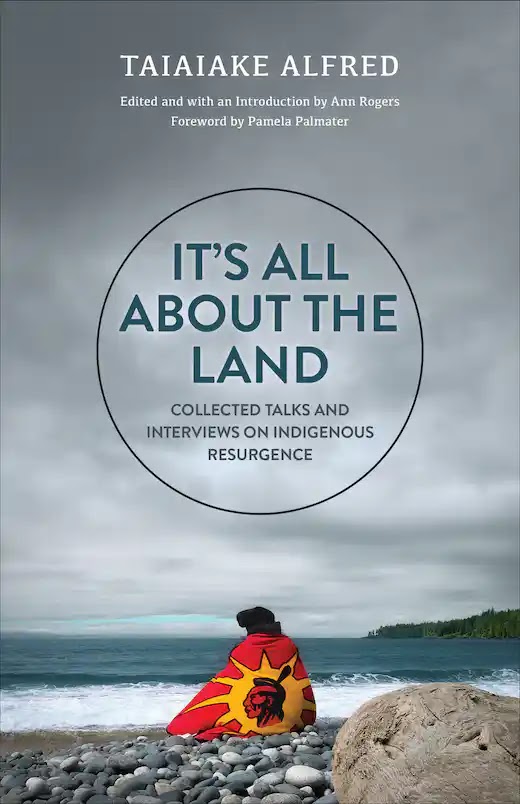
Book Notes: Taiaiake Alfred, It's All About the Land

I’m not the intended reader for Taiaiake Alfred’s new book It’s All About the Land. You probably aren’t either. 

Mostly, Alfred is addressing indigenous people about what they must do to get out from under us. To that end, he argues that Canada and settlers and industrial civilization have so colonized indigenous peoples that even legal, structural changes that would amount to self-government will fail unless indigenous peoples succeed in decolonizing themselves psychologically, culturally, and collectively. He argues for an indigenous spiritual awakening, drawn from the land and expressed in a warrior sensibility, meaning not violence but a willingness to suffer, to take responsibility, and to confront.

Alfred has advised royal commissions and the TRC, but he is profoundly critical of any indigenous person who participates in band councils, the Assembly of First Nations, and all the other Indian Act-approved forms of self-government. He used to be a professor at the University of Victoria, but he finds indigenous academics overwhelmingly susceptible to being co-opted and colonized by their employment. One can guess he makes enemies.

Reconciliation? Nice in principle, he says, but mostly a con:

Reconciliation in a classic sense… I think that anybody who comes at the concept in an objective way would say… ‘We need to go through those steps.’ But in Canada reconciliation is not that. … It’s recolonization. …  Everybody likes the idea of reconciliation as a concept, but as it is being developed and applied in Canada, it’s a problem and, I would say, even a manifestation of contemporary colonialism.

Wednesday, October 25, 2023

CIHE on John A, part 2

Tonight the new Canadian Institute for Historical Education continues its series, which has seemed to constitute a "Rehabilitate John A" campaign (in person in Toronto, online everywhere) with J.R. Miller and Sean Conway discussing "John A. Macdonald on Indigenous Relations."  J.R Miller is the groundbreaking and influential historian of Canada-Indigenous relations, the author of Compact Contract Covenant, Shingwauk's Vision, Skyscrapers Hide the Sky, and other works. Sean Conway is a former Ontario Liberal politician with a longstanding interest in Canadian history.

Note that the poster linked to above has an incorrect date -- mentioning October 17 where today, October 25 is clearly intended.  

Friday, September 22, 2023

Book Notes: Taiaiake Alfred About the Land


Kahnawà:ke Mohawk philosopher and political strategist Taiaiake Alfred speaks online next week about his new book It's All About the Land, which argues 
how the Canadian government’s reconciliation agenda is a new form of colonization that is guaranteed to fail.
The book, a collection of speeches and essays, is forthcoming from University of Toronto Press. The talk is next Thursday September 8 at 1.30 pm EST, on the LinkedIn Live platform.

Wednesday, June 28, 2023

Daniel N. Paul 1938-2023 RIP, indigenous historian

Daniel N. Paul, Mi'kmaw elder, activist, and historian of his nation, was the author of several historical works, most notably We Were Not the Savages, the history of the confrontation between Mi'kmaq and European civilizations, which he declared to be "the first such history ever written by a First Nation citizen."

We Were Not The Savages, first published in 1993 and repeatedly republished since, is a detailed history, based on both documentary and oral sources, of Mi'kmaq-European conflicts, treaties, legal battles, and ongoing tensions from earliest times to the present.

Paul was born on the Indian Brook Reserve of Sipekne’katik First Nation in Nova Scotia. He attended Indian day schools but described himself as largely self-educated. Early in his career he was employed by the federal Department of Indian Affairs. He was later executive director of the Micmac Confederacy and other indigenous agencies as well as a Nova Scotia Justice of the Peace.  He was named to the Order of Canada in 2006.  He continuously revised and expanded We Were Not the Savages up to its most recent edition in 2022, when he was 84.

“While I have learned a great deal from the writings of Indigenous Peoples from all over Turtle Island, there is one book that has been my anchor: We Were Not the Savages by Mi’kmaw Elder and author Dr. Daniel N. (Danny) Paul. I have relied on his book as both a shield against the longstanding, widespread anti-Indigenous racism in society and as a powerful sword of knowledge, challenging racist and false government propaganda about our peoples.

                                                       -- from the foreword to the 2022 edition by Pamela Palmater. 

John Reid's appreciation of the importance of We Were Not the Savages appears in Acadiensis online.

Tuesday, June 13, 2023

This month at Canada's History: now with podcasts!

I noted the cover of the June-July Canada's History last month. But now I have my subscription copy, hope you got yours, I have to mention that not only is there my big beautiful article on how striking tenants and railroad promoters and an endless succession of short-term premiers saw Prince Edward Island into Confederation a hundred and fifty years ago, just six years late. There is also a companion piece, a new entry to Canada's History's new podcast series on the Canada's History website. 

This one features Senior Editor Kate Jaimet and I talking with Mi'kmaw scholar and law professor Cheryl Simon about stolen lands, the treaty obligation, and confederation in Prince Edward Island and the Maritimes. Find it right here -- it runs about forty minutes.

Monday, May 15, 2023

This Month at Canada's History: Explorers, Confederation, Mi'kmaw Rights, Immigrant History


This month at Canada's History you can choose your cover image.  They have done a split run.

The newsstand cover -- if you can find a newsstand -- relateds to Ken McGooghan's article "Ships of Misfortune" on Jens Munk, one of a long unhappy history of navigators trying to find a Northwest Passage. Social media friends of Ken are already noticing that the image of Munk on the cover looks very much like Ken himself. Canada's History's new podcast supplement has Ken in conversation with senior editor Kate Jaimet.

My own feature story "Confederation or Bust" is inspired by Prince Edward Island's observance of its 150th anniversary of joining confederation in 1873. It's a story less of constitutional negotiations than of land wars, railroad crises, and the remarkable and ultimately tragic career of Island reformer George Coles.  

Maybe for the first time in non-indigenous media, I also took up the question of what the Mi'kmaq Nation of Atlantic Canada (and by extension other First Nations) thought and did about Confederation. That's in the article as well as in the podcast supplement (about to be posted) in which Kate Jaimet talks with Mi'kmaw scholar and law professor Cheryl Simon and me. From the article, Mi'kmaw concerns about Confederation's potential impact on indigenous rights:

The Mi'kmaq Grand Council -- a centuries-old governing body -- raised funds to send a delegate, Peter Cope, to meet with British Colonial Office officials in London. In 1926 Mi'kmaw elder Joe Cope recalled how Peter Cope was assured that as long as any Indigenous person "remained a True Ward of the English Government, so long his treaty rights would be respected and adhered to.  No bye-law can ever alter or change his Treaty Rights and Privileges."

The "subscription cover" this month features a memoir by the Canadian artist JJ Lee -- seen here with a photo of her grandfather, about four generations of her immigrant ancestors' experiences and the art she is creating about them.

And reviews, letters, notes, a visit to Baie St-Paul, and more.  If you subscribed like you oughta, it would be on its way to you.


Follow @CmedMoore