
Thursday, March 31, 2011
Wierd history watch


Federal Election history 4, September 1878: He's baaaak.
Was open voting such a bad thing? Not the violence and intimidation part, but the idea that citizens ought to stand up in public and take responsibility before their neighbours for their electoral choice? Does that not have some merit? As an MP said in the 1874 debate on the bill that ended open voting,: "Under vote by ballot an elector may take your money and vote as he likes without detection."
Anyway, the 1878 federal election was the first fought under the new election rules introduced by the Liberal government in 1874: one voting day everywhere, bars closed on election day, new anti-corruption controls -- and the secret ballot.
Macdonald running on an effective platform rooted in the National Policy slogan, crushed Alexander Mackenzie's government, and was sworn in with a big majority. He'd be in for the rest of his life.
Anyway, the 1878 federal election was the first fought under the new election rules introduced by the Liberal government in 1874: one voting day everywhere, bars closed on election day, new anti-corruption controls -- and the secret ballot.
Macdonald running on an effective platform rooted in the National Policy slogan, crushed Alexander Mackenzie's government, and was sworn in with a big majority. He'd be in for the rest of his life.
Wednesday, March 30, 2011
Federal Election history, 3: January 1874: confirming a government
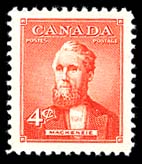
He did, and he initially expected to govern for some time.Parliamentary government was taken seriously in those times; no one doubted the authority of the people's elected representatives to make and unmake governments between elections. But results in a by-election looked so promising for the Liberals' prospects that the new government soon pulled the plug. Worked too: in a post-election House that had grown to 206 members, Mackenzie had the support of about 133.
Mackenzie called the election before bringing in the electoral reform plans the Liberals had promised for some time. So this was the last general election before the secret ballot. It was, however, the first in which practically all constituencies voted on the same day.
[Source notes: I'm relying quite a bit on the Parliamentary website record of federal elections, on Wikipedia's similar list (a bit dodgy in places, I think), and John Duffy's terrific electoral history Fights of our Lives, plus the DCB and various specific period histories. Errors and corrections gratefully received. Interpretations and emphases my own.]
Prize watch: Dafoe, Gelber, Donner
The Dafoe Prize (given annually since 1984 for a nonfiction book about Canada, Canadians and the nation in international affairs, has announced its 2011shortlist, sez the Winnipeg Free Press, where John W. Dafoe was editor more or less forever. The nominees:
* Reinhold Kramer and Tom Mitchell, When the State Trembled, a study of the 1919 Winnipeg General Strike
* Tim Cook, The Madman and the Butcher by Tim Cook -- on the struggles between Samuel Hughes and Arthur Currie in World War I
* Shelagh Grant, Polar Imperative by Shelagh Grant, said to be the definitive history of sovereignty issues in the polar region
* Carman Miller, A Knight in Politics by Carmen Miller, a biography of Sir Frederick Borden.
* Robert Wright, Our Man in Tehran , on Kenneth Taylor and the "Canadian caper."
A clean sweep for professors of history, I think. Kramer and Mitchell are at U. Brandon, Grant and Wright at Trent, Cook at Carleton (okay and the national museums too), and Miller at McGill.
A few weeks ago, Shelagh Grant's book won the Lionel Gelber Prize for "the world's best nonfiction book in English that seeks to deepen public debate on significant global issues."
And yesterday a couple of books related to aboriginal history made the shortlist for the Donner Prize for Canadian books on public policy. One is Oka: A Political Crisis and its Legacy, the memoir by Harry Swain, Deputy Minister of Indian Affairs during the crisis in 1990. I can affirm this is an impressive and interesting work, though I was a bit set back to read that when Swain became deputy minister, he had never heard of the Royal Proclamation of 1763. The other is Tom Flanagan, Christopher Alcantara and André Le Dressay, Beyond the Indian Act: Restoring Aboriginal Property Rights
Tuesday, March 29, 2011
A good idea
From Andrew Waldron of Parks Canada, via H-Canada (http://www.h-net.org/):
Waldron includes the URL, plus twitter, facebook and flickr info (parks canada is hip with the kids!):
http://www.historicplaces.ca/
twitter: Historicplaces | Repertoirelieux
facebook: Canada's Historic Places | Lieux patrimoniaux du Canada
flickr: Canadian Register of Historic Places
I looked up Africville, and found a fair amount of text, some photos (from back in the day) and a good internet-style map.
But I'm scratching my head to think of anyone who would have had occasion to spend months of research to track these down, as Waldron suggests. A coffee table book author? If so, he or she is in certainly in luck.
About a month ago, a new Canadian Register of Historic Places Web site was launched by Parks Canada. It's a useful tool that has been developed over the last decade by a partnership between Parks Canada and provincial and territorial governments. You can use this tool to find over 12,400 designated historic places across the country. A decade ago, you couldn't find this information without spending months of research; now, you can see how easy it is to find information and history on an historic place.And here's an article about it at ipolitics.ca.
Waldron includes the URL, plus twitter, facebook and flickr info (parks canada is hip with the kids!):
http://www.historicplaces.ca/
twitter: Historicplaces | Repertoirelieux
facebook: Canada's Historic Places | Lieux patrimoniaux du Canada
flickr: Canadian Register of Historic Places
I looked up Africville, and found a fair amount of text, some photos (from back in the day) and a good internet-style map.
 |
(General view of Africville National Historic Site of Canada prior to the relocation.
Public Archives of Nova Scotia/ Archives publiques de la Nouvelle-Écosse, Bob Brooks Collection/ Collection Bob Brooks.)This is much better than the old registry, which basically told you there was a plaque or should be a plaque and the general vicinity (Halifax!) So yes, the registry will be a "useful tool" for those looking for places to take photographs to illustrate books and newspaper articles, and no doubt a big help to teachers planning field trips.
But I'm scratching my head to think of anyone who would have had occasion to spend months of research to track these down, as Waldron suggests. A coffee table book author? If so, he or she is in certainly in luck.
Pringle on the Inca
Heather Pringle, the terrific archaeology journalist from Vancouver, has a piece in the current National Geographic on the rise of the Inca empire.
Between 1150 and 1300, the Inca around Cusco began to capitalize on a major warming trend in the Andes. As temperatures climbed, Inca farmers moved up the slopes by 800 to 1,000 feet, building tiers of agricultural terraces, irrigating their fields, and reaping record corn harvests. "These surpluses," says Alex Chepstow-Lusty, a paleoecologist at the French Institute for Andean Studies in Lima who has been studying the region's ancient climate, allowed the Inca to "free up many people for other roles, whether building roads or maintaining a large army." In time Inca rulers could call up more conscripts and supply a larger army than any neighboring chiefShe also contributes to the science blog LWON.
Federal Election history, 2: October 1872: "I must have another $10,000"
Can't wait for the election campaigning to be over? In the 1872 election, right at the end of the full five-year life of the 1867 Parliament, the voting itself took nearly three months, with constituency voting contining from July though October.
Manitoba and British Columbia voters participated in federal elections for the first time, but Canadians in the Northwest Territories had no representation at all.
Macdonald's Liberal-Conservative coalition did reasonably well and secured another Parliament in which a majority would support his government, though the L-Cs slipped a little in both Quebec and Ontario. With campaigns already beginning to coalesce around the party platform and the leader, Macdonald first introduced his "National Policy" platform in this campaign.
This was the "I must have another ten thousand" election," in which the government's corrupt election practices would set the stage for future turmoil.
Manitoba and British Columbia voters participated in federal elections for the first time, but Canadians in the Northwest Territories had no representation at all.
Macdonald's Liberal-Conservative coalition did reasonably well and secured another Parliament in which a majority would support his government, though the L-Cs slipped a little in both Quebec and Ontario. With campaigns already beginning to coalesce around the party platform and the leader, Macdonald first introduced his "National Policy" platform in this campaign.
This was the "I must have another ten thousand" election," in which the government's corrupt election practices would set the stage for future turmoil.
Monday, March 28, 2011
Federal Election history, 1: September 1867: a coalition election
[This is a history blog. I hope there will be nothing on it about the current federal election. But it might be fun to run a few notes on the forty previous federal elections, just to see if any comparisons emerge]
The first federal election is odd in that the Crown picked a prime minister and let him choose a cabinet before July 1, 1867, and then had them fight the first election as incumbents. Hey, they won. Allowing for some independents and loose fish, John A. Macdonald's first government had the support of about one hundred members of the 180-member House.
A big issue in the first election was coalition. Once the extraordinary coalition that put together the terms of union had done its job, George Brown argued that ordinary partisan politics should resume, and sought to fight a straight Conservative-Reform electoral battle. But several leading reformers quite liked being in government and declined to leave Macdonald's team. Macdonald campaigned vigorously for the "confederation coalition" and the Liberal-Conservative label. Coalition worked pretty well for him; he got the majority, and Brown was defeated in his own riding.
Who can read your email?
Jonathan Swainger of UNBC draws our attention to a story currently consuming American historico-political circles. (Briefly, the Republican party operatives want to use freedom of information laws to search history professor Cronon's university email records, fishing for evidence of political activity on his part.)
Cronon declares he never uses his state university-provided internet access and email for political purposes. Which raises a nice ethical point: if your university provides you with email, do you only use it for university business?
Update: Gregory Kealey of UNB reports: " 2 University of Ottawa faculty members and one at Windsor have already been targeted in this way."
My own interest in Academic Freedom has drawn my interest in events south of the line where historian William Cronon [incoming president of the American Historical Association] has attracted the ire of the state Republican Party. I expect that readers will be very interested in these developments.He provides a link to Cronon's new blog. which sets out the situation in great detail. Thanks, Jon. Also of interest (this story has gone viral across the border): Talking Points Memo founder Josh Marshall, a history student before he went all journo, writes a personal tribute to Cronon the historian. Jack Shafer of Slate suggests, however, if you don't like how Freedom of Information laws work, the response should be to change the law, not criticize those who use them against you.
Cronon declares he never uses his state university-provided internet access and email for political purposes. Which raises a nice ethical point: if your university provides you with email, do you only use it for university business?
Update: Gregory Kealey of UNB reports: " 2 University of Ottawa faculty members and one at Windsor have already been targeted in this way."
Friday, March 25, 2011
What's Christopher Moore up to

Wikipedia has what seems a pretty decent summary of the Triangle Shirtwaist Fire, which killed 146 workers, mostly women, mostly immigrants, who were employed on the upper floors of an industrial building in Greenwich Village and could not escape when a fire broke out. Here is a recent New York times piece on the work of Michael Hirsch, whose historical and genealogical research has identified the last six unidentified victims of the fire.
(Photo from the NYT story.)
Thursday, March 24, 2011
History of Printing

DA is published just twice a year ("printed offset on the Heidelberg KORD at the printing office of the Porcupine's Quill in the Village of Erin, Wellington County, Ontario, Canada"), and is now up to issue 67. If it were about science fiction or underground music, it might be called a ‘zine, for it is a labour of love by people who do deeply researched studies of a subject hardly anyone else cares about. In this case the subject is the history of Canadian printing, typography and book design. In DA's world, people who can operate a nineteenth-century handcranked cast iron printing press are rock stars. Of course, unlike the grubby xeroxed or Gestetnered zines of yesteryear, DA is beautifully printed, with elegant bookmarks, prints, and other little extras inserted in each issue.

Who knew that the poet Robert Bringhurst wrote a book, The Surface of Meaning, as a “reaction to the perceived deficiencies in the History of the Book in Canada project, a gargantuan three-volume set that the author takes to task”? (DA 65)
Who knew that Frank Newfeld and Dennis Lee, illustrator and author of Alligator Pie and other classics of Canadian children’s literature, were deeply at odds throughout the project, and Newfeld seems kinda pleased that similar books Lee did without him were not so successful? (DA 65)
And my favourite, from DA 54: an appreciation of the life of Louis Blake Duff, newspaper publisher and friend to fine printing, of whom Peter Saracino wrote:
Born in the rural village of Bluevale, Huron County, in January 1878, he was named Louis by his mother after Louis Riel, the Métis leader, and Blake by his father, a supporter of the former liberal premier of Ontario, Edward Blake.There’s a study for some history graduate student: support for Louis Riel among the farmers of southwestern Ontario 1870-1885. Duff, we are told, wrote the first study of his Huron County contemporary William Jackson, who would become Honoré Jaxon and Riel’s secretary in 1885.
Wednesday, March 23, 2011
The art of history
 I don't get a chance to look through the great British periodical History often enough. When I do, I am often impressed with the articles dealing with meta-topics. The latest to catch my eye is "How Historians Begin: Openings in Historical Discourse," by the great medievalist/legal historian Trevor Dean (not to be confused with the Coronation Street character of the same name). The article, which appeared in the October 2010 issue, is unusual in looking at the structure of history writing as a literary form which has interesting things in common with fiction.
The abstract:
Why is the problem of beginning – much discussed in literary scholarship – not dealt with in similar depth by historians? This article attempts an answer to this question, and does so in three ways. First, it examines literary scholarship on textual openings, showing the various ways in which the beginning is given significance. Then, it examines and challenges the common presentation of historical discourse as distinct from fiction. Finally, it examines two sets of data: the openings of 100 historical monographs are analysed for their ‘fictionality’, and the openings of 200 research articles are analysed for their rhetorical structures
 Dean answers the question he poses somewhat provocatively:
 I hope senior honours history undergraduate and graduate history courses in Canada pick up on this article. There is an admirable amount of attention paid to methodology and research design in post-secondary history pedagogy nowdays, but (as far as I am aware) not much paid to the form in which this research is presented. Not only would Dean's six tropes for beginnings be useful to newbie historians, but his analysis of the reasons for these choices and the reasons for non-discussion would be sure to fire up a seminar.
...[H]istorians succeed in concealing the elements of their writing that they share with the writers of fiction: they conceal them from themselves and they conceal them from their readers. Hence the absence of reflection on this issue. (p. 417)
Tuesday, March 22, 2011
New research establishes Franklin still dead

Is it Chris Rock who has the concert routine where he suddenly says, "All you brothers chill a moment. I got a message just for the white folks in the audience tonight. [Long pause.] Elvis is DEAD, man!"
Franklin is dead, man.
(Julius Payer photo from National Post]
Monday, March 21, 2011
Queering the Archives: The Collections of the CLGA #2
 For the second installment highlighting some collections of the Canadian Lesbian and Gay Archives we'll look at the papers of Jim Egan and Gays of Ottawa.
As a pioneer gay activist Jim Egan was one of the most important figures in the early gay rights movement in Canada. As early as 1949 he was writing politicians, newspapers, magazines and tabloids protesting anti-gay attitudes and correcting gay myths and stereotypes. This includes letters occasionally published in Saturday Night and participation in an article in MacClean's For example, David Churchill has noted that:
Throughout the 1950s, Egan undertook an extensive one-man letter-writing campaign challenging the sensational representation of homosexuals as sex perverts. Every time a negative story appeared in the tabloids, or in the mainstream newspapers for that matter, Egan would write a letter to the editor challenging the views expressed in the article. During the 1950s alone, Egan would write some eighty-odd letters and articles challenging the representation of homosexuals in the tabloids and offering up his own opinions and views on the subject.
- David Churchill, MOTHER GOOSE’S MAP: Tabloid Geographies and Gay Male Experience in 1950s Toronto. Journal of Urban History 30.6, Sept. 2004.
As well, Egan and his partner Jack Nesbit took the gay rights movement to the Supreme Court of Canada. In 1995 in which they used the the Charter of Rights and Freedoms to challenge the exclusion of same-sex couples from pension benefits. Though they lost their specific cause the Court ultimately read in sexual orientation as a grounds for discrimination under The Charter.
 The CLGA holds the papers of Jim Egan as one of its treasures. One of its volunteers, Donald W. Mcleod, edited Egan's autobiography, Challenging the Conspiracy of Silence: My Life As a Canadian Gay Activist. The entire text is available online here.
For background information on Gays of Ottawa I'll direct you to a link which also directs to some earlier posts. The CLGA describes its Gays of Ottawa Records:
Founded in Sep 1971 by, among others, Charles Hill (who had earlier been with Canada's first post Stonewall gay group, the University of Toronto Homophile Association), Gays of Ottawa (GO) remained for many years the focus of gay activism in Ottawa. And even across Canada: many records here pertain to GO's role as Coordinating Office of the National Gay Rights Coalition (1975-1980; by its end called the Canadian Lesbian and Gay Rights Coalition). GO's newsletter Go Info, launched in 1972, became the city's gay community newspaper. Its premises housed a library and drop-in centre; it held dances and later ran a licenced bar. Part of this collection survived a 1979 fire that destroyed GO's first office, sparing only these files. GO became ALGO (the Association of Lesbians and Gays of Ottawa) in 1989. The organization closed its doors in Sep 1995. But it left a legacy: the city's AIDS Committee, its Pink Triangle Services organization, and the Abiwin housing co-op can all trace their roots back a quarter century to the founding of Gays of Ottawa.
 If anyone is looking for issues GO Info there is an incomplete record of them at Library and Archives Canada and a complete collection at the Kelly McGinnis Library of Pink Triangle Services in Ottawa.
Happy hunting and I hope these posts bring historians to the doorstep of the CLGA.
Jordan
Andrew Smith on the AV debate among British historians and on historians as experts
Recently a distinguished list of British historians signed a letter criticizing the proposal for electoral reform in Britain, and now a perhaps equally distinguished list of other British historians defends the proposal -- and quickly gets all personal and ad hominem, it seems. Andrew gives access to all the details, and goes on to ponder expertise in general.
Friday, March 18, 2011
History of Branding: Two hundred years of Ned Ludd, forty years of Starbucks

Or, just grab a grande. It's the fortieth anniversary of Starbucks in Canada, sez Dan Francis.
Wednesday, March 16, 2011
Archive Envy
I knew it would happen. Chris scooped me on my topic of choice for this week (Olive Dickason), and I was about to be reduced to writing about History Television's new Pawnathon Canada (which looks like a kind of a down market Antique Roadshow).
Then I read the most recent post on the Legal History Blog by Dan Ernst, on the Clarence Darrow Digital Archive and Database of the University of Minnesotal Law Library. Which made me fairly green with envy, then made me start thinking it was maybe just a bit Brave New World. This is what Ernst has to say:
Then I read the most recent post on the Legal History Blog by Dan Ernst, on the Clarence Darrow Digital Archive and Database of the University of Minnesotal Law Library. Which made me fairly green with envy, then made me start thinking it was maybe just a bit Brave New World. This is what Ernst has to say:
The site includes an extraordinary collection of personal letters written by and to Clarence Darrow. These letters include correspondence with Darrow's family members as well as with many other prominent individuals who influenced the development of American law during the first half of the 20th Century. In addition, the site has sections focused on both Darrow's famous and lesser known trials. Incorporated throughout the site is commentary about a wide variety of political and social issues that were of importance to Clarence Darrow professionally and personally. The site contains a rich and unique array of material including trial transcripts, cases, articles, books, photos, and narratives about Clarence Darrow's life and legal career.
This site provides access to a free, publicly accessible Searchable Database of Darrow Cases. Courtesy of Westlaw from Thomson-Reuters, this database contains all published state and federal cases in which Clarence Darrow or his law firm is listed as counsel for one of the parties. The database also contains all published state and federal cases that quote or refer to Clarence Darrow. This database will be periodically updated.
 |
The detective part of archival research is annoying, time-consuming and often expensive. And who doesn't prefer to read sources on the computer screen to microlm, which always makes me feel sea-sick. But at least you own the parameters of your search, to a certain extent--having picked a political legal topic which crosses jurisdictional time zones, ie the switch from Canada West to Ontario, with the archival consequence that only my later half of my sources are in Toronto, I see the temptation of letting archival policy dictate temporal and geographic limits. But we should never forget that archival policy is in fact policy: collections don't just happen. See for example Valerie Johnson, "Creating History? Confronting the myth of objectivity in the archive" in Archives, Autumn 2007 and John Scott, A Matter of Record: Documentary Sources in Social Research (Polity Press, 1990), pictured.
And isn't it better that the limits be set by the research question? Not that the historians using the Darrow collection will be corrupted by the temptation to assume that the searching has all been done. But the temptation is there.
And isn't it better that the limits be set by the research question? Not that the historians using the Darrow collection will be corrupted by the temptation to assume that the searching has all been done. But the temptation is there.
Valley of the Historians
Tenured Radical has a funny-serious consideration of all the physical damage you can do yourself just sitting in the reading room working through a few boxes of documents.(Anthrax poisoning is just one of them.) She also evaluates the "Valley of the Dolls" treatment method: codeine, vodka, more Valium to stop the spasms, and ice packs.
Seriously, let's be careful in there.
Seriously, let's be careful in there.
Tuesday, March 15, 2011
Olive actually retires. (Olive Dickason 1920-2011 RIP)
The historian Olive Dickason, who died in Ottawa the other day at ninety-one, was a newspaper journalist until she was fifty. She then began thinking of her ancestry (anglophone father,Métis mother, raised in northern Manitoba). She thereupon earned a doctorate in aboriginal history and became both a leading historian of Canadian First Nations and an inspiration to Métis and First Nations scholars. (How many historians get an obituary tribute from the Minister of Indian Affairs?)
Then she also became an inspiration to professors who did not want to retire. Having just got up to speed with a doctorate (University of Ottawa, 1977, age 57) and an academic job, she hit sixty-five and was told she would have to retire. She did not want to, and Dickason v. University of Alberta, her Supreme Court of Canada case against mandatory retirement, became one of the leading cases in the field.
Her survey Canada's First Nations (now in a fourth edition, with David McNab) remains a standard text. I remember being impressed, when it first appeared, by her observation in it that the foundation of the Hudson Bay Company should probably be credited to the Cree of northern Ontario more than to Charles II, or even Radisson and de Groseilliers. It was the Cree, after all, who had both knew the geography and had the urgent desire for a link to European traders that avoided the then-embattled territories along the Ottawa River route to Montreal. Seems entirely plausible when you think of it. But previously no one had.
Then she also became an inspiration to professors who did not want to retire. Having just got up to speed with a doctorate (University of Ottawa, 1977, age 57) and an academic job, she hit sixty-five and was told she would have to retire. She did not want to, and Dickason v. University of Alberta, her Supreme Court of Canada case against mandatory retirement, became one of the leading cases in the field.
Her survey Canada's First Nations (now in a fourth edition, with David McNab) remains a standard text. I remember being impressed, when it first appeared, by her observation in it that the foundation of the Hudson Bay Company should probably be credited to the Cree of northern Ontario more than to Charles II, or even Radisson and de Groseilliers. It was the Cree, after all, who had both knew the geography and had the urgent desire for a link to European traders that avoided the then-embattled territories along the Ottawa River route to Montreal. Seems entirely plausible when you think of it. But previously no one had.
Monday, March 14, 2011
Deep History: earthquakes and human history
It's hard not to reflect on how ill-prepared our societies are for events like the Japanese earthquake and tsunami. Japan is probably the best prepared nation in the world, with most of its building earthquake-resistant, with berms and seawalls along a large part of its exposed coastlines, and with extensive emergency training for its citizens. Presumably that means things could have been worse there in the past few days.

But for all the preparation Japan has done, the damage there is catastrophic and heartrending, and the defences seem hopelessly inadequate. We cannot help but wonder: How well prepared, by comparison, is the west coast of North America?
Strange thing is, we are the first society ever to have the option of considering how to prepare for high-magnitude earthquakes and tsunamis. At any particular location on the Ring of Fire, they may come along every three- to eight hundred years. What human society until ours has ever even been able to consider planning for events that may occur every 500 years?
It's only our history-drenched (and scientifically-informed) societies that can maintain, however dimly, a five hundred year event horizon. We actually can calculate rather precisely what will happen when the next Big One occurs on the Canadian-American west coast.
Indeed, There is amazingly precise information available about the history of the magnitude 9 earthquake and tsunami that devastated the west coast of British Columbia and the Pacific Northwest on January 26, 1700 and did considerable damage even on the coast of Japan (See the information summary and links here.) But even the West Coast aboriginal survivors of that disaster probably moved back to the coast as soon as they could, if only because they depended so completely on marine resources. Word of the event would not have travelled very far, and even where it was preserved in oral tradition or written records, there could have been few practical ways to avoid or mitigate damage from the next one.
How much we, with our historical information and foreknowledge, can act to mitigate our next one... that's the question.
But for all the preparation Japan has done, the damage there is catastrophic and heartrending, and the defences seem hopelessly inadequate. We cannot help but wonder: How well prepared, by comparison, is the west coast of North America?
Strange thing is, we are the first society ever to have the option of considering how to prepare for high-magnitude earthquakes and tsunamis. At any particular location on the Ring of Fire, they may come along every three- to eight hundred years. What human society until ours has ever even been able to consider planning for events that may occur every 500 years?
It's only our history-drenched (and scientifically-informed) societies that can maintain, however dimly, a five hundred year event horizon. We actually can calculate rather precisely what will happen when the next Big One occurs on the Canadian-American west coast.
Indeed, There is amazingly precise information available about the history of the magnitude 9 earthquake and tsunami that devastated the west coast of British Columbia and the Pacific Northwest on January 26, 1700 and did considerable damage even on the coast of Japan (See the information summary and links here.) But even the West Coast aboriginal survivors of that disaster probably moved back to the coast as soon as they could, if only because they depended so completely on marine resources. Word of the event would not have travelled very far, and even where it was preserved in oral tradition or written records, there could have been few practical ways to avoid or mitigate damage from the next one.
How much we, with our historical information and foreknowledge, can act to mitigate our next one... that's the question.
Mount Allison to demolish 1927 Memorial Library?

Information and petition here.
Sunday, March 13, 2011
New CanHist blog: legal history
Jim Phillips, U of T law professor, legal historian, and editorial director of the Osgoode Society for Canadian Legal History, announces the launching of a new blog for Canadian legal history under the auspices of the society and run by Mary Stokes (who promises she will continue to blog here, too) and himself. Congratulations and welcome!
Friday, March 11, 2011
History of the internet: The case against anonymous commenting...
... made by Farhad Manjoo, Slate's technology columnist. This blog has generally followed the lead of bloggers who discourage anonymous contributions, and I'm inclined to continue that. (Downside: Manjoo suggests I have to learn some Facebook.)
History repeats itself

Seventy years ago, just as today, the tyrant's tanks head east to Sirte:
Rommel’s armour arrives in Libya. 5th Light Division’s Panzer Regiment completes unloading from freighters at Tripoli, parades through the town (they go around several times to create the illusion of greater strength) and then heads East to Sirte.
Thursday, March 10, 2011
Andree Levesque on Robert Rumilly

Andrée Levesque's review of Jean-Francois Nadeau's biography Robert Rumilly, l'homme de Duplessis at H-Canada starts with an arresting sentence:
Who at some time in their life has not picked up one of the forty-one volumes of Rumilly's History of the Province of Quebec? [my translation]Among anglophone historians, I think the answer would be "Practically everyone!"
Levesque provides not only a vigorous review of Nadeau but also a striking precis of the life of Robert Rumilly. I thought he was a kind of Quebec precursor to Pierre Berton. The successful and prolific non-academic historian of Quebec turns out to have had a French military colonial childhood (born Martinique 1897) and a past as a street-fight organizer for the extreme rightwing Action Francaise in the interwar years. He was thirty when he came to Quebec, which appealed to him precisely because it seemed still to partake of the traditional, royalist, reactionary France he supported. Rumilly then turned into an writer of what Levesque calls almost bulemic productivity, and declared himself an independent dispassionate chronicler of Quebec while maintaining an active career as an eminence grise to Maurice Duplessis, and filling his works with anti-semitism and other hatreds.
Amazing story, and the long review in French is worth the effort, not least because Andrée Levesque writes the most elegant French.
Subscribe to:
Posts (Atom)