Showing posts with label history of science. Show all posts

Tuesday, May 19, 2020

History of DNA history


Shawnadithit: still dead
I was a little creeped out recently by a recent CBC-News headline: "Thought to be extinct, Beothuk DNA is present in living families." It smelled a bit of, not exactly pseudo-science, but surely the misapplication of scientific data to historic and cultural questions.

DNA was recently harvested from teeth preserved from the corpses of two of the last known Beothuk individuals (sort of creepy in itself). According to a Memorial University biologist, that DNA matches DNA in living individuals. Therefore, trumpets the news headline, the Boethuk are not extinct.

Two things. One, the Beothuk nation is extinct. It is not coming back. Two, the Beothuk did not arrive in Newfoundland from outer space. It stand to reason that they had close links to other indigenous peoples nearby, in Labrador, Quebec, and possibly the Atlantic provinces. Therefore Beothuk DNA, if accurately identified, will compare closely to existing indigenous DNA from the region. Conclusion: Having one's DNA match to an early 19th century Beothuk does not make one a Beothuk, any more than having a mix of European and indigenous DNA makes one Métis.

The biologist concerned seems to be aware of this, and most of his remarks are hedged. The misleading claims seem to come mostly from the reporter. But the whole process of taking an isolated DNA test result, so far unreplicated, and using it to support large cultural/historical/political claims, out of all context, as this article does, is an abuse of both science and history. 


Update, May 20, 2020:  the current Canadian Historical Review includes a review of Tracing Ochre: Changing Perspectives on the Beothuk, a collection of articles evidently sensitive to many of these issues.    

Wednesday, March 14, 2012

History of the universe

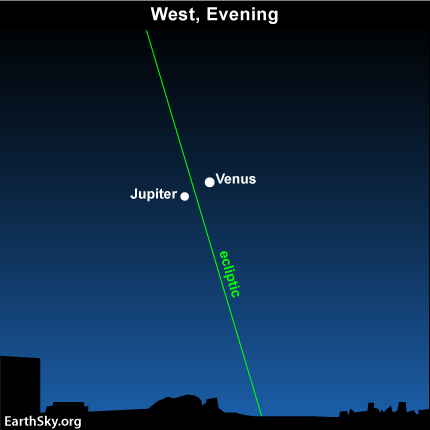
Okay, it's not exactly history, and it's available to the whole world not just Canada.  But really if you have any sense of the big picture like a historian should, you owe it to yourself to walk outside one of these evenings.  And just look at Jupiter and Venus low in the western sky after sunset.  They are not hard to find. And they will dance together all this week. With binoculars better than mine, it is said, you can spot four of the moons of Jupiter crossing the planet.
(Diagram from EarthSky, which has a lot more on these matters.)

Wednesday, December 21, 2011

History of planetary motions


Dark when you get up, dark when you head home.  Even at 44 North, it's dark dark dark this time of year.  But word is that today the planet completes its leaning in one direction and is about to start rolling majestically back toward midsummer.

Y'know, if in a couple of days, somebody was watching carefully and noticed the days beginning to get longer again, wouldn't that be cause for a festival?

This blog may start observing our own seasonal festivities, so blogging may be light, unless inspiration or my co-bloggers strike.  We may do some review of historical highlights of 2011 in the new year, so feel free to email suggestions of best books and events.  

Merry Christmas to all and brighter days in 2012.

Friday, April 08, 2011

Monday, March 14, 2011

Deep History: earthquakes and human history

It's hard not to reflect on how ill-prepared our societies are for events like the Japanese earthquake and tsunami.  Japan is probably the best prepared nation in the world, with most of its building earthquake-resistant, with berms and seawalls along a large part of its exposed coastlines, and with extensive emergency training for its citizens.  Presumably that means things could have been worse there in the past few days.


But for all the preparation Japan has done, the damage there is catastrophic and heartrending, and the defences seem hopelessly inadequate.  We cannot help but wonder: How well prepared, by comparison, is the west coast of North America?

Strange thing is, we are the first society ever to have the option of considering how to prepare for high-magnitude earthquakes and tsunamis. At any particular location on the Ring of Fire, they may come along every three- to eight hundred years. What human society until ours has ever even been able to consider planning for events that may occur every 500 years?

It's only our history-drenched (and scientifically-informed) societies that can maintain, however dimly, a five hundred year event horizon. We actually can calculate rather precisely what will happen when the next Big One occurs on the Canadian-American west coast.

Indeed, There is amazingly precise information available about the history of the magnitude 9 earthquake and tsunami that devastated the west coast of British Columbia and the Pacific Northwest on January 26, 1700 and did considerable damage even on the coast of Japan  (See the information summary and links here.)  But even the West Coast aboriginal survivors of that disaster probably moved back to the coast as soon as they could, if only because they depended so completely on marine resources. Word of the event would not have travelled very far, and even where it was preserved in oral tradition or written records, there could have been few practical ways to avoid or mitigate damage from the next one.

How much we, with our historical information and foreknowledge, can act to mitigate our next one... that's the question.

Friday, June 25, 2010

History of Malaria

It's old, it's really old.  Human beings are its only reservoir -- it could not get along without us. And we took it around the world.

Speaking of Heather Pringle, doesn't she have one of the cool jobs?
One of the great joys of my job is to set out armed to the teeth with notebooks, cameras and voice recorder, and join an archaeological crew in some remote part of the world.
In comparison, it's dull as tombs here in the T.dot.

Thursday, February 12, 2009

Happy birthday Charles and Abraham

Historians who are aware of the long eclipse endured by Darwin’s ideas perhaps have a clearer idea of his extraordinary contribution than do biologists, many of whom assume Darwin’s theory has always been seen to offer, as now, a grand explanatory framework for all biology. Dr. Richards, the University of Chicago historian, recalls that a biologist colleague “had occasion to read the ‘Origin’ for the first time — most biologists have never read the ‘Origin’ — because of a class he was teaching. We met on the street and he remarked, ‘You know, Bob, Darwin really knew a lot of biology.’ ”
From a thoughtful history of Darwin's influence in the New York Times.

How curious that Charles Darwin and Abraham Lincoln would share their birthdate, and how apt that Adam Gopnik both noticed and produced a book putting them together.

History Today recently had a Darwin piece, with the interesting European perspective on the reception of Darwinian ideas: Darwin is not controversial. There is no pro/con Darwin debate. Throughout the educated world, they say, Darwinian evolutionary principles are simply fundamental. It's only in the United States there is controversy, and it's really socio-political rather than scientific.

Monday, February 09, 2009

Making History From Inside Hyenas

The often cool science website Afarensis links to a study of what African hyenas were eating 195,000 years ago.

Hominids. Us.
 
Follow @CmedMoore