Showing posts with label reconciliation. Show all posts

Tuesday, February 18, 2025

Canadian Encyclopedia expands its Macdonald/Indigenous content.

Following the Dictionary of Canadian Biography, the Canadian Encyclopedia is the latest standard reference work to reflect on and revise its coverage of John A. Macdonald and indigenous relations as part of the general rethinking of Macdonald that has been taking place in Canadian life and letters..  

TCE has acted cautiously. At the end of January it posted two "editorials," one an essay by Sean Carleton and Niigaanwewidam James Sinclair, entitled "John A Macdonald was no Friend to Indigenous Peoples" and the other "A Few Facts Everyone Should Know about Sir John A Macdonald" by Greg Piasetzki. (The sir/no sir usage alone is indicative of the mindsets behind each.) 

I can accept this both-sidesing of the question, though surely an encyclopedia usually canvasses the best sources and makes up its mind, doesn't it? Let there be debate as we move toward a new historiography as part of the slow process called Reconciliation, and I am confident which viewpoint will have the strongest arguments and ultimately the most credibility. The Carleton/Sinclair text seems likely to become the received standard before long, anyway.

Carleton and Niigaanwewidam are both professors at the University of Manitoba. Carleton's doctorate is in history, Niigaanwewidam's in Literature, and both are prolific writers and activists on indigenous and reconcilation matters widely published on matters of public policy, history, and indigenous rights and titles.  

Piasetzki is a private practice lawyer in Toronto, whose public statements seem to have mostly been defences of Macdonald and and anti-woke declarations.  

I was fact-checking Piasetzki's "A Few Facts" by the second paragraph. ("He is widely considered to have written a majority of the terms of Confederation." suggests the low standard of what is "widely considered" about the drafting of confederation, but it is surely not a fact.)  

But read both essays and see which seems more credible and substantial to you.

Friday, June 21, 2024

Solstice, and National Indigenous Peoples Day


Happy solstice --tho' technically it arrived yesterday afternoon, this being a leap year. Enjoy the daylight. 

It is also National Indigenous Day which falls on the solstice every year  And of course it's been National Indigenous History month throughout June.

The Toronto Star has an article this morning entitled "Liberals lose steam on reconciliation."  It might be about how the Star, and indeed the country, have lost steam on reconciliation. As reconciliation priorities, the story lists federal action to end boil-water advisories in reserve communities, and action on missing and murdered women and on residential schools issues. 

Worthwhile goals, sure, but there is no awareness here that reconciliation is about more than such things as local waterworks. As long as the Minister of Indigenous Affairs has to be the waterworks manager for every reserve in the country, and also the director of the local school board, and the manager of the local clinic and.... there is going to be little progress either on these specific concerns or on the larger matter of reconciliation.

Reconciliation has to come from treaty implementation,* and treaty implementation means adequate indigenous self-government and a secure source of revenues (presumably from adequate indigenous ownership and control of land and resources) so that indigenous communities can run their own water systems and school systems and medical services and cultural activities -- as every other community in the country does.  

The story does quote indigenous leaders arguing there has been more progress in the last nine years "than we have ever had in our history." and fear of "going backwards" under a new government. But we have a long way to go -- even to get started, it sometimes seems.

___

* By treaty implementation, I mean not the "cede, yield, surrender" texts filed in Ottawa, but the treaties as they were actually settled between the parties on the land, as agreements to share the land.  Surely it is one of the great achievements of Canadian historical research in recent decades to have established pretty conclusively the real intent of treaties-as-sharing-agreements when they were being negotiated. But the message has not travelled very far.

Tuesday, February 20, 2024

Canadian Historical Review: An article to read

Birtle Residential School
Article of the week -- my week at least, as I may have been slow coming to it -- has to be “'Not a Shred of Evidence': Settler Colonial Networks of Concealment and the Birtle Indian Residential School" by Tyle Betke. It is in the most recent issue of the Canadian Historical Review (and likely available only to subscribers). It's about sex slavery, and death, and coverup, at a residential school in the early to mid twentieth century.  

It ought to put an end to the "until you prove every case and exhume every body, it's okay to assume it never happened" approach to the whole issue of abuse at residential schools.  Probably it will not.  

Since the link may not make the full text available, I'm copying part of one representative paragraph, concerning the experience of one family: 

Lazenby’s superiors within the DIA also helped cover up the truth by discrediting the girls and their family members. The father of the girls was known to the DIA. He was one of many Indigenous parents across Canada who advocated for the proper education and treatment of their children. He had sent multiple petitions and letters of complaints to the DIA Upon hearing the news of Currie’s charges, Deputy Superintendent General of Indian Affairs Duncan Campbell Scott characterized the girl’s father as “a trouble maker.” Scott surmised that the father was causing trouble because of having “become embittered recently” when his other daughter died while running away from the school.

Thursday, November 02, 2023

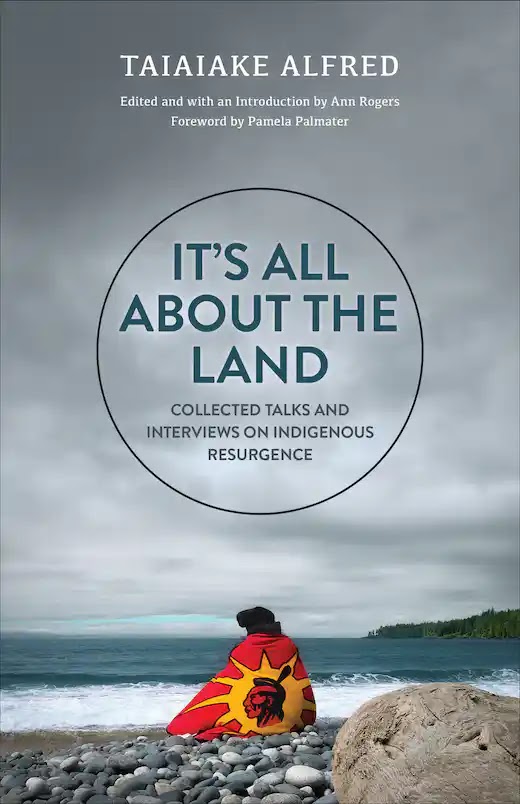
Book Notes: Taiaiake Alfred, It's All About the Land

I’m not the intended reader for Taiaiake Alfred’s new book It’s All About the Land. You probably aren’t either. 

Mostly, Alfred is addressing indigenous people about what they must do to get out from under us. To that end, he argues that Canada and settlers and industrial civilization have so colonized indigenous peoples that even legal, structural changes that would amount to self-government will fail unless indigenous peoples succeed in decolonizing themselves psychologically, culturally, and collectively. He argues for an indigenous spiritual awakening, drawn from the land and expressed in a warrior sensibility, meaning not violence but a willingness to suffer, to take responsibility, and to confront.

Alfred has advised royal commissions and the TRC, but he is profoundly critical of any indigenous person who participates in band councils, the Assembly of First Nations, and all the other Indian Act-approved forms of self-government. He used to be a professor at the University of Victoria, but he finds indigenous academics overwhelmingly susceptible to being co-opted and colonized by their employment. One can guess he makes enemies.

Reconciliation? Nice in principle, he says, but mostly a con:

Reconciliation in a classic sense… I think that anybody who comes at the concept in an objective way would say… ‘We need to go through those steps.’ But in Canada reconciliation is not that. … It’s recolonization. …  Everybody likes the idea of reconciliation as a concept, but as it is being developed and applied in Canada, it’s a problem and, I would say, even a manifestation of contemporary colonialism.

Wednesday, October 25, 2023

CIHE on John A, part 2

Tonight the new Canadian Institute for Historical Education continues its series, which has seemed to constitute a "Rehabilitate John A" campaign (in person in Toronto, online everywhere) with J.R. Miller and Sean Conway discussing "John A. Macdonald on Indigenous Relations."  J.R Miller is the groundbreaking and influential historian of Canada-Indigenous relations, the author of Compact Contract Covenant, Shingwauk's Vision, Skyscrapers Hide the Sky, and other works. Sean Conway is a former Ontario Liberal politician with a longstanding interest in Canadian history.

Note that the poster linked to above has an incorrect date -- mentioning October 17 where today, October 25 is clearly intended.  

Friday, September 22, 2023

Book Notes: Taiaiake Alfred About the Land


Kahnawà:ke Mohawk philosopher and political strategist Taiaiake Alfred speaks online next week about his new book It's All About the Land, which argues 
how the Canadian government’s reconciliation agenda is a new form of colonization that is guaranteed to fail.
The book, a collection of speeches and essays, is forthcoming from University of Toronto Press. The talk is next Thursday September 8 at 1.30 pm EST, on the LinkedIn Live platform.

Monday, March 06, 2023

George Manuel in Manhattan

The New Yorker must have a huge number of subscriptions in Canada, but Canadian subjects very rarely attract attention from its editors and writers. (I recall a profile of Miriam Toews a few years ago.) Recently, however, a Canadian did earned some coverage, when a somewhat sceptical article on the global movement to unite indigenous people credited the origins of the movement to George Manuel.

To understand the origins of a global Indigenous identity, we need to turn to the activist networks that formed in the nineteen-sixties and seventies. And this means turning to George Manuel.

Born in 1921 in the Shuswap territory of British Columbia, Manuel started to think seriously about a global Indigenous identity in 1971. He was then the president of the National Indian Brotherhood, a young organization representing Canada’s two hundred and fifty thousand officially recognized “status Indians.” When the Canadian government arranged for a delegation to go to the South Pacific to learn about the Maoris’ place in New Zealand, Manuel was invited along as the representative of Canada’s Indigenous peoples. [....]
What struck him about his unofficial tour was that the Maori were engaged in the same struggle. They, too, were an Indigenous people fighting a white Commonwealth nation for land, representation, and cultural survival: “What we are doing here in Canada is a part of a world wide movement for cultural autonomy and aboriginal rights of native people.”


Wednesday, July 13, 2022

Review notes from the west coast: UPDATED

Catching up on the British Columbia Review, which must be the most comprehensive review publication in the country these days, online at least (though it only covers BC books), brought me to Ken Favrholdt's review of the new second edition of Unsettling Canada by Arthur Manuel and Ron Derrickson, with an introduction by Naomi Klein. The first edition was published in 2015, without the introduction.

This review is a mostly biographical sketch of Arthur Manuel and suggests the book is largely a personal memoir. If this truly is the "decolonization manifesto" mentioned in the review's headline, the reviewer might have discussed those matters in more detail.  

But Manuel is important, as readers of his second (2017) book The Reconciliation Manifesto (also co-authored by Derrickson) will recognize. That one still strikes me as the best summary available of what is required for "reconciliation" to succeed and how to go about it: namely, treaty implementation leading to a secure revenue base and serious Indigenous self-government. From this review, I'd recommend going to Reconciliation Manifesto first.  [July14: see more on this in the update below]

The Review also published Jason Colby's review of Possessing Meares Island: A Historian’s Journey into the Past of Clayoquot Sound by Barry Gough, a prolific scholar of early west coast history whom I feel I've  never sufficiently covered here (or elsewhere). Meares is an island tucked into the west coast of Vancouver Island, the scene of much eighteenth century contact history and also of recent confrontations over both logging and indigenous title. The book under review covers Gough's involvement with both aspects of that history: as a historian of the contact events and as a consultant in the legal struggles over logging and title.

Colby's review suggests the book also provides a glimpse into how "what matters" in Canadian history has been changing, and how that complicates life particularly for long-active historians with a long publication record. Colby praises Gough, "a genial and learned guide":

He gives careful attention to the experience of Indigenous peoples, emphasizing their relationships to land and sea and teasing out their nuanced interactions with Europeans. In doing so, Gough wrestles with the asymmetry of source material that inevitably results from an encounter between an oral culture and a literary culture. Put simply, non-native explorers and settlers tended to leave the written documents that historians have traditionally considered their “primary” sources, thereby privileging European accounts and perspectives. “Of all the challenges the historian faces, this is the most formidable,” he admits. “And so it is with this book” (p. 7).

He also praises Gough's account of his work as a consultant historian in contemporary legal matters:

In 1986 (when I was still in middle school), Barry Gough learned of the threat to Meares Island and the stakes for Indigenous rights, and he answered the call. Over the following years, he marshalled all of his knowledge, research skills, and intuition as a historian to help save Meares Island and secure Indigenous title. That is the big picture, and he deserves our thanks.

Yet Colby has reservations:

Gough’s account is richer in maritime than in Indigenous history, to be sure, and there are moments when his phrasing seems to mimic the diction of non-native sources too closely. At times, this can be innocuous and even charming, such as when he describes characters as “raw-boned” or “well-moneyed” (p. 153). But in other passages, it results in language that demands further analysis.[...]

In addition, despite Gough’s careful attention to contingency, there are also passages that seem to hint that history itself was the product of European agency. Of the decades during which European ships bypassed Vancouver Island’s West Coast, for example, Gough writes that “history had passed the place by” (p. 129). Of the British effort to chart the coast and inner waters, he observes, “The navy’s survey of Clayoquot Sound stands at the gate of history: the ancient giving way to the modern, the Aboriginal world view to that of Western science” (p. 155).

That may be where more than one veteran Canadianist is: trying to work with a new paradigm, still not entirely succeeding -- or, at least, not entirely satisfying some younger, born-woke readers.

Update, July 14:  Reader Jared Milne expands on Arthur Manuel and his reviewers:

I caught your blogpost about the writings of the late, great Arthur Manuel today. I don't know if you've read Unsettling Canada, but I have and I can say that while the book is excellent, the review you cited...not so much. 

Unsettling Canada gives a lot of historic, personal context towards the struggle for Indigenous rights and self-determination, including Manuel's idea of taking the resistance international by appealing to various UN agencies. The book also summarizes some of the most long-standing problems surrounding Indigenous governance-namely, how band councils can still be overridden by Ottawa bureaucrats even today. 

He and Grand Chief Ronald Derrickson also offer some interesting political points, namely how Algonquin peoples in Quebec developed good working relationships with lumber companies and provincial authorities that could have led to mutual benefits for everyone, made with actual in-depth Native involvement. They even point out that Indigenous territories with full control over their resources might actually charge lower stumpage fees than provincial governments, and more of the wealth from resource development itself would stay in Canada. 

Unsettling Canada is perhaps more personal and historical than The Reconciliation Manifesto, but the former gives the latter some more context and background.

Thanks, Jared, I think you are right. And (should have been made clear) I have not read Unsettling Canada.


Thursday, September 30, 2021

National Day of Reconciliation

It's the National Day of Reconciliation in Canada today, a good thing but very much a thing in the making still.  A public holiday for federal employees, but emphatically not a "holiday." An event very much driven by Indigenous agency, but one in which non-Indigenous people are either to take the lead or, well, not to take the lead.  This will all take some evolution

I heard Murray Sinclair the other day saying Reconciation is essential for non-Indigenous Canadians; the onus is on them.  And I see what he means.  But in recent months one notices, beneath the politenesses and the gentleness and the accommodation frequently given us by indigenous people, there has been breaking through signs of the deep, deep anger and bitterness among indigenous peoples at all that has been done to them by Canada, by us.  That will not go away easily; Indigenous people do need to be reconcilied to us if we are to make progress, and that will not happen quickly.

No answers here. But I do suspect in the long run reconciliation hangs not on residential schools, or missing and murdered indigenous women, or boil-water advisories, or statues, painful and urgent as those and other recmatters are.  Reconciliation depends on a treaty implementation to a degree few Canadians have yet contemplated: one that understands the treaty relationship as one based on sharing, and in which sharing mean that creating a situation in which indigenous governments have a tax claim upon Canadian territory and resources that enables them to function independently, to be accountable to their own communities, and to provide a decent subsistence at least to all their people.  At that point serious reconciliation on the other matters becomes conceivable.

Thursday, June 17, 2021

Reconciliation

As part of its coverage of Indigenous History Month, Canada's History happened yesterday to feature my article Finding Reconciliation, about the wisdom of rebuilding the treaty relationship. 

I also happened to come across my own forgotten post from six years ago, from when I'd been reading the Truth and Reconciliation Report, and asking:

How and where will all the dead of Canada's residential schools be memorialized? It's pretty sure they will be, sometime, somewhere.

Still, I'm not about to join the currently trending #CancelCanadaDay. It's not like I have some other, better country I can go to. Odd as it may seem at this time, if we are going to address these issues, the Canadian state structure and the Canadian constitution offer the best and probably only mechanism to do so, again, through the treaty relationship that has been integral to indigenous-newcomer relations for centuries and was imbedded in the Canadian constitution in 1867. 

When they came to draft a constitution for Canada, however, that same generation of politicians, representing all parties, had endorsed an alternative model for relations between the Canadian state and the First Nations. When they made Confederation in 1867, the politicians who negotiated the terms of union put a Treaty-based relationship with First Nations permanently into Canada’s Constitution. [from Finding Reconciliation]

In order to address what we wish to repair, we are going to have to draw on what we have.

Tuesday, January 05, 2021

Book Notes: Heidi Bohaker on Doodem and Council Fire


Christmas Day afternoon we got a call from the concierge desk where we live: they had a package for us. We thought we knew what it was, because a relative had promised to drop off a misplaced gift. 

Instead, it was the annual members' book from the Osgoode Society for Canadian Legal History, Heidi Bohaker's Doodem and Council Fire: Anishinaabe Governance through Alliance. We laughed: they think we need this on Christmas Day? (It had probably come a few days earlier, and the guys at the desk were just catching up with backlog. The cousin came through on Boxing Day) 

But even among the other pile of Christmas gift books (I did well, thanks, hope you did too.), I found myself reading Bohaker. And while I have not finished it, it resonates so closely with the issues raises in the book I had been reading before Christmas, the subject of yesterday's post, Kent McNeil's Flawed Precedent, that I feel obliged to blog it here and now.

It was one of McNeil's key points that Chancellor Boyd, the Ontario judge who presided in the trial court that first heard St. Catherine's Milling, concluded with absolute confidence and no evidence, that the Saulteaux, an Anishinaabe people of northwestern Ontario, lived in a primitive condition without any government or law that a court of law needed to consider or any Canadian government needed to respect. With one or two dissents, the Ontario Court of Appeal, the Supreme Court of Canada, and the Judicial Committee of the Privy Council had little trouble accepting Boyd's conclusion as good law.

With my copy of McNeil not even returned to the library, I was able to take up Bohaker. She's a historian at the University of Toronto, and her book is not about cases like St. Catherine's Milling; it is not concerned with the clash between peoples like the Anishinaabe and courts like Boyd's. It is about the Anishinaabe -- a historian's booklength effort to understand and elucidate, in all their sophistication and complication, just how Anishinaabe nations -- like the Saulteaux of St Catherine's Milling -- ran their affairs, settled their differences, allocated their territories, and determined leadership and authority across an enormous territory across the Great Lakes lowlands. It starts with an extraordinarily detailed and well documented account of a ... well, a parliament, that Anishinaabe groups from around Georgian Bay, Lake Ontario and adjacent regions, held somewhere near what is now Parry Sound, Ontario ... in 1642.   

St. Catherine's Milling, and Boyd, and the twists and turns of Canadian law on aboriginal title do not appear in Bohaker's text. Their concerns are irrelevant to the concerns of her history. But there could hardly be a more effective refutation of the assumptions built into St Catherine's Milling than the history recounted in Doodem and Council Fire. Well done, Heidi Bohaker.


Thursday, February 13, 2020

Book Notes: Borrows and Coyle on Indigenous Title


Yesterday, for a project largely unconnected to the current protests and blockades responding to the Wet'suwet'en crisis, I was looking at The Right Relationship: Reimagining the Implementation of Historical Treaties, a 2017 book edited by John Borrows and Michael Coyle.  (See yesterday's post below).

It happens to set out, quite succinctly, that the United Nations Declaration on the Rights of Indigenous Peoples, or UNDRIP, establishes that states seeking to use indigenous land need to acquire "FPIC" -- "free, prior and informed consent" from the indigenous parties concerned.  

Canadian courts, however, even when advancing recognition of indigenous title in Delgamuukw, T'silqotin, and other cases, have adhered to a lesser standard, "the duty to consult and accommodate" and, along with that, the requirement for "compelling and substantial" reasons when overriding indigenous title. Compelling and substantial reasons is the standard the BC court Federal Court of Canada (correction, Feb 14) applied last week in authorizing the gas pipeline across Wet'suwet'en territory. Essentially, if I read these deep legal waters right, in Canada indigenous title is still overridden in Canadian law by provincial, let alone federal, economic objectives.  

Hence the resistance.


Follow @CmedMoore