Showing posts with label pandemic. Show all posts

Tuesday, June 13, 2023

History of Covid


So I felt ill and tested positive for Covid on May 28. And felt pretty wretched - well, mostly fatigue, actually -- for most of the week that followed. But on the morning of May 29 I started on Paxlovid -- six pills a day for five days, and by the end of the week I felt much better. Wonders of modern science! -- and I only make a couple of jokes about whether this is where Bill Gates would get his microchips into me. 

The theory of Paxlovid, as I understand it, is that if taken early in your Covid infection, it prevents Covid cells (are they cells?) from spreading and reproducing, so the disease burns out over the five days. By June 4 I had a covid test that had only the very faintest positive line, and I assumed that would be the end of it for me.  

Except it turns out there is a thing called "Paxlovid rebound" where in a small proportion of cases, some covid cells survive the five days of bombardment and start to reproduce again. So on June 8, I felt a bit dodgy, tested positive again, and was pretty much wiped out once more until yesterday. 

I hope this has been the end of it. But don't let anyone tell you Covid is over.  In the last two weeks, I never imagined oxygen tents or intubation or felt in lethal danger, as I would have if this was June 2020 instead of June 2023. But the first two weeks of June have been pretty much a write-off for me and for my unfortunate spouse, who tried to isolate from me but got it anyway, so that we went through it more or less together.

Covid is historic, but I'm here to say it's not "history" in the sense of being in the past.  

Friday, September 10, 2021

History of Confederation at the Confederation Centre for the Arts

Robert Harris, "Local Stars"

Stopped briefly in Charlottetown on Thursday during our brief visit to Prince Edward Island, and we visited the replica at the Confederation Centre of the room where the Confederation Conference was held . I had not realized the Confederation Conference chamber in Province House (the legislative building in Charlottetown) is closed along with the rest of the building for a major renovation. Rumour has it the building's sandstone materials from the 1840s have been more-or-less turning to sand.  The is replacing it for the time being.

Anyway, the replica and presentation at the Confederation Centre for the Arts in Charlottetown is charming, interesting, and forward-facing in acknowledging the failings of the confederation makers and incorporating reference to women, Indigenous nations, and others excluded from the process. Historians may be in conflict, but the heritage industry is moving forward.

Travel note:  the inspection and paperwork required at entry to Prince Edward Island is both extensive and very efficient. It included a mandatory fast-result covid test, which we took at the bridge, having driven in from Moncton airport.  And since PEI has had zero Covid deaths and maintains vigorous contact tracing for every case, being in PEI feels like being on Covid holiday: some mask-wearing by store clerks, very little by anyone else beyond Ontarians and others totally habituated to it.  More places are closed because its the post-Labour Day slow season than due to covid issues. 

Also:  it is very beautiful in Prince Edward Island.  Also, I swam in the ocean.  Also we liked the Robert Harris exhibit currently on at the Confederation Centre. 

Monday, August 09, 2021

History of academic freedom

In the rapidly changing situation regarding vaccine passports and vaccine mandates and requirements for entry to restaurants, theatres, galleries, stadiums, and the rest, I've been struck by the non-participation of post-secondary institutions -- and their faculties in particular.

Apart from Seneca College and one or two other outliers, most post-secondary institutions in Canada have been either silent or extremely non-enthusiastic about making (or even addressing) what seems like the obvious choice: to make attendance on campuses, classrooms, and student residences this fall conditional on proof of vaccinated status. (Yes, with some exceptions where warranted, but still....)

I guess these decisions are largely made by governing boards, with the advice of their administrators and legal counsel,  And one can imagine them being cautious, business-oriented, and very eager not to get on the wrong side of the provincial premiers who foot the bills.  But it's the silence of university Senates and faculty organizations that is really striking.

I notice this, I think, because in recent years I've been repeatedly struck by how professors have in recent decades increasingly adopted a sort of company-man subservience to their institutions and administrators, outsourcing all kinds of policy matters, including ones that ought to be of vital concern to scholars and teachers,  to "the boss." Some doctors who double as medical faculty have certainly been outspoken on Covid policy issues throughout this pandemic, but shouldn't we expect faculty to speak out about safely reopening their workplaces -- and to have some institutional capacity to do so?  

If university and college faculties across the country took a leading stand on this matter, they could really shift the institutional response -- and public opinion.  And some leadership on this matter seems urgently needed from somewhere.  

Update, August 10:  Okay, so yesterday the University of B.C. Faculty Association officially asked the president of the university to institute a vaccine mandate and other measures on campus.  

We therefore call upon UBC to adopt an indoor mask mandate in all its spaces and a vaccine mandate for all its employees and students (subject to the normal legal exemptions) in advance of the September reopening.

Not because of anything they read here, I am sure, but a sign that perhaps academic communities do still survive to some degree. More to come?

Monday, April 19, 2021

History of Cabinet

Here and there in the coverage of the Ontario government's flailing attempts to avoid blame for the province's new wave of Covid infections come mentions of the Ford government holding cabinet sessions that go long into the night, or cause scheduled press conferences to be delayed for hours while they wrangle.  

We tend to assume that the modern government cabinet is mostly a political irrelevance. Serious political stratagizing and decision-makers involves a leader and his or her strategists and spin-doctors, with the cabinet and caucus gettng their instructions later. 

But somehow one can imagine Doug Ford being strengthened and reassured by his cabinet, who doubtless tell him that the doctors and scientists on the pandemic advisory panels are pointy-headed theorists who don't really understand things, whereas they themselves just talked to a businessman or a town councillor back home who said blah blah blah. Ford alone with knowledgeable people might be swayed, but in cabinet it's collective ignorance that gets reinforced.

I'm generally an advocate of real parliaments, where cabinets are accountable to legislatures and caucuses and leaders are accountable to all three.  But sometimes even in our debased parliaments, I guess sometimes the worst are full of passionate conviction.  And it show.


Friday, March 12, 2021

Covid and the point of history

I saw a comment the other day that I can't recover right now. The gist of it was: considering how much interest we have now in the 1919 pandemic, what will be judged most important about 2020 a century from now: this pandemic, or climate change and environmental destruction?

What reminded me of that was a post on History News Network by a young American classicist named Sarah Christine Teets. While caring for a newborn and a small child, she's been pondering what Thucydides wrote about the Athenian plague of 430 BCE.

Here’s a brief explanation of the passage, usually referred to by the number 2.48.3. After Thucydides described the initial outbreak of disease and asserted that medical science was utterly useless against it, he introduced his description of the symptoms with the following: “I will say how it happened, and whoever studies this, if the plague ever strikes again, because he knows something in advance, would be particularly able to not be ignorant; these things I will make clear, since I myself got sick and saw others suffering it.” 

She goes on to argue that this is the kind of statement often taken to mean that if we learned from history we might avoid its mistakes. But Thucydides, she points out, believed there was no wisdom that would have averted the plague: history offered no solution. For the lesson to be learned from Thucydides, she quotes a fellow scholar, Sarah Bond, on another value of history:

There is absolute worth in remembering the past, but let us not cast it as something we do to keep us from repeating the mistakes in the historical record. This is rarely the case. Vonnegut noted: “We’re doomed to repeat the past no matter what. That’s what it is to be alive.”

What we can do is use historical literacy to create perpetual empathy towards humanity & to instill in us a hunger to understand, to inquire, & to document. That is the worth of history. And it is empathy which we can & should repeat into the future.

There is "useful" history. Most of the highly technical and quantitative economic policy that we will rely on to keep the world economy rightside up during and after this pandemic is based entirely on careful modelling and analyzing of past successes and failures in economic policy-making. Much of law, you might say, is built upon endless review of a long history of past lawmaking.

But Teets makes an important point.The empathy argument may the main thing that keeps people returning to the history of Covid-19, as to the Athens of 2500 years ago.  

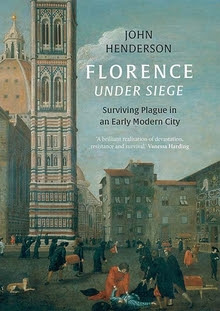
I've been reading a recent history (Cundill Prize longlister, in fact) of the Florentine plague of 1630: Florence Under Siege, by John Henderson. Henderson mentions that the 1630 outbreak there is notable not only for Boccaccio's Decameron (empathy!) but also because the measures Florence took to fight the plague became models for how Europe tried to deal with successive epidemics for the next several hundred years: specialized hospitals, plague cemetaries, isolation and quarantine, border controls, limits on trade and movement. Nothing worked very well, of course, and except for the vaccines, it all sounds rather like the world's struggles with Covid-19. 

Societies have sought historical lessons with which to respond to plagues, that is. History hasn't actually provided solutions, and maybe shouldn't be expected to.       

Thursday, November 12, 2020

Pandemic history


Okay, maybe pandemic history does have things to teach us, despite what I was saying recently.

This woman seems to have had the basic rules pretty well figured out in 1918.

Image:  Toronto Star.  (You can donate to the Star Santa Claus fund from this link too.)

Monday, November 09, 2020

Is the pandemic history yet?

Since the start of the pandemic lockdowns in Canada, I haven't covered that subject much here. In truth, I don't understand the pandemic. By which I mean I don't have any historical perspective on "the meaning" of it.  I find myself feeling we will have to live through it for a while longer before I have any big ideas about what it means. As to surviving this pandemic, I take a great deal of interest. But, for purposes of this blog, you might say, I don't seem to have a lot of interest in the topic. It's not yet that good for thinking with.

Also I have retained a certain suspicion that when/if it goes away, a lot of people and the institutions they work for will happily abandon working from home, won't they? That is to say, a lot of pre-pandemic normality may return and there will be a lot of forgetting. The flu pandemic of 1918-19 seems to have left limited influence behind it, considering the death tolls. And certain countries seem already to be ignoring the pandemic, even as it is killing their citizens by the tens of thousands.  

Writing at Borealia recently, Jerry Bannister refers us back to Dennis McKim's essay from last April "Canadian History after Covid-19," which argued why one consequence might be a shift away from "globalism" -- and with it the transnational emphasis that typifies a lot of historical practice these days. (The extensive comments attached to McKim's piece are worth reading.)

Bannister now notes how much our attempts to give meaning to the pandemic have been, in effect, attempts to predict the future. Well, we don't do the future here much. 


Thursday, July 30, 2020

History of the pandemic ... and of journalism


Here we are, waiting for a Covid-19 vaccine so we can go back to our old lives. This story points out they've been working on an AIDS vaccine since the late 1970s, and there still isn't one.  Flu vaccine?  Works fairly well, most years.   

Haseltine also wants citizens to appreciate this bit of wisdom: a vaccine will not likely end this pandemic for several reasons.

For starters the most affected population, people over the age of 60, are the most difficult population to develop vaccines for. As the immune system ages, the effectiveness and duration of vaccines wanes with it. “It is very difficult to develop a vaccine for older people,” notes Haseltine.

The profile of cancer/HIV researcher William Haseltine by Alberta journalist Nikiforuk suggests neither of them is a crank or a shyster, but they have views on the pandemic I'm not seeing much elsewhere.  It appears in a Vancouver-based born-digital online only local "newspaper" called The Tyee.

I don't know how The Tyee got going or how it survives, or how it attracts so many good journalists. But it's enough that I find myself coming back to it often enough.  And some of the answers can be found in this conversation between founding editor David Beers and a Tyee intern

Thursday, May 21, 2020

History of pandemics


In the Coastal First Nations newsletter Talking Stick, Hilistis (Pauline Waterfall) notes the times created by Covid-19 are not exactly "unprecedented" for First Nations:
To subscribe to this notion is to deny or negate the previous pandemics that First Nations peoples have experienced historically. In 1780-82, 1831-34, 1862-63, 1888-89 smallpox epidemics had catastrophic impacts upon First peoples in B.C. and across Canada greatly reducing previous numbers of people who didn’t have immunity against this dreaded disease.
Image:   A Nax Nox mask depicting smallpox. Photo from the Museum of Vancouver archives. Catalogue number: AA 84, reproduced in Talking Stick.

Monday, April 06, 2020

Archival history of the 1918-19 flu


Frank Rockland of Ottawa has been taking a deep dive into Library and Archives Canada's online materials from the Spanish Flu of 1918-19, and he supplies a few links.F'rinstance:  


And on Epidemic Catarrhs and Influenzas (Oct 1918) –  history of influenza, preventive measures, and treatments.

Not sure I can bear to look at these right now, but there it is.  Thx, Frank.

Tuesday, March 31, 2020

History of writers in need


The Writers' Union of Canada, the Writers' Trust, and the Royal Bank of Canada have stepped up to provide emergency support to writers who have suffered severe economic loss during the Covid-19 emergency.

The Writers' Union, which has been surveying its members on their income losses, has already identified more that $1.6 million in lost income by independent writers.
“The Writers’ Union of Canada is proud to be a founding partner in the Emergency Relief Fund,” said John Degen, TWUC’s executive director, “The crushing economic blow from COVID-19 comes at a time when writers are already imperilled by regulatory failure around copyright licensing. And yet more than ever, the works of Canada’s authors are desperately in demand by teachers and students. We hope our contribution will inspire others to donate to keep authors working.”
Lost income may not be a problem for tenured and salaried academic historians, but directly affects trade-market historical writers and other nonfiction writers and freelance journalists along with other creative writers. And who will support unorganized sessional lecturers and other insecure scholars remains an open question.

The Emergency Fund is accepting donations through the Writers' Trust website. I think I'll send them something. 

Friday, March 27, 2020

This changes everything? First survey responses


So far, on the key survey question from yesterday -- "will Covid-19 fundamentally change our world? versus, "will things mostly get back to normal? -- "change everything" has opened up a 66/33% lead over "back to normal."  The survey remains open; to shift these numbers, click the link above.

Some responses re #2, the open-ended comment item: (Not everyone chose to answer this)
This is a tough one, because I want to believe that we will see the value of the environmental benefits realized during the pandemic, as well as the utility of a basic income program. I also hope that "we're all in this together" wins out over finger-pointing and blame. I do think many of us will realize the value of both slowing down and focusing on basics, as well as of time spent with those we love. (These are the musings of someone who has the privileges of continuing to work and of living in the country where distancing comes easily.) I just know that humans also have an enormous capacity to ignore long-term threats, and to revert to what is easy and familiar. And then there's the image I can't get out of my head, of Homer Simpson, after being spared from death, saying that he'll live every moment to his fullest...cut to him on the couch eating pork rinds and watching bowling.

More online shopping, more non-air trips - the airlines have done themselves no favours - bad refunds, cancelling flights without a plan for people to get home

Faith in institutions of governance will be shaken with varying results in different places. In global south autocracies and klepto states may be unsustainable. What replaces them will be more local and more efficient. In global north, one result may be sweeping away of our current massive centralised bureaucracies in favour of more localised, more efficient, more nimble and responsive service delivery — in hospitals and schools, for example.

Less flying more vc  [vc = virtual communication, I guess?]

I foresee: decreased unnecessary travel (a lot of travel will come to be seen as unnecessary); slowing or stalling globalization; and disruption to established industries and corporations, and ways of working and doing business.

Full disclaimer - I have no expertise, and am usually wrong about major world events. I also don't know if this is a cynical take or an optimistic one, but I do think things will get back to normal, or very close to it. I think that humanity invests an enormous amount of effort and ingenuity into assuring its own comfort, and we don't much like change: I can imagine more investment in incremental changes like more automatic doors and touchless shopping options, but I think we continue to do things like fly to Germany to meetings because we want to. And there will be enough money in encouraging people to do so that making it viable again will become a scientific and engineering priority.

I think your point in the post is bang on: I'm on a flight every two weeks, and I'm just an academic (but in a travel-intensive sub-field). Holding meetings and events via Zoom isn't always as great, but I must admit, I would be surprised if I returned to the level of travel I used to. Some events will probably never bounce back from this, but more importantly, I think we are going to become better at remote events.
In the realm of aspirational change -- what we might like to see change as a result of Covid-19, rather than what changes we expect -- the most interesting I have seen is environmentalist Bill McKibben's proposal in the New Yorker: that all the vast bailout monies that are about to flow be made conditional on the recipients (banks, airlines, oil companies...) agreeing to meet the targets set out in the Paris Climate Accords and promptly providing clear plans as to how they will do that.

Now, that could have changed the world.  


Thursday, March 26, 2020

Survey: This changes everything?


Above:  "(We're All) Homebound," my current fave online find about our moment.  (Don't know who these people are at all.)  


What's Covid-19  gonna change? Here's a survey to pass the time.

Background: My smarter older brother is a bit of an astronaut, constantly in orbit to global conferences and board meetings on environmental matters.

But recently he cancelled a two-day trip to Germany. He and the twenty-four people he had planned to meet there got all their work done in a couple of hours of online conferencing, each from a different place of isolation somewhere in the world.

They could have done this anytime, he acknowledges. But it took Covid-19 to shake their inertia. He thinks that as this lesson is absorbed by his globe-circling cohorts, business travel will never recover.  One of many permanent transformations to be wrought by this pandemic?

Will Covid-19 permanently change our world?  Or will things fall back into old and familiar normal ways when they are able to? One might think, for instance, that the pandemic would end all opposition to universal healthcare in the United States. But since that has not happened up to now, we have to admit, the forces against it may be deeply enough entrenched to resist even this. 

We're historians. we don't do the future.  But we think we have some familiarity with processes of change (and inertia) over time.

In case you have been pondering this question of what and how much Covid-19 will change, I've set up a two-question survey to collect your wisdom.  I'll leave it open a few days.
 
Follow @CmedMoore