Showing posts with label World War Two. Show all posts

Thursday, April 23, 2026

Book Notes: Ghosts of Ortona

I have not read this, but it sounds like an interesting take on military history by an anthropologist  -- a history of what people don't talk about, almost.  

As a young anthropologist, Ian Cosh set out to document the memories of a little-known but costly World War II battle fought over Christmas in the Italian town of Ortona. His research took him across western Canada, and to Italy and Germany, interviewing veterans and civilians. In their stories, he encountered puzzling details—hints of things unspoken and unresolved. Sam was obsessively mapping a minor skirmish on graph paper. Mel kept mentioning an Indigenous sniper he’d never met. Ted was haunted by the ghost of a church. Bill recalled nothing of Christmas dinner, though his comrades swore he was there.

When the project ended, Ian tried to leave it behind. Now returning to his field notes and interview transcripts, he’s determined to understand what was missed.

-- from the publishers' blurb for Ian Cosh, Ghosts of Ortona: Reckoning with the Traumas of Canadian World War II Veterans. 

Friday, November 07, 2025

Book Notes: Levine on Dollar-a-Year Men


A friend told me he has been enjoying Allan Levine's new The Dollar A Year Men.  I haven't seen it myself but here's a bit from the publisher's summary:

When Canada went to war in 1939, the goal was to provide the British with the ships, planes, and weapons that it desperately needed to defend their island against Nazi Germany. But at the time, Canada had little to offer in terms of military hardware. That was when Canada recruited top business leaders to take charge. In six years, they turned Canada into one of the greatest military powers in the world. They helped to win the war, and in the process they turned Canada’s economy into a modern industrial one. What’s more, they served the country for a dollar a year, or even nothing. This is an inspiring and patriotic story for Canadians in a time of crisis.

Same friend tells me Allan even cited a long-ago piece of my ephemeral journalism for something I said long ago about one of his people. I don't think I have a copy of it anymore.  

Tuesday, August 05, 2025

Book Notes: Milner on credit for the Normandy campaign

I know of Marc Milner for North Atlantic Run and U-Boat Hunters, which in the 1980s and 1990s pretty much set the standard for serious Canadian naval history. Apparently, while I wasn't looking he has expanded to international histories of Second World War history.  

Recently the Times Literary Supplement of June 13, 2025 took notice of Milner's new history, Second Front, published by Yale University Press. The reviewer, British military historian Gary Sheffield, salutes the distinguished Canadian historian who has been "putting Canada's scandalously underplayed role in the Normandy story front and centre." 

Milner's title for this new book is clever and ironic, for his subject is the battles between the United States and Britain over control of the conduct of the war and particularly over who would claim postwar credit for having won it. As Sheffield tells it, the Brits were eager to subsume Canadian contributions into their own claim to remain a world power, while the Americans' mighty PR machine liked to imply the British were barely contributing at all.

Who would have thought Normandy would remain a battlefield in 2025? Historians, of course.

Saturday, November 23, 2024

Book Notes: Canada in the post -World War II Tokyo War Crimes Tribunal

I've been reading in Gary Bass's Judgment at Tokyo: World War II on Trial and the Making of Modern Asia, a finalist for the Cundill History Prize 2024. There was a Canadian on the panel of judges at the Tokyo trial of Japan's accused war criminals, and I naturally wanted to find out a bit about him.

 He was E. Stuart McDougall (1886-1957, a judge of the Quebec court of appeal and very briefly a Quebec cabinet minister in the 1930s.) Bass has almost nothing to say about him except to note that he, along with the Australian and New Zealand judges, worked in close concert with the British judge and formed the core of the majority consensus on the tribunal. The closest Bass comes to anything about McDougall personally is his comment that in the sweltering summer heat of Tokyo, "the Canadian judge, acclimatized to Montreal temperatures, was especially miserable."

Americans! If a place is north of the border, it surely can know nothing of summer heat.

More about the book itself shortly.  

Update, November 28: The war crimes trial of the Japanese leadership after World War Two was a good deal less successful than the Nuremburg trials that preceded it.  The Japanese defence argued effectively against the charge of waging aggressive war, not only by arguing that such a crime did not exist in international law, but also by arguing that Japan's war aim -- building up its imperial holdings in Asia -- mirrored what the prosecuting powers had always done and continued to do even as the trial went on. And in response the charges of war crimes and atrocities, the Japanese could simply point to Hiroshima. The judge from India strongly endorsed these defences and argued for the acquittal of all the defendants. 

Bass's method is to focus closely on the trial itself, almost a day by day and judgment by judgment recitation.  The part of his title "... and the making of modern Asia" is developed only briefly, in an epilogue.  (The executions of those convicted are given a great deal more space.) It is easy to grasp how the debates at the trial and among the judges would be picked up in anti-imperialist movements across Asia and the rest of the colonized world, but that is mostly implied rather than worked out in detail.

I was impressed by the evidence Bass's book provides of what might be called the historical-industrial complex, faced with materials that took "years and years to get through."  Bass is not a specialist in Japanese history and acknowledges he does not read Japanese or Chinese, But he was able to assign researchers to translate everything of possible interest (rather than make notes or summaries) in the Japanese and Chinese archives, and he read all the translations whether he used them or not.  That takes a well-funded scholar!

Update, December 2:  Gary Bass gets in touch to tell me, gently: 

You had an amusing complaint that provincial Americans don’t know about Canadian temperatures. As it happens, I’m Canadian and grew up in Toronto (also have US citizenship), and have some basis for writing that MontrĂ©al summers are milder than those in Tokyo.

I grew in Vancouver and still find summers in both Toronto and  MontrĂ©al pretty steamy and sticky.  But I've never been to Tokyo, so I defer to his experience.


Thursday, October 24, 2024

History at the Yorkminster Park Speaker Series in Toronto

A couple of historically-connected speaking events coming up at this Toronto speaking series -- one involving me. 

The first features actor RH Thomson talking about his remarkable global Remembrance Day projects and about his new memoir of his family and its many wartime losses.   In person in Toronto, and free via Zoom.


And the second features Marsha Faubert discussing her book Wanda's War, about two young and unremarkable Polish people's hellish experiences during the Second World War and how they happened to survive and to come to postwar Canada, where they met and married -- and eventually became Marsha Faubert's mother- and father-in-law.  


Wanda and Kazimierz (later "Casey") never really spoke about their wartime experiences, and Marsha's discoveries about that make for a remarkable piece of historical research and writing. I'll be interviewing Marsha about that story at Yorkminster Park in Toronto, and free via Zoom everywhere. 

Thursday, November 09, 2023

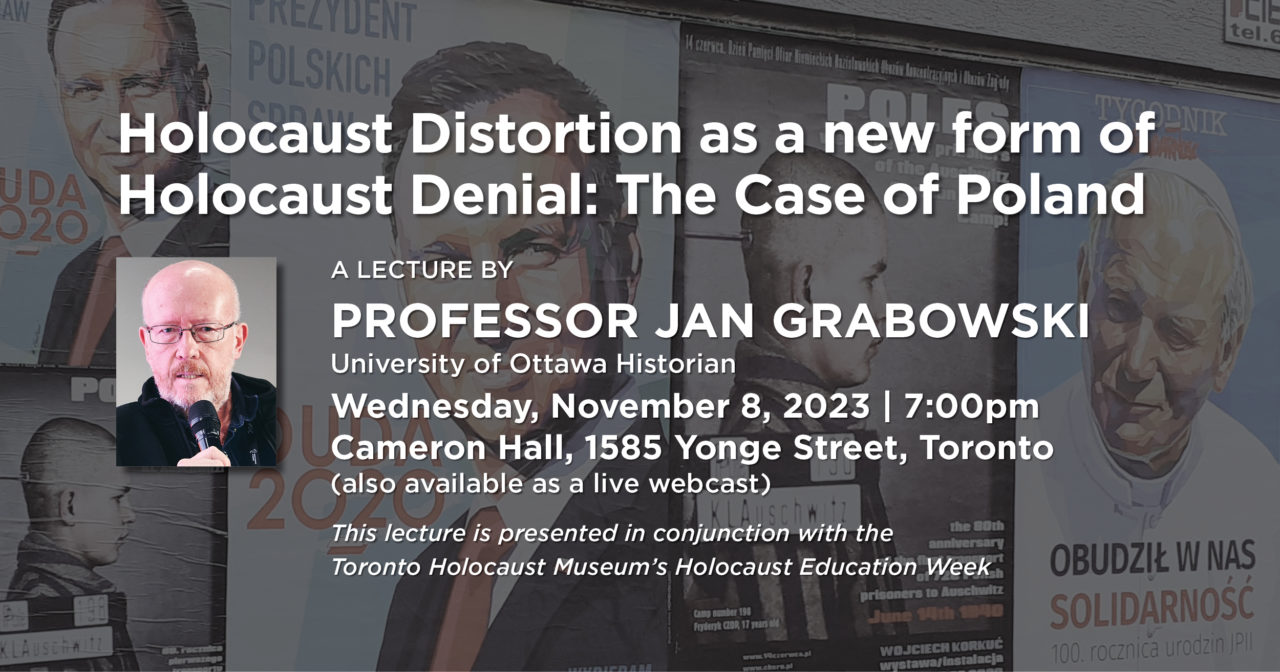
Professor Jan Grabowski on historians' responsibilities


Went last night to the Yorkminster Park lecture series here in Toronto, to hear Jan Grabowski, a University of Ottawa historian, talk about state-sponsored Holocaust distortion in Poland. He spoke via an internet link from Warsaw.

I was a little disappointed not to have him in the room with us but pleased to learn he could live and work in Warsaw. I had known that he and other scholars of Polish history had recently faced trial for causing "offense to the national dignity" in scholarly works that took note of instances of Polish complicity with the Nazi Holocaust. Details in this 2021 Masha Gessen article in New Yorker -- possibly paywalled.) 

Given the Polish laws to control historical speech, I had imagined that Professor Grabowski would not be able to live in Poland at all (even though in the end the case against him was unsuccessful). So after he spoke, I asked how safe he was to research and write and speak in Poland.

He said little about how safe or unsafe he actually was.  He spoke instead about the duty of historians to do their work and affirm the truth, no matter what the state and its supporters might do or threaten to do. I found it quite impressive. You can hear my question and his reply here near the end of the video at about 1.01.30.

In response to the second part of my question -- whether the results of the recent national elections in Poland might change the situation he described -- he did not give a lot of cause for hope. Effectively, the belief that Poles generally tried to protect Jews, and that ethnic Poles suffered more than Jews did during the Second World War, is very widely held in Poland. And defending "the national dignity," he says, has been about the only policy on which the new victorious democrats have usually voted in lockstep with the (probably) outgoing nationalists. 


Tuesday, September 26, 2023

History of the Bloodlands

I haven't very often taken cues from Twitter/X for posts here and given X's situation, I'm likely to do so less in future. But, regarding the national embarrassment over who was honoured in the House of Commons during Ukrainian President Zelensky's recent appearance there, I was struck by an X commentator who posted, more or less:

Wouldn't it be useful to have someone around Parliament who knows some history?

I happened to see the television news coverage the night of the tribute, and I was, well, surprised a little, to hear the Speaker of the Canadian House of Commons honour someone for having fought against Russia during the Second World War. 

Canada was an ally of Russia during the Second World War; Russia was fighting on our side. And fighting against the Soviet Union in eastern Europe at that time did necessary mean assisting the perpetrators of the Holocaust (at the very least). 

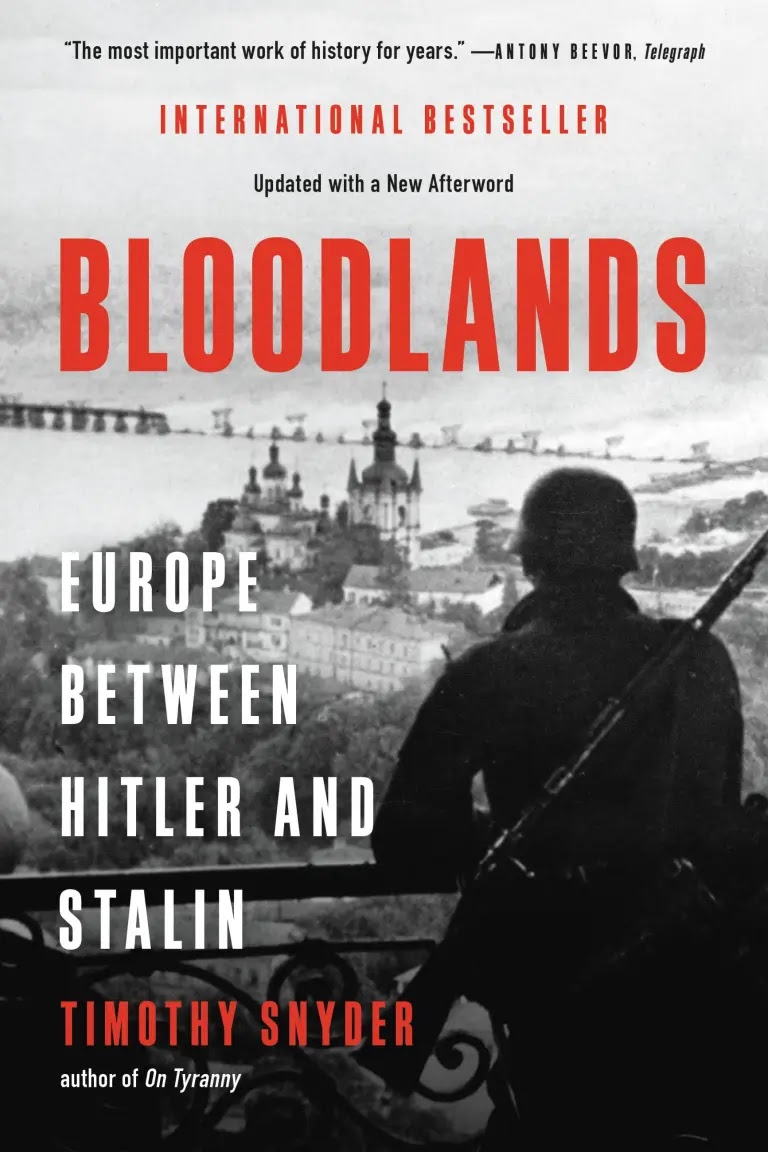
Beyond that, I find the whole situation both tragic and murky. Anyone with a glancing familiarity with, say, Timothy Snyder's Bloodlands, knows there were no good options for people seeking to defend themselves and their communities in the territories contested by Nazi Germany and Stalin's Soviet Union during that war. Not everyone who resisted Stalin's murderous legions was a Nazi.

Did none of those considerations cross any minds among the planners of the event on the Hill? Surely Canada can give all possible support to today's Ukraine without venturing into black-and-white distinctions about loyalties and alliances in that place at that period.

Wednesday, March 08, 2023

Book Notes: Wanda's War

Recently I had a piece published in the Literary Review of Canada about writing the histories of individuals who pretty much left no record of themselves. I did not realize then that my friend Marsha Faubert was about to publish a book that is dedicated to precisely that task.

Faubert's Wanda's War: An Untold Story of Nazi Europe, Forced Labour, and a Canadian Immigration Scandal (from Goose Lane Editions) explores the lives of her Polish-Canadian mother-in-law and father-in-law, Wanda and Casey (Kazimierz) Surdykowski during and after the Second World War. They left a few photographs, but mostly they did not talk about the war, or their lives in Europe, or coming to Canada. 

Wanda's War explores how Wanda survived first the Soviet and then the German invasion of Poland and ended up a forced labourer in a factory camp in Germany. Meanwhile, Casey, then unknown to her, had been seized by the Soviet forces after they invaded eastern Poland in 1939. He was shipped off to serve as a forced labourer in a Siberian forestry camp. From there, he followed a very implausible path (which the book explains) to becoming a soldier in the Polish Division fighting alongside British and Canadians in Italy. My own father, serving in the British Army in Italy, must have been nearby at times; he remembered how everyone felt safer when the Polish Division was nearby, because no German attack was going to get past the Poles. 

At the end of the war, both Wanda and Casey became "displaced persons," unwilling and unable to return to Soviet-occupied Poland, unwanted most other places. Wanda reached Canada via a bizarre scheme through which a Canadian businessman was permitted to bring young Polish women from refugee camps to be cheap labour in his factory in rural Quebec. Eventually she fled to southern Ontario, and saw her mother and siblings also reach North America. Casey benefitted from the grudging respect the Western Allies paid to the military service of the Free Polish Army, and was able to join a group of his fellow soldiers being accepted into Canada. He got to Kitchener, Ontario, in the late 1940s, where he met and married Wanda and where they spent the rest of their lives. One of their sons met Marsha Faubert in law school, which is how she became daughter-in-law to Wanda and Casey, who have since died.

They didn't willingly talk about any of their nightmarish wartime history. But Marsha Faubert has pieced together a remarkable amount of information both about them individually and about the world-historical events through which they lived. From family genealogy to pre-war Polish rural society in Eastern Europe, to gulags and slave labour camps, to the military history of World War II, to the intricacies of postwar immigration and adjustment, to the politics of memory, she has got it all in one story.

There's a book launch for Wanda's World tomorrow at Baka Gallery Cafe in Bloor West Village, Toronto. Goose Lane is promoting it on Facebook, so I guess they would not mind if a few of the sophisticated audience of this blog joined in.

A book launch, a real in-person book launch! Imagine.


Tuesday, May 25, 2021

History versus politics: the apology to interned Italians in the Second World War


On Thursday, the prime minister will offer a formal apology to Italian enemy aliens who were interned in Canada during the Second World War, despite comprehensive historical evidence that the internment conformed to international law, was directed against individuals with links to Fascist organizations developed in Canada by Mussolini's diplomats during the 1930s, and (from more than 122,000 Italian-Canadians) covered only some 600 people, many of whom were released on having demonstrated that their internment was misguided or having committed to peaceable behaviour.

The evidence is comprehensively presented in Enemies Within: Italian and Other Internees in Canada and Abroad, a collection of essays edited by Franca Iacovetta, Roberto Perin, and Angelo Principe, and published in 2000 by the University of Toronto Press after a previous campaign for such an apology. 

Interning known and suspected supporters of an enemy power in wartime hardly seems like something for a state at war to apologize for. However, there are a lot of Italian-Canadian voters determined to get their share of the apologies going around. Yeesh.

Previous note on this subject here.

Update, May 26:  Russ Chamberlayne responds:  

Perhaps with wise advice from Stephen Harper, Bill Clinton et al., the Trudeau government might want to set up an Apology Secretariat in its own high-profile building (the Repentagon?).


Tuesday, February 16, 2021

Book Notes: Thompson on Mackenzie King as "the third man"


I was not aware until recently of Neville Thompson, a retired history prof from Western U who is the author of a shelf of books, mostly in British and European history, now including The Third Man, a study of the three-cornered relationship between Winston Churchill, Franklin Roosevelt, and William Lyon Mackenzie King before and during the Second World War. It is published today, and I've been reading it courtesy of a review copy from Sutherland House publiist Sarah Miniaci.

My impression has been that historians have generally treated King as the wannabe in this group, a sort of headwaiter at occasional meetings between the British and American leaders. Thompson makes a case that such is a serious misreading.

King knew both Roosevelt and Churchill much better and longer than either of them knew the other. In Thompson's telling, King had stronger relationships and more influence with both of them than has been thought. He gives substantial evidence for the view that King significantly facilitated and sometimes influenced the vital Roosevelt-Churchill relationship, not least by usefully interpreting each to the other on several occasions.

Thompson is impressively well-informed about British, American, European, and Canadian politics in the mid-twentieth century and can constantly flesh out minor details, drawing on seemingly every memoir and biography of the period ever published. A key source for him, however, is Mackenzie King's own diaries, which he employs constantly to cover King's encounters with the other leaders back to 1900. King's notes enable him to flesh out what British and American scholars have often covered in regard to Roosevelt and/or Churchill without drawing on King's diary.

It's an impressive and readable book on what might seem a well-trodden topic, and Thompson's confident familiarity with the period and its people makes for engaging reading. It's marred, unfortunately, by way too many small failures in copyediting and proofreading. Sutherland House, a welcome new venture in Canadian publishing, may need to up its game in that regard.

The underestimation of Mackenzie King, not exclusively by non-Canadians, is also demonstrated in a recent review by the Guardian film critic Peter Bradshaw of a Canadian film, "The Twentieth Century" by Matthew Rankin. If Bradshaw is accurate, the film "satirises the country’s stolid colonial traditions" and portrays King as "subservient to the British colonial establishment" and "a properly pompous and pointless Canadian prime minister." Well, it's only a movie; directors can say what they want.

But if you are at all susceptible to this kind of self-hating Canadianism, Thompson's book could be a useful corrective. One of The Third Man's themes, in fact, is King's endless, skillful, and effective campaign to keep Canadian wartime policy as free as possible from Churchill's imperial aggrandizing and Roosevelt's new American empire. King, indeed, was one of the reasons Churchill failed to keep his promise not to preside over the breakup of the British Empire.

Active History recently posted Sean Graham's interview with Neville Thompson about The Third Man.

Monday, July 22, 2019

Apologies to Interned Italian-Canadians? Hmmm

I'm pretty sceptical about the prime minister's proposal to apologize for the internment of Italian Canadians in the Second World War.

In 1940 there were tens of thousands of Italian citizens who were immigrants in Canada in 1940, and as citizens of a foreign belligerent at war with Canada, they were declared enemy aliens. Of the 40,000 or so recent immigrants, some 586 were interned. Some were released on appeal, but others remained in detention through much of the war.

Were none of these 586 sympathetic to Mussolini or to the military ambitions of their homeland? Interning known and suspected supporters of a foreign power at war with Canada does not seem like something to apologize for.  Apology may be a political convenience, but I'm not convinced it has historical merit.

Happily, there is a book that has looked into the Italian-Canadian internment: Enemies Within: Italian and Other Internees in Canada and Abroad by Iacovetta, Perin, and Principe, published in 2000. When I've had a look at it, I may have more to say  -- unless you have info to offer.

Update, August 6:  Okay the book is excellent, really a triumph of relevant scholarship, and the Italian-Canadian claims for redress cannot be taken seriously as a "war on ethnicity" or anything else. 

Of some 112,000 Italian Canadians at the time, some 600 were interned, largely because they were associated with Fascist organizations run in Canada by the Mussolini regime. It is true that Italian Canadians naturalized after 1922 were denied the rights of citizens, and required to report to authorities regularly. Other hardships also occurred, but taking steps to defeat Fascism at home and in Italy does not seem like something for Canada to apologize for.

Monday, June 10, 2019

History of D-Day in perspective: lest we forget


The D-Day commemorations were moving and personal and very widely broadcast again this year.  As they should be.

But to counter the inclination of some commentators and maybe even some historians to speak of "the turning of the tide" or "the beginning of the end," it's worthwhile to read this essay from the American History News Network, confirming that the turning of the tide occurred at Moscow, or Stalingrad, or Kursk, and not in Normandy. 

Monday, January 30, 2017

Book Notes: Mellor on Dieppe republished


Vimy @100 is not the only Canadian military anniversary of 2017.

Ron Caplan reminds me that this is also the seventy-fifth anniversary of the Dieppe Raid -- in some ways as central to Canadian memory of the Second World War as Vimy is to that of the First.

Caplan's Cape Breton Books this year republishes John Mellor's Dieppe: Canada's Forgotten Heroes. Given the number of books on Dieppe that appeared both before and after its first publication in 1975, one might quibble with the "forgotten" in the subtitle. But it's good to see work like this returning to print. Good to see reprints in Canadiana anytime, in fact.

Caplan writes, "I am also searching for Cape Bretoners who fought in the raid. I had been told that there were none but have since located two." History continues apace.


Follow @CmedMoore