Showing posts with label Ukraine. Show all posts

Tuesday, September 26, 2023

History of the Bloodlands

I haven't very often taken cues from Twitter/X for posts here and given X's situation, I'm likely to do so less in future. But, regarding the national embarrassment over who was honoured in the House of Commons during Ukrainian President Zelensky's recent appearance there, I was struck by an X commentator who posted, more or less:

Wouldn't it be useful to have someone around Parliament who knows some history?

I happened to see the television news coverage the night of the tribute, and I was, well, surprised a little, to hear the Speaker of the Canadian House of Commons honour someone for having fought against Russia during the Second World War. 

Canada was an ally of Russia during the Second World War; Russia was fighting on our side. And fighting against the Soviet Union in eastern Europe at that time did necessary mean assisting the perpetrators of the Holocaust (at the very least). 
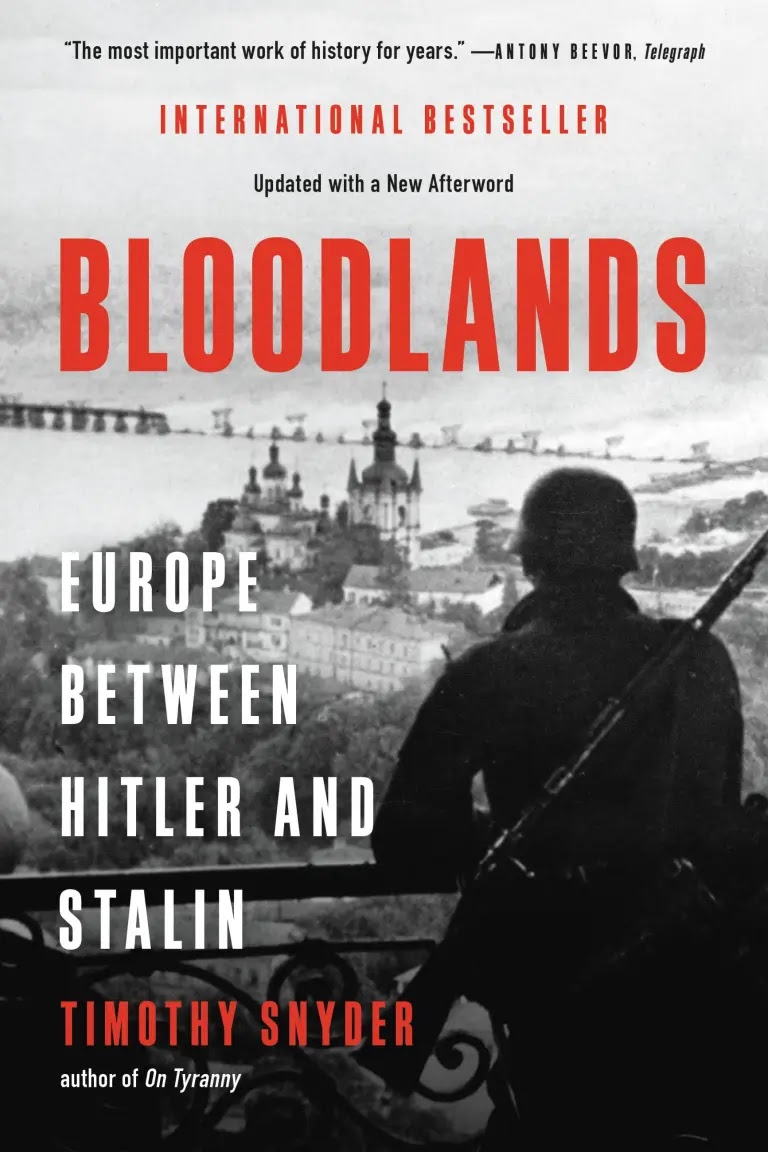
Beyond that, I find the whole situation both tragic and murky. Anyone with a glancing familiarity with, say, Timothy Snyder's Bloodlands, knows there were no good options for people seeking to defend themselves and their communities in the territories contested by Nazi Germany and Stalin's Soviet Union during that war. Not everyone who resisted Stalin's murderous legions was a Nazi.

Did none of those considerations cross any minds among the planners of the event on the Hill? Surely Canada can give all possible support to today's Ukraine without venturing into black-and-white distinctions about loyalties and alliances in that place at that period.

Tuesday, June 06, 2023

Book Notes: Kostash on family and photographs

Myrna Kostash, since the 1970s our philosopher of the Ukrainian-Canadian diaspora, has a new memoir, Ghosts in a Photograph: A Chronicle, based on her extensive research and focussing on family photographs she has acquired over the years in Alberta and in the Galacian province of western Ukraine, from which her grandfather Fedor Kostashchuk emigrated in 1900.  

Ghosts in a Photograph is unusual among immigrant stories in that it does not present the pre-immigration moment as a complete blank. Kostash reports how she became aware that the homeland was more than some blank peasant anonymity from which the Kostashes emerged to become real people. It was actually more comfortable, and more cultured, than the 160 acres on the North Saskatchewan to which Fedor and Anna devoted their lives. She even discovers she is not the first writer and intellectual among the Kostashes/Kostashchuks. 

Even more vividly, she emphasizes (has done since the 1970s) that the Kostashs did not come to settle a blank and empty landscape. Barely twenty-five years separated Treaty Six and the clearing of northwestern Alberta's original people to "open" the land for settlement by her forebears. Indeed the dispossessed Cree still lived nearby, in 1900 as in 2020. 

She has made this reality a big part of her working life in recent years. The dispossession that made possible the settlement of the Kostashes in Swan Hills is here mirrored against the dispossession of the Kostashchuks from Galicia to make a vital part of this book  -- a process that needs to become a large part of all Canadian immigration and settlement narratives.

The book is built around photographs: of the Kostash family photograph that celebrates all the sons went from the homestead to university -- and neglects the one daughter who stayed home.  Of the young Kostashchuk resistance fighter who died fighting the Soviet Union ... in the 1950s. Kostash gives very detailed "readings" of each photo but has chosen not to include any of them in the book, the better to foreground her own readings of them. 

I remain unconvinced that this was a best possible decision.  I could see the photos and still be enriched by her discussions of them.  But there you are. Myrna Kostash has a very strong commitment to the power of prose.  

Update, June 13:  Myrna is hearing from readers and fans, and she has started posting the photos that are discussed but not shown in her terrific book on her Facebook page. 

Tuesday, April 19, 2022

History of Azovstal


Historian of the day Adam Tooze recounts his recent discovery of the history of the vast Azovstal steel works in Mariupol, currently the site of a Thermopylae-style resistance by the remaining Ukrainian defenders of the city. The steel plant began with a 19th century investment by American financiers attracted to the close association of coal, iron ore, and a seaport. It was massively expanded in the 1930s to become one of the showplace achievements of Stalinist heavy industrial development, then destroyed during the German occupation in the Second World War, and rebuilt by the Soviets once more.  At the collapse of the USSR it became the prize toy of an oligarch, who instantly became Ukraine's richest man -- and is now supporting Ukraine against his old benefactors. 

What brought us to this point of a factory fight in Southern Ukraine?

At moments like this, history truly reveals its quality as a pal·imp·sest - a manuscript or piece of writing on which the original writing has been effaced to make room for later writing but of which traces remain. The search functions of the internet reinforce that quality, constantly surfacing long-forgotten pieces from a different era.

Slava Ukraini. 


Thursday, March 10, 2022

If history has answers, who's delivering them?


Who is the historian to explain what's going on in Eastern Europe and global geopolitics right now? It's a hot market.

Maybe Anne Applebaum, who works as a journalist but has serious credentials and a substantial bibliography on eastern Europe and Russia.  She writes mostly for The Atlantic (which is a pretty cheap online subscription, though I recently abandoned mine, getting tired of too much insular Americanism.)

Maybe Adam Tooze. Tooze is a British economic historian now teaching in the United States. He came to prominence with a big book called Crashed, which smart reviewers seemed to think was the best book on the 2008 global economic crash. These days his substack "Chartbook"  (adamtooze.substack.com) is absolutely relentless in pouring out deeply researched opinions on just about everything going on. Free, mostly. (The image above is from his Chartbook #96, that takes the Ukraine crisis back to 1918.)

Maybe John Mearsheimer, if you lean to the idea that NATO forced Putin to invade Ukraine, because it's a law of politics that Great Powers must dominate smaller nations around them, and to hell with all that sovereignty and self-determination twaddle. In right-wing American publications, though he has an odd left-wing following too, for those who blame the American empire for everything. Did himself no favours in a New Yorker interview published March 1, which looked like Putin apologetics to a lot of readers.

Maybe Fiona Hill, British expat, biographer of Vladimir Putin, and eastern European policy expert at American universities, think tanks, and sometimes the White House. (She worked in the Trump White House, but Trump thought she was a secretary or the coffee girl, and she testified for his impeachment). Actually, if you want a break from Ukraine horrors, her book There is Nothing For You Here, particularly the memoir in its first half, is a terrific account, from her own lived experience in northern England, Moscow, and the United States, of how all three countries, from the 1980s to today, have created their own massive rustbelts, economic devastation of the working class, and much of the subsequent socio-political upheaval we live with today. Doing a lot of media, so she's all over YouTube right now (here on Colbert)

 Who else? And whose twitter feeds to follow? Suggestions welcome.


Follow @CmedMoore