Showing posts with label historic sites. Show all posts

Thursday, January 22, 2026

Canada's Historic Places to be Deregistered


Here's a strange one.

The National Trust of Canada reports that Parks Canada will shut down the Canadian Register of Historic Places, "an online searchable database of historic places in Canada which have been formally recognized for their heritage value by federal, provincial, municipal or territorial authorities."  It records more than 13,000 such places across the country.  It will cease to function in the spring of 2026, according to Parks Canada.

For the time being you can still search the fed's Register yourself at historicplaces.ca.  The National Trust report includes a list of federal and provincial ministers and agencies you can complain to.

Update, February 5.  The CBC reports that within 24 hours some tech-smart guy named Stephen Taylor, who did not like this plan, simply scraped all the data on the Register and reposted it all on a new site of his own creation called Heritage Guide Canada, with many new features and a cleaner modern interface. It's free to all - as the old one is. If the feds want it back, he'd be happy to give it to them, he says.   

Tuesday, July 23, 2024

This month at Canada's History: Parks Canada on Canada's History


Features

THE UNSETTLED PAST

In a stature-toppling era, Parks Canada adapts its retelling of this country’s complex history. by Christopher Moore

This month, the August-September Canada's History leads with my article "The Unsettled Past," investigating how Parks Canada is seeking to shape a new narrative for Canadian history at its sites and plaques all over Canada.

Update, June 23: The full story is now available at the Canada's History website.

Parks Canada's historic sites agency, like other Canadian museums and historical institutions, was put under tough scrutiny by the Truth and Reconciliation Commission. The TRC's 2025 report shone a painful spotlight on the pervasive neglect of Indigenous history and historical perspectives at Parks Canada's hundreds of sites and thousands of historic plaques, and it called for a fundamental reassessment. 

 And of course there was backlash.

Nearly a decade into that reassessment, I talked to Parks Canada historians and planners, to administrators, to Indigenous consultants, and also to the critics hotly opposed to what is happening to Canadian history at Parks Canada's sites. I think it's an important story, and a hopeful one too. Subscribe, and it should be in your mailbox already. (The online version will come along a little later.) It's a beautiful issue too: Parks Canada's sites photograph well, let us say.

Also in the issue: David Frank on child labour and neglect in New Brunswick; Sophie McGee on our tangled history with orcas; Nancy Payne's spectacular text-and-picture spread on historic lighthouses; and Enid Mallory exploring historic Yukon roads. The lead in the review section features Gerald Friesen's new and important The Honorable John Norquay, about the remarkable career of the 19th century Indigenous premier of Manitoba.  

And more. 


Thursday, July 21, 2022

Louisbourg rebuilt again

 ... This time it's in Lego.

Two hundred thousand pieces of Lego, two years labour, and the fortress city rises again, this time in scale to the iconic Lego figurine.  And I want to go to there.
"Me and my brother went to the fortress for the 250th anniversary of the second siege of the fortress [2008]," said Bédard. "It was just magical with all of the British and French soldiers and the fortress itself and the fog." [....]

 Bédard said he began the replica project in January 2020, and soon after a team was assembled.

The five people behind the project have all chipped in to cover its cost, estimated at around $20,000.

No word on whether there are teenyl ittle Lego historians behind the scenes of this reconstruction, but it's got a good review from one who could be there, John Johnston, the dean of lifesize Louisbourg specialists: 

A.J.B. Johnston, a historian who worked at the Fortress of Louisbourg for 23 years, said he's impressed by the Lego creation's accuracy and detail.

 "It's an endless pit, or an endless treasure trove," he said. "Louisbourg can fascinate you in countless ways."

Update, July 22: Mark Reynolds comments:

Sometimes you don't know what your dream is....until you see a full scale Lego replica of Louisbourg, and realize that you've wasted your life. To think I've been raising children, when I could have been doing that instead - if they ever make Canadian history Lego kits, I will be *bankrupting* this family, I swear.


Wednesday, June 08, 2022

History of commemoration on indigenous territory

This -- permanent inclusion of indigenous representation at the Historic Sites and Monuments Board, in keeping with Call to Action 79 of The Truth and Reconciliation Commission -- seems both like a worthy idea and awkwardly overdue.

There is, of course, the other approach to be maintained: direct negotiations between First Nations as landholders with agencies such as Parks Canada about appropriate commemoration on First Nations lands. But the two approaches can work simultaneously. 

Tuesday, May 24, 2022

Drunk History


The fortress city of Louisbourg is offering a taste of history:  rum, imported from les iles, barrel-aged in the fortress's caves, and now available to you from your local liquor store (Ontario ones at least).  

I only wish I had thought of this myself when I was writing some of the first planning memos on food-and-drink interpretation at the fortress many years ago. 

Celebrate the historic New France rum trade. Distilled by Authentic Seacoast, at their Nova Scotia distillery, Fortress rum is matured in barrels at the Fortress of Louisbourg in Cape Breton. Flavours of maple, fig and toasted oak leading to a smooth and lengthy finish. Enjoy neat after dinner or with apple coffee cake.  ($54.20/750ml at the LCBO)

Monday, May 25, 2020

Selma Barkham, explorer, 1927-2020 RIP


The Globe and Mail has a very good obituary article on Selma Barkham.  I was going to say "Selma Barkham, historian," and she's entitled to the descriptor, but really she was kind of sui generis -- as the article makes clear. A remarkable life.

I recall seeing her once at a conference in Ottawa, describing the very detailed information she had on a 1565 Basque shipwreck in Red Bay, Labrador, and asking if anyone in the room had the kind of marine archaeological expertise she needed. At the end of the session, I watched Robert Grenier, Parks Canada's head of marine archaeology, heading for the front of the room as if shot from a cannon. I presume that was the start of the excavation of the San Juan and its preservation at Red Bay, a historic site I am happy to have visited.

Photo credit: Michael Barkham, via G&M.

Tuesday, February 18, 2020

Louisbourg to Versailles


At Versailles there is an annual Grand Masquerade in honour of those held by Louis XIV and Louis XV.  The military nobility of eighteenth century Louisbourg held their own masquerade parties, and recently the animators there decided that they had to be present at the Versailles recreation. Looks like they brought it off. At the Fortress you may have encountered the soldiers and fishers in their shapeless woollens -- who were maybe more representative of the community.  But given the chance, they clean up real nice.

Kristy Martell and Ruby Fougere, who were among the Versailles party, will speak on the topic "Louisbourg to Versailles: An Historical and Cultural Journey" at the next Old Sydney Society meeting, 27 February 2020, 7:30 PM at the Sydney Museum, 173 Charlotte St., Sydney, Cape Breton. 

Wednesday, November 18, 2015

Same OLD story: history of urban renewal


Went down yesterday to an overflow press conference with Toronto mayor John Tory and a crowd of other politicians and urban planning luminaries.  They were announcing "Project: Under Gardiner," a clever and not very costly plan ($25 million, donated) to turn the space under the downtown Gardiner Expressway, always accepted to be a grim godawful unuseable wasteland, into a urban playground. Landscaping, cultural amenities, bike and pedestrian walkways, all placed under the sheltering five-storeys-above roof provided by the highway, will now turn the Under Gardiner into "back yard and front room" for the 70,000 people who already live in the vertical city that has blossomed in the former industrial zone and transportation corridor on the west side of downtown.

Although the presser was held in a (spacious, convenient, well-appointed) space at the recently opened Visitor Centre of Fort York National Historic Park, and although speakers did allude to the potential of the fort's green spaces for dog-walking, cycling, kite-flying and the like, almost none of the pols and planners on the podium mentioned how the historic space has in fact been the prime mover in reconceptualizing the once-blighted space around it. For about 20 years people associated with the fort, foreseeing the new residential population about to settle in the area, have worked to make the fort the key identifier (Fort York Neighborhood, @FortYork, etc) of the new community, and also to maximize the value of the historic property to community values and community life. The Fort York campus is the largest green space in the community and the central node of the new non-car connections in the area, and the Visitor Centre is both an architectural asset and the best place for the community to gather (as at the press conference).  With no loss of its historic significance, Fort York has "suddenly" moved from being stuck in a peripheral wasteland no one wanted to visit to being the jewel of one of the hottest new neighborhood in Toronto.

This is not unique or strange or odd. It is always historic sites and heritage architecture - and the derided buffs and geeks who value them -- that lead in the preservation and then the rehabilitation of undervalued urban spaces.  Even when the planners and architects take the credit.

Photo:  Project: Under Gardiner, via Globe and Mail

Friday, September 07, 2012

Ridgeway battlefield walking tour


This summer is full of 1812 battlefields, but tomorrow morning Peter Vronsky  is leading a battlefield tour of the key sites of the historic 1866 battle of Ridgeway, near Niagara Falls.

Peter is the author of the recent Ridgeway: The American Fenian Invasion and the 1866 Battle That Made Canada (Penguin Books).

As he says: 
Fought near the town of Ridgeway, Ontario, on June 2, 1866, the Battle of Ridgeway was Canada’s first modern battle, the first fought in the age of steam power and telegraph. It is the first modern battle led exclusively by Canadian officers and fought entirely by Canadian troops from the Queen’s Own Rifles (QOR) and the Royal Hamilton Light Infantry (RHLI), currently celebrating their 150th anniversary.  No British Army personnel were on the field of battle.  Ridgeway was where Canada’s modern military sustained their first nine battlefield deaths, and the site of the last battle fought in Ontario against a foreign invading force crossing from the United States.
Tour goes Saturday, September 8, at 11:00 A.M. The tour will begin in the parking lot of the Ridgeway Battle Cairn Monument on Garrison Road just east of Ridge Road N. and will last approximately 90 minutes walking the perimeter of the battlefield.  Everybody, including media, welcome and it is free of charge.  For further details and downloadable battlefield maps for the tour please visit www.ridgewaybattle.ca/tour 


Monday, August 27, 2012

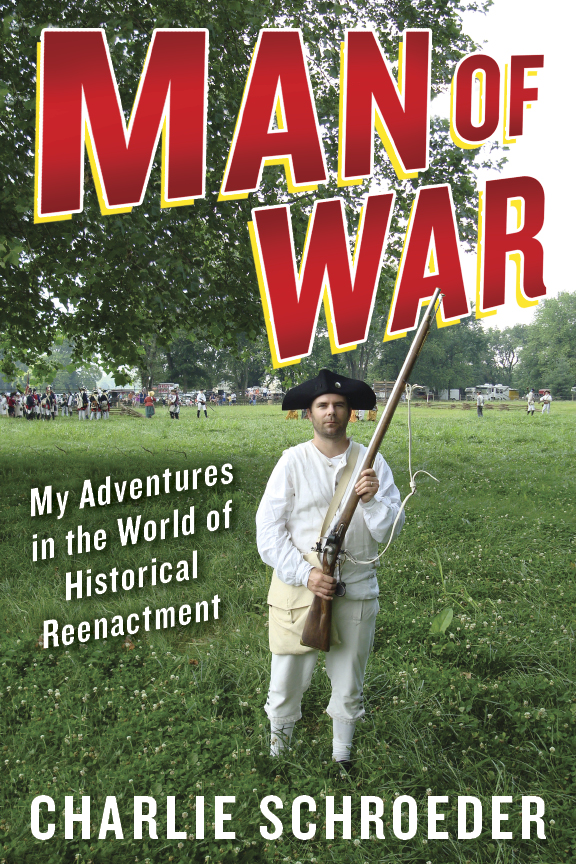
Man of War on historical reenacting


American journalist Charlie Schroeder spent a couple of summers exploring the world of historical reenactors for a funny new book Man of War:
In Arkansas, there is a full-scale Roman fort with catapults and ramparts. In Colorado, nearly a hundred men don Nazi uniforms to fight the battle of Stalingrad. On the St. Lawrence River, a group of dedicated history buffs row more slowly than they can walk—along with author Charlie Schroeder, who is sweating profusely and cursing the day he got a book deal. 
Taking readers on a figurative trip through time and a literal journey across America, Man of War details an ordinary guy's attempt to relearn history by experiencing it. Embedding with his fellow countrymen, Charlie Schroeder jumps headlong into the idiosyncratic world of historical reenactment. From encounters with wildlife and frostbite to learning more than he ever expected about guns, ammo, and buttons, Schroeder takes readers to the front lines of bloodless battles in order to show exactly how much the past has to teach us all about our present (and explain why anyone would choose to wear wool in a heat wave).
Line I liked, from one of Charlie's informants: "It's not easy being a public historian.  These are non-profits and they can't pay good salaries. Not every town needs a Revolutionary War historian."   True fact.

Tuesday, May 01, 2012

What's with Harper's war on history?

Just the other day, they were hot for commemorating the War of 1812.

Now it's 600+ job cuts at Parks Canada, with particular focus on historic sites (120 jobs at Fortress of Louisbourg alone, it seems), and over 200 positions to be cut at Library and Archives Canada.

Wednesday, December 14, 2011

Heritage for the Holidays

Karen Black of Toronto Heritage sent me a note about all the festive holiday stuff going on in historic homes and heritage sites around Toronto this season.   And last week Ken Donovan let me know about the carol singing in the 18th century chapel at the Fortress of Louisbourg  (though it was last Sunday -- sorry Ken).

That kind of thing is happening in cities and towns all over the country.  Do some heritage for the holidays.
 
Follow @CmedMoore