Showing posts with label publishing. Show all posts

Saturday, October 08, 2022

History of Canadian publishing, from a Canadian publisher

If you take an interest in the state of Canadian publishing, particularly the category of "researched nonfiction," don't miss Kenneth Whyte's Substack #168 

[It's ShuSh@Substack.com -- but it seems you have to be subscribed (free) for yourself or go to Substack.com and run a search for ShuSh -- direct links disabled. SubStack: what can I say?)  Update, October 13:  okay, ignore all that. You can go direct to shush.substack.com for the latest -- and add /archive for a list of its whole run.  Hey, it's not like you come here for tech advice.] 

Actually, if you just like lively take-no-prisoners journalism, Whyte's piece has that too.

Here he is quoting Dan Wells, proprietor of Biblioasis Bookstore and publisher of Biblioasis Books, on the consequences of the federal government's allowing free trade in publishing houses (commitments notwithstanding):

"It would be easier for me, as a bookseller,” he said, “to build a section of Australian or East Indian history from the available titles of the multinationals than it is for me to build a Canadian history section. There are more new books available to me on the US Civil War or American neocon political posturing than Canadian history. And it’s not just that our market is flooded with American and British books, which is bad enough. It’s that their direct access to the Canadian market undermines the ability of Canadian publishers to increase their own revenues which they can then, in turn, invest in the publication and promotion of more and better Canadian books

You want SHuSh #168, entitled "It started out as polite talk..."

Yes, it's about the webinar I was talking about the other week.  Told you you should join in. 

Update, October 16:  SHuSH #169 includes a reader's comment on the column discussed above. It has some very odd opinions to offer.  First, it suggests that novelists reflect other Canadians in having no interest in Canadian stories because they are so boring. (Assignment: make a quick list of, say, 100 Canadian novels set in the Canadian past.) Then it says "Fiction is a buttress of non-fiction, imagining the past into a palpable reality."  Well, I guess you can imagine a reality, but you know, imagining something does not make it real. It is still just an imagined reality.  Fiction is imagined reality, nonfiction is a search for what is true about reality (past or present).  

This idea that fiction makes things real, rather than imagining them so they seem real, is a powerful one in some literary circles. We need to call it what it is: fiction bigotry  

Monday, April 11, 2022

History of Literary Unionism

The latest from Ken Whyte's SHuSH blog #143 argues that Canadian writers "need a real union." I think he means a union that succeeds in some ambitious goals, and in that sense I agree with him entirely. I'd welcome such successes. But as one who contributed in small ways to various campaigns of the actual and existing Writers' Union of Canada over the years, I could not help smiling at some of the proposals Whyte puts forward as new and original.

Among the goals of "a real union" of writers, Whyte recommends:

  • more pay for writers -- a demand he supports with detailed data on how low writers' incomes are. He doesn't mention that all his data on the earnings of Canadian writers seem to come from surveys commissioned and paid for by the Writers' Union of Canada, which actually has been working at this matter for many decades;
  • increasing payments to writers from Public Lending Right. Whyte doesn't mention that after decades of advocacy by Canadian writers, it was the sustained lobbying of the Writers' Union that brought PLR into being in 1987, or that more recent lobbying by the union led to recent and significant increases in PLR funding. More? Sure, but likely to come along the same way.
  • better contract terms for writers. Whyte seems unaware of the model trade book contract  laboriously developed and promoted by the Writers' Union, the contract advising service it has always offered its members and other writers, the legal advice it provides, the grievance process it runs, the Minimum Terms Agreements negotiations it sought to have with publishers, the random royalty audits of publishers' royalty statements it undertook. It's true that many of these initiatives, particularly bargaining with publishers over money and rights, have had limited success (which may be why the Union makes more noise about its many successes in changing the writing-and-publishing policies and practices of governments and public agencies).  The failure to unionize publishing contracts was mostly due, I can testify, to the granite-hard opposition marshalled by virtually every publisher large and small, foreign and Canadian, and by their well-heeled organizations. Lack of success in this area is because it is hard, not because it has not previously been thought of or fought for . 
  • union activity rather than employment of agents. Whyte mocks Canadian writers for both having both a union and employing agents. Historically, the seemingly endless impossibility of achieving contract reform coincided with and doubtless spurred the rise of literary agency in Canada, which indeed has benefited writers much more than Whyte, a publisher as well as a writer, can see, and which still leaves much scope for union activity in areas which agents do not address.  
Surprisingly, Whyte fails even to note the need for a union-run collective licensing agency to manage and licence creators' reprography rights (ie, copying both digital and xerographic) -- which ought be another significant source of Canadian writers' incomes. The Writers' Union of Canada campaigned for collective licensing from its first moments, and  was instrumental in bringing into being the Canadian legislation for collective licensing in the 1980s  -- despite immense opposition from the education sector and much apathy in the publishing community. Regrettably, the copyright collective Access Copyright has since been captured by publishers, so that a handful of foreign-owned educational publishers control how -- and how much -- income collected on creators' behalf actually reaches creators. It seems to be as a result of that capture that legislators and judges, while they continue to endorse the fairness of collective licensing in principle, have been consistently reluctant to give the existing collective the tools necessary to allow it to work in practice.

Whyte does offer one rather original suggestion: a campaign to abuse librarians and cultural bureaucrats for their job security and high salaries. I think he's right to suggest the real Writers' Union has never engaged in that. The union has, however, engaged constantly in negotiation with those same libraries and bureaucrats to secure benefits for writers -- a form of collective action which does seem more directly useful to writers than abuse and barrier-building.

Still most of Whyte's other proposals do have quite a lot of appeal to writers. He goes wrong, I think, only when he suggests the existing writers' organizations would call them "impractical, unworkable, untested, ridiculous." More likely, they might reply, it's just difficult, given the forces lined up against them, particularly in the publishing sector. 

One very early Writers' Union gathering  


Wednesday, February 10, 2021

Survey on academic publishing

University of Toronto Press, concerned about the future of academic publishing, is taking a survey "to better understand the needs of our customers and our authors in this dynamic environment."  Share those concerns? The survey is here. There are prizes offered.

Monday, October 14, 2019

Payback's a bitch: university presses threatened by open access


I think of myself as a trade book writer, but I've had some books published by academic presses. And now I am getting emails asking me to respond to a survey by Canadian university presses on the subject of open access publishing.

Apparently the Federation for the Humanities and Social Sciences  has proposed that ASPP, the Awards to Scholarly Publications Program (i.e., the federal subsidy money offered to scholarly publications), will only be available to Open Access publications, that is, works that upon publication are made available in digital form at no cost to anyone who wants them.

Meanwhile, SSHRC, the Social Sciences and Humanities Research Council has advised the Association of Canadian University Presses "that the policy change will not be accompanied by additional funding" for the presses.

Now the university presses are sending emails to their authors declaring [I'm quoting from the email of one large Canadian university press]:
most if not all of the 40-50 books a year the ASPP funds would not be submitted to them [by us, the university press] because we could not afford to lose the sales resulting from such a policy.
The emails, I guess, are to advise their academic authors to panic.

Goes around, comes around.  The universities, vigorously supported by the Canadian Association of University Teachers, have been leaders in the campaign to normalize "free copying," when it means that universities can take pretty much anything they want and call it "fair dealing." The university and schools community in Canada has been pretty successful, even getting the Copyright Act changed for their benefit.

Now the federal government's agencies are saying, hey, if you can take anything you want, how can you justify asking others to pay you for what you offer? If you take it for free, you ought to give it away too, no?

Now the academic presses see the consequences. They'll be out of business, pretty much, or trying to turn into trade-market publishers. Or more likely, they will go the way of the open access journals, and turn to vanity publishing.  Open access journals, which give away their work "free," (in order to spare university libraries from having to pay for subscriptions), typically charge the authors they publish many thousands of dollars to have a piece published.  Presumably if you want to get a history book published with an academic publisher, you had better be prepared to get your department or university to pony up an estimated $28,000 to have the university press publish it and give it away.

I don't live by academic publishing, so I'm ignoring the questionnaire.  But if you do, you should consider it carefully.

Monday, March 04, 2019

Book Notes: Quebec Conference of 1864

McGill-Queen's recently sent me a copy of its handsome new essay collection The Quebec Conference of 1864, edited by Eugénie Brouillet, Alain-C Gagnon and Guy Laforest, which includes my essay "A Big Group in a Small Room: Parties and Coalitions at the Quebec Conference." The book is the English-language equivalent of La Conference de Québec de 1864: 150 Ans Plus Tard, published in 2016 by Presses de l'Université Laval. Both are the fruits of an impressive conference held in Quebec City in the fall of 2014, with a large attendance of  francophone and anglophone scholars of confederation, of which I was happy to be one.

Does this happen much: conference papers published in both English- and French-language editions, with all the papers translated for one or the other? Anyway, the papers reflect an impressive diversity of views among the participants: including Confederation as "the completion of a conquest," as the project of London financiers, or as virtually "an imperial fiat," to assertions of and attacks upon the Macdonald/Creighton centralizing vision, to assertions of Canadian autonomy vis-a-vis London, of provincial autonomy vis-a-vis Ottawa, and of confederation of a multicultural "union without fusion."

Publishing note: each press sent me the usual academic press contract, which I would paraphrase as "the contributor surrenders all conceivable rights in perpetuity throughout the universe, in exchange for which the press promises to do whatever it pleases with the work." In each case, I sent back a note stating that I declined those terms, but was glad to permit the press to publish this work in this specific edition.

Neither press responded, but both included my essay -- carefully edited, and with Laval going to the trouble of having it skillfully translated, for which I am most grateful. I have long been puzzled by the willingness of scholars to surrender their works on almost any terms, and mention my experience here only to hint how it suggests that academics could transform the terms of academic publication any time they chose to.

Wednesday, August 19, 2015

Why are university presses' contracts so bad?


The (US) Authors' Guild has some thoughts on why scholars should not assign copyright:
"When you assign copyright to publishers, you lose control over your scholarly output. Assignment of copyright ownership may limit your ability to incorporate elements into future articles and books or to use your own work in teaching at the University.” And those are by no means the only potential problems. That’s why we admonish authors never to assign a copyright to a publisher.
And yet:
The copyright grab remains endemic among university presses. To find out why, we recently canvassed several academic authors. Every form agreement that a university press had initially offered these authors contained the copyright grab clause. And yet every author we know of who requested to retain copyright was able to get the publisher to change the agreement.
So?
The problem is that most academic authors—particularly first-time authors feeling the flames of “publish or perish”—don’t even ask. They do not have agents, do not seek legal advice, and often don’t understand that publishing contracts can be modified. So they don’t ask to keep their copyrights—or for any changes at all. Many academic authors tell us they were afraid to request changes to the standard agreements.
One could add a Canadian question:  Why do Canadian academic presses want a waiver of moral rights? (Moral rights: essentially your right to be identified as the author of your work and not to have the integrity of the work tampered with.)

Update:  An object lesson on why not to yield copyright, from this blog just a couple of weeks ago 


Friday, June 26, 2015

History of CanCult: Dave Godfrey 1938-2015


Quill and Quire reports the death in Victoria of Dave Godfrey, avant-garde novelist, publishing impresario, literary entrepreneur, and a key figure in the blossoming of Canadian writing and publishing in the late 1960s and 1970s.  He went on to be a software entrepreneur, a literature prof, and latterly a winemaker.
“In the decade after 1967, Dave Godfrey was a powerhouse in Canadian writing and publishing,” says Dennis Lee, who in 1967 co-founded House of Anansi Press with Godfrey. At the time, Anansi, which was instrumental in publishing early work by Michael Ondaatje, Margaret Atwood, Graeme Gibson, and Matt Cohen, was located in the basement of Godfrey’s rented house on Spadina Avenue in Toronto. “The energy he brought to the mannerly literary world – for a time, it looked as though he would go on hatching a new press every couple of years – was like a force of nature,” says Lee.
Margaret Atwood has described agreeing to join the board of House of Anansi, "not knowing it was house of vice, murder, intrigue, blood all over the floor (laughter)." Lively times, long gone.

Friday, January 02, 2015

WLU Press to close?


There is a petition circulating against Wilfrid Laurier University's decision that WLU Press is not essential to the university's "mission" and that the press and/or WLU's funding for it should perhaps be phased out.

WLU Press is perhaps best known for its many publications in military history, in childhood and family studies, and for an innovative program in life writing and memoirs, but a look at the website suggests a widely diversified range of titles, including quite a few by historians.

The more publishers the better, so this is a bad thing, is probably the reaction of any academic author thinking about publication opportunities.

But how many university presses does the Canadian academic community need?  Evidently the press is some significant financial burden on one of Ontario's smallest universities.  If McGill and Queen's have been able to collaborate on a jointly-labelled press (for fifty years or so) , there might be opportunities for some similar partnership here.

Thursday, May 29, 2014

History of writing in Canada: Carmen Aguirre's Gran Malon


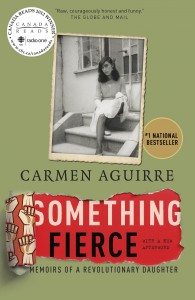
A few years ago Carmen Aguirre of Vancouver wrote Something Fierce, a memoir of her childhood living underground in various South American countries as part of a Chilean-Canadian family working against the Pinochet dictatorship.  It's a significant contribution to immigrant literature and Chilean-Canadian history, I think, but it is also a terrific read and a fine memoir. Winning the CBC Radio "Canada Reads" thing helped it to sell a ton of copies (by Canadian weighting, anyway).

And then her publisher Douglas & McIntyre of Vancouver, went bankrupt, and all the revenues from sales of Something Fierce went to the banks.  The publishing house was soon revived under new ownership, but as always, the authors, as unsecured creditors, lost all they were owed. Aguirre's loss in unpaid royalties was $60,000.

Friends of Aguirre, including D&M staff, have organized a Gran Malón  -- a fundraiser, though the term has a different origin, as you can see from the link -- in Vancouver in June. If you feel some writerly solidarity and live in Vancouver, you could go, and if you don't live there, you could go virtually or just donate.

You could read the book too; it's still available.  Doing something to require publishers to put their owed royalties into trust accounts ... that still seems to be a bridge too far.

Friday, June 12, 2009

John Flinn and the DCB

Down yesterday to the University of Toronto to have a drink in honour of John Flinn, who has just endowed the Dictionary of Canadian Biography with a couple of hundred thousand dollars to sustain its endeavours, particularly in translation.

Appropriately, the DCB responded with a biography. They told us Flinn, born in 1920, went to Harbord Collegiate in the 1930s and studied Greek, Latin, German, French, and English there. He spent much of the war listening to German military radio traffic, then spent most of a decade in France working up one of those immense French doctorates in medieval French literature (and yet still speaks the language with one of those charming Toronto accents). And then he did the French to English translation for all the DCB volumes from 1966 to 1998. Well, he might still do a little something for them if they asked, he said yesterday. He's only 89.

Interesting question arose. Will the DCB (now fifty years old) continue that long line of handsome volumes -- or will future development be entirely online? John English, the general editor, mentioned that the average length of stay for a visitor to the DBC online is eleven minutes -- apparently that is huge, for online statistics. (Scholarship with an attention span of eleven minutes?)

Friday, August 29, 2008

Toronto shuts down Fifth House

Fifth House, prolific publisher of western history titles, will close its Calgary office and lay off all its western-based staff, Quill & Quire is reporting. Fifth House's recent history publications include Ernie Lakusta's biography of explorer James Hector, Brian Brennan's biography of western historian James Gray, and John Weinstein's just-published study of Metis politics.

Fifth House is a subsidiary of the Toronto publishing enterprise Fitzhenry and Whiteside. F&W declares that the house will continue as before ... except that everything will now be done by its Markham headquarters. But this is a delayed death sentence. It's good that FH titles will continue to be stocked and distributed, but Fifth House is/was a rootedly western press, with close links to western writers and western history. They won't get that strength and insight from some part-time staff in Markham, no matter how well-meaning.

F&W is doing the same to its Red Deer Press imprint.

Monday, January 28, 2008

What Have You Done For Us Lately?

Barbara Berson, the Penguin Canada editor who developed "Our Canadian Girl," the very successful multi-volume series of historical novels for young readers, has left the company. Part of a restructuring, the company says.

"Our Canadian Girl" and the rival series developed at Scholastic Canada, "Dear Canada," were part of the ongoing expansion of kids' historical fiction in Canada in the last ten years. Entertained a lot of kids and kept quite a few good writers in work. Good luck, Barbara Berson.

Wednesday, January 09, 2008

The History Book market

No Canadian history books in the top 50 sellers? (see post below)?

Well, Altitude Publishing of Canmore, Alberta, had a refreshingly commercial and pragmatically down-market approach to moving books about Canadian history. Amazing Stories: slim books, colourful stories -- crimes, disasters, heroes, legends. No pretention, no promotion, mostly unknown authors. Titles published in great profusion, prices kept low, and 20 or 40 different titles displayed together on Altitude's own display racks rather than shelved with all the other publishers' wares.

Now Altitude is unable even to pay royalties to its authors and may be toast.

Altitude is blaming the aggressive returns policies of the big-box chains. It's easy to see the problem. Altitude's marketing strategy is to make Amazing Stories timeless. When you want a little history, there's sure to be something on the Amazing Stories rack to catch your eye. Just published or ten years old, who cares?

But the chains want to wallpaper their stores with new books and return everything that doesn't sell through very fast. And they are too big and inflexible to understand niche strategies that might actually work for Canadiana and Canadian history.

If Altitude can survive, it should future-focus on tourist destinations, hotel lobbies, and other retail spaces that mesh with its strategy. Live by the Chindigo, die by the Chindigo.

[Later update: On reflection, I realize this is misplacing the blame. I'm not a reflexive big-box hater. They do a lot to sell books and bring people into contact with books. But we desperately need alternate outlets too. When Chindigo dominates the retail marketplace, things like this happen that should not happen.]

Meanwhile, here's a history title guaranteed its fifteen minutes of fame. If there's anything the media likes about Canadian history, it's a story that can be treated as funny and trivial.

Tuesday, January 08, 2008

History: Um, let's think of it as a special interest

Quill and Quire magazine has just published a listing of the top-selling 50 titles by Canadian authors during the Christmas rush, December 2007. (QQ uses the relatively new BookNet system, which is said to generate pretty reliable data. Before BookNet, it was often rumoured booksellers called a title a hot seller when they wanted to generate interest in it -- because it was not selling.)

Anyway, lots of good books in the top fifty. Literary fiction, current events, hockey, how-to, memoirs, the whole gamut. But not a single title I would have claimed as a "history" title. You won't find any of the books on my Notable History Books list (see below, January 2) in BookNet's top 50 sellers.

Friday, October 19, 2007

Come, friends of piracy...

Publishing trade mag Quill & Quire online (paywalled) reports that University of Toronto Press is so keen to digitize its backlist and do it cheap that it will even destroy its last copy of particular works rather than pay for non-destructive scanning.

But the key to the initiative is the press's request that authors accept a reduction in their digital royalty share from 50% to 10%. As long as there were no digital sales, that is, UTP was willing to share the revenues equally. But now that there is revenue potential....

Think of the costs to the press of buying paper, printing, binding, shipping, warehousing all those backlist books in paper form: substantial. Think of the costs to the press of delivering a digital file: tiny.

UTP reports most of its authors are rolling over for this. Course, their authors are mostly profs, who can be as innocent as babes about their rights.

Friday, May 18, 2007

American Heritage dies.

This can't be good. The American history magazine American Heritage has suspended publication. New York Times has a story.

It sometimes had a wave-the-flag Republican Americanism that grated on a reader across the border, but I admired (envied) how they covered history. I always thought, look at the resources an American history mag can deploy! Turns out they've been losing money forever.

Lively website, www.americanheritage.com, will continue for the time being.
 
Follow @CmedMoore