Thursday, June 30, 2011

Happy Canada Day

I'm outta here for a few days, and I hope you are too.

I hear Michelle McQuigge is running a Canada Day story in the Toronto Star this weekend, based on conversations with some historians about Canadian history.  Canada.com has a Canada Day package, including a link to one of those Historica-Dominion Institute history quizzes that all serious historian types can ace.

If you really want to spend the day indoors reading historical journals online, Routledge offers a free look--  just until noon on July 2.  Y'know, I might miss that one..

H-Canada reports the journals included in the celebration are:

American Review of Canadian Studies - www.tandfonline.com/RARC Canadian Foreign Policy Journal - www.tandfonline.com/RCFP Canadian Journal of Development Studies - www.tandfonline.com/RCJD Leisure - www.tandfonline.com/RLOI Atmosphere-Ocean - www.tandfonline.com/TATO Canadian Journal of Plant Pathology - www.tandfonline.com/TCJP

Norwich Archives #2 - Throckmorton Diary 1817-1862


Mar 1817 - first entry
 
The unassuming small town Ontario Norwich and District Museum & Archives holds a collection of local diaries stretching into the late 20th century, providing an overview of the settled history of the township. Over the next several of months I will highlight some of these diaries in the collection and hope to attract attention and researchers to the invaluable resources housed there.
I’ve just finished reading the diary of Joseph H. Throckmorton, written between 1817 until his death in 1862. Throckmorton was born in 1788 in New Jersey and settled in the Norwich area with his father’s (John Throckmorton) family between 1810 and 1817. John, a Loyalist in the American Revolution, had his New Jersey land confiscated in 1779 and then moved to PEI cir. 1782 or 1787 on half-pay. In 1820 the Throckmorton’s owned lots 10, 22, and 23 in Concession 3 (Quaker St.) in Norwich Township. In 1853 Joseph Throckmorton is noted as owning lot 10, Concession 3 and Lot 2, Concession 11 in South Norwich (Otterville). Joseph was a farmer, landowner and miller but also held the rank of Captain in the Oxford Militia. He is buried in the Norwich Village Cemetery along with his wife, Adeline.
 
Throckmorton & Wife Adeline - Norwich Cemetery


crops, livestock, militia 1825

Tannery shipmets
His diary is an amalgam of weather, farming, politics, births, deaths, marriages, business and a source of local news. Each entry, usually only a line per day, contains the wind direction and weather conditions.  His meticulous recording of arrivals, departures, births, deaths and marriages make the diary a Rosetta Stone of local genealogy. One can see the evolution of his enterprise as he diversified and increased his crops and livestock. He often gives sowing and yield numbers by the bushell and the pounds of extracted livestock meat. He sheds light on the religious culture of Norwich Township. While Henry was either Anglican or Methodist, he noted attending Camp Meetings and Quarterly Meetings of a number of denominations including Episcopal, Quaker and Methodist. This perhaps provides insight into the social and relgious culture of the township. At times he only notes meetings and others he specifically mentions his attendance. He also mentions a Black congreation meeting. Norwich's abolitionist Quaker population provided a haven area for Black settlers.
 The diary presents several mysteries. Throckmorton noted events often without detail. He reserved detail for his everyday focus; his land, crops and livestock. He recorded deaths, but unless they were unnatural he rarely record the reason. Even when he documented a person as sick he did not often identity the illness or symptoms. His meticulous recording of deaths reveals some troubling times in Norwich history. For example, while 1824 saw only three deaths, the figure spiked to twenty-three between August and December 1825. Another nine died between February and August of 1826 after a prolonged community wide struggle with disease. Both Throckmorton and his wife Adeline (Delong) became sick during the 1826 incident. Quoting his entry from Feb. 1826, “I was taken very sick” and from May, “My wife very sick with intermittent fever.” It is a mystery as to which disease struck the community or whether the cause was the same for both years.

Aug 1825 - deaths

Sept 1825 - deaths


Throckmorton made note of the Norwich connection to the Rebellion of 1837-1838 (the Duncombe Uprising). Though no evidence in the diary connects him directly to the rebellion, he was aware of the events and conveniently travelled to the American side of the border as the rebellion took its course. Also, the entries from 1838 to 1840 are missing. The follow is taken from his December 1837 entry:
Dec. 6 – Charles Duncombe raising a rebellion in Norwich
Dec. 7: Radical Meeting
Dec. 8: Started for Lewiston [New York – across the river from Queenston]
Dec. 14: …near Lewiston. Duncombe’s army dispersed
Dec. 27: Cannon firing on Navy Island [William Lyon McKenzie attempted invasion of Upper Canada)
Dec. 29: Cannon firing, steam boat sent down falls
Rebellion - Dec1837
Occasionally, amidst the reams of paper and books usually piled around one's head, one is reminded that history is human. People from the past can sometimes seem to almost jump from the page. Such occurrences, experienced at least twice while reading the Throckmorton diary, are often subtle but contain significant depth.

1859 finger print
For example, within the diary there are at least two clear ink fingerprints, assumingly belonging to Throckmorton as he wrote. This is insignificant perhaps, but they stood for me as a reminder that this collection of papers was more than dull ink and dead wood. It suddenly humanized it and made it tangible, as a part of the person himself seemed to still remain.
I was reminded again of the writer’s humanity. In the May 1 of 1860 he wrote, “I was taken sick.” One can see beginning in April 30 through to his last entry in 1862 that the quality of his penmanship declined significantly, becoming unsteady, as if he had developed a shaky hand. This subtle transformation and impact of his sickness brought out to me the human presence in the paper. It perhaps provides evidence of a slight stroke, hindered eyesight or the onset of some weakness in his hand.
This is just one example of primary sources available through the Norwich Archives. The diary itself provides fodder for a myriad of research field: weather, agriculture, religious, political are just a few overarching examples. He provides the daily wind direction, temperature information, snow depth, frost, etc.The diary is littered with secondary aspects such as bee keeping, railroad construction, road construction, local, national and international travel, the planting and yield bushell numbers, the amount of pounds extracted from livestock, home construction, agricultural construction (specfically mentioning types of community Bee's in some cases and other community farm and construction work), prices are at times given for land transactions, court cases are noted, local elections, dances, suicides, crimes and the list goes on. I don't pretend that this diary is unique among other 19th century Upper Canadian examples, but my purpose here is to note an intact and available source for academic research. If there's time this summer I hope to be able to digitize the diary and put it in the Our Ontario database.
Jordan Kerr
Norwich and District Museum & Archives

Is "1867" Canada's Best Political Book?

The Writers' Trust and the Samara Foundation's short list of nominees for the best Canadian book about politics of the last quarter century is up today.

Leading the list, at least alphabetically, is 1867: How the Fathers Made a Deal.  

So look folks: it's a political prize. Let's get political.  Paul Wells will have Maclean's behind him.  Lawrence Martin will get big coverage in the Globe and Mail.  Sun TV is going to be all over Ezra Levant. The whole CanLit fiction crowd will plump for the only novel on the list, Terry Fallis's  Best Laid Plans.   The winner will be determined by online voting between now and late July.

As I see it, it's a cyberjungle out there, and you the readers of this blog are the only constituency 1867 can count on.  So I'm throwing my modest, mild-mannered Canadian discretion to the winds. My book seem to have been nominated for the only book prize that does not come with a cheque for $25,000, but no matter.  In the best political fashion, I'm urging you to get in there and vote.

Here's the link to the whole shortlist and the voting procedures.  PS. There's some other damn good books there.  And, for that matter, some good ones did not make the short list.

Update.  Bright, hip, historically-aware, politically-motivated, websavvy?  Samara Foundation is hiring.

Wednesday, June 29, 2011

A New Exhibit to Open Exploring the Changing Landscape of Nepean, Ontario


Here in Nepean (a division of Ottawa), a new exhibit will be opening next month to explore the Nepean landscape. Created by the Nepean Museum, ‘Then and Now: Nepean's Changing Landscape” opens at The Atrium Gallery in Ben Franklin Place, this July to explore history of Nepean through a comparative lens of the city's landscape. With the help of the community and the Camera Club of Ottawa, this exhibit will illustrate the ever-changing landscape of Nepean, reflecting its history as a former neighbouring city to the city amalgamation with Ottawa. The exhibit runs from July 8 to July 27. Also, if you are looking for a new place to stop on your visit to Ottawa, please visit the Nepean Museum to learn about the local history of one of Ottawa's oldest neighbours.  

Tuesday, June 28, 2011

Maclean's on Prime Ministers

It's been out a couple of weeks now, but we had missed Maclean's new ranking of the Canadian prime ministers.  Apparently it is the first large-scale survey of this kind in Canada, with almost 120 experts having contributed rankings.  Lawrence Martin observes in today's Globe & Mail that the scores make the Liberal Party look pretty good, despite its current situation.  John A. Macdonald, second to Laurier, is the only Conservative in the top seven.

Norman Hillmer and Stephen Azzi, the Carleton University professors who directed this project and wrote Maclean's long and interesting article about it, were kind enough to invite me to be one of the contributors to this ranking back in April.  I declined. (I wonder if anyone else did?)  I salute their efforts and defer to the wisdom of those who did contribute, but I found (and still find) myself bewildered by the historical challenge involved.  How do you compare Pearson to Bordon. How do you determine if  Laurier would have handled the 1970s better than Trudeau would have handled the 1900s?

Update, June 29:  Dan Francis defends Kim Campbell as not absolutely the worst ever.

Image:  from the House of Commons Heritage Collection online, Mackenzie Bowell, prime ministers in 1896 and painted from a photograph in 2002 by the always terrific Joanne Tod.   Bowell lost out to Kim Campbell in the contest for Canada's worst prime minister.  (The only historical novel I have ever contemplated never got any further than the title:  Bowell: The Memoirs of Canada's Greatest Prime Minister.)

Monday, June 27, 2011

All quiet on the War of 1812 front?

The Montreal Gazette fears the War of 1812 bicentennial is going to be unremarked in Quebec -- but offers a pretty newsy story of what there is to be commemorated.

Same in Ontario?  A while ago I was trying to float interest in live-blogging the whole damn thing, from June 2012 to February 2015, from New Orleans to Lake Superior to Europe.  But enthusiasm for a job so big seemed to flag. Have not heard much of that lately.

Drivel watch: Reynolds on confederation

Globe columnist Neil Reynolds's ideas on business often strike me as pretty strange, but then he gets on to history....  Today his thesis is that an 1864 American confederate incident on the Canadian border,  in the midst of Canada's confederation planning, somehow gave us our Senate.

But Mr Reynolds thinks the great coalition of 1864 was between John A. Macdonald and George-Etienne Cartier.  Um, they had already been partners for a decade; it was the coming in of George Brown and the reformers that made the coalition - and confederation.

Mostly Mr Reynolds raises the St Albans thing to allow him to suggest the impetus for confederation -- and the Senate -- was John A. Macdonald's fear and loathing of American democracy.  But confederation was an all-party consensus, not Macdonald's handiwork, and the form of the Senate was mostly the Reformers' doing.  Brown in particular was determined to limit the power of the Senate, precisely to put authority in the lower, more representative house, the one elected on a broad franchise and strict representation by population.  That was a triumph for democracy, not for authoritarianism.

The achievement of the confederation-makers was to create a Senate that was weak, because a strong upper house forms a threat to democracy, not a bulwark of it.  In planning a weak upper house, who can deny that they succeeded? The Conservative plan of recent years to empower the senate now seems to be falling apart as even conservatives recognize what a fundamentally dumb idea is is.  Here's Lysiane Gagnon's dismissal in the same issue of the Globe & Mail, and these days the National Post is full of rue and rependence from erstwhile Triple-E'rs

Update, June 29:  Historian Lawrence Hannant of Victoria demolishes Reynolds in the Globe letters column:
 In fact, Canada did and does have checks and balances, and that structure was built at Confederation. The balance was provided by the fact that two levels of government were created, each with distinctive powers. 
 And Janet Ajzenstat does the same at The Idea File:
Neil Reynolds argues that “thanks to John A. Macdonald’s “fear of democracy, Canada would never experience multiple centres of political power now celebrated as checks and balances.”
It’s a familiar idea; it’s been taught in departments of history and political science for decades. The Fathers of Confederation did not want democracy. We did not get it in 1867 and Canada today is still not democratic.
But dear friends, familiar as it is, it’s not true. The Fathers, including Macdonald, prescribed liberal democracy. Ours is one of the world’s oldest liberal democracies. 

Friday, June 24, 2011

C'est la Saint-Jean-Baptiste

.. or in Québec, la fête nationale.  Andrew Smith provides a link to this history of the event.   In the French colonial regime, official festivities tended to focus more on the feast of St. Louis (that would be King Louis IX of the Bourbon dynasty), August 25.  But St John the Baptist was associated with New France and later Quebec from early times -- if only because of the surprising frequency with which explorers and colonizers seemed to reach North American shores on or about June 24th.  Early in the 19th century the day was revived, more by politicians and journalists than by the clergy, for a notably secular and political celebration of French life and culture in Montreal and later other communities around Quebec.  And the rest is history

Thursday, June 23, 2011

Excellence in teaching Canadian History Finalists

Canada's History Magazine has announced the 18 finalists for the Governor General's Awards for Excellence in Teaching Canadian History. Six winners, each of whom wins $200 and an additonal $100 for his/her school, will be announced in November.

The projects sound fascinating and innovative. They include oral history gathering, re-enactments, multimedia, and material history. No blogs involved, so far as I can tell, though, which is too bad. Blogging is a great teaching tool for undergrads, and could be great for school-age kids as well. Not to mention the value to the rest of us of being able to access the results of these amazing projects.

Things that don't seem to make the headlines/things fall apart

Yesterday was the seventieth anniversary of the German invasion of the Soviet Union -- and, you might say, the beginning of the Allied victory over Nazism -- though that unpleasantness at Pearl Harbour six months later also had no small effect.  Some details here.

In a related anniversary, here's a thoughtful essay about the actual collapse of the Soviet Union, fifty years after Hitler's failed attempt at bringing it about.  It wasn't Ronald Reagan's doing, says this scholar from the conservative American Enterprise Institute.

Update, June 24:  The Second World War claims another casualty.  After 662 daily posts following the war's events live+70 years, the sole author of World War II Day By Day has been overwhelmed by the scope and scale of events and is "taking a break."

Wednesday, June 22, 2011

Women's History Thrives

The annual Berkshire Conference on Women's History in the hills of western Massachusetts seems to be the summer camp for women's history scholars, according to history bloggers who were there. At this year's, the fifteenth, Franca Iacovetta of the University of Toronto was elected president. Franca will bring the fun to Canada next year.

(Years ago, I was a one-day a week visitor for a term at the University of Guelph history department. One of those days, at the office I had been provided, I encountered Franca, then a post-doc, I think, who had also been provided with that office.  Could have been awkward, but it wasn't -- clearly Franca's management skills were already finely honed.  Congratulations, Franca.)

Meanwhile we hear a domestic initiative in women's history, the Feminist History Society, has attracted some seven hundred members, whose annual membership fees support an ambitious publishing program and will provide them with an annual book in exchange. The initial volume, Feminist Journeys/ Voies Feministes, came out last year, and histories by Michele Landsberg and Constance Backhouse are forthcoming.  Society info and memberships here

Tuesday, June 21, 2011

Nobody knows anything, again

We often hear that Canadians are not just ignorant of Canadian history but uniquely ignorant. Other countries care, we are told.  Look at the Americans, look at the British.

This is a view that requires an invincible ignorance of other countries.  For instance, here is news of a study demonstrating American know nothing of American history.  And another showing they never did:
[T]he first large-scale proficiency study—of Texas students, in 1915-16—demonstrated that many couldn’t tell Thomas Jefferson from Jefferson Davis or 1492 from 1776. A 1943 survey of seven thousand college freshmen found that, among other things, only six per cent of them could name the original thirteen colonies. “Appallingly ignorant,” the Times harrumphed, as it would again in the face of another dismal showing, in 1976. ...
Promoting history is a good thing.  But people know what they need to know.

Monday, June 20, 2011

Happy Birthday Public Archives of Canada


I was short-cutting through the Toronto Eaton Centre this morning when one of those ubiquitous public address flatscreens put up the announcement that today in 1872 the Public Archives of Canada was established.  History goes to the mall.

And the historical accuracy scale of the Eaton Centre is currently 1 for 1.

Library and Archives Canada's website seems to be silent on the subject of its own origins. Its Wikipedia entry says Library and Archives Canada was founded in 2004, which is correct in a sense but maybe also evidence on the historical sense of LAC today.  Indeed the whole entry has a painfully officious and official in-house feel to it. Remember when Wikipedia was fun and unpredictable?

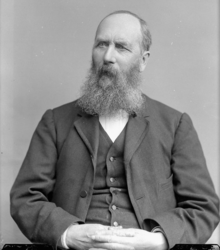
Fortunately the Dictionary of Biography Online comes through:  Douglas Brymner was appointed Archivist of Canada by order in council June 20 1872 -- having already started work.  That's him with the whiskers -- from the Wikipedia "stub" on him.

Update, June 22:  Stephen MacLean observes:

Would it be too pendantic to write that Douglas Brymner was the first Dominion Archivist of the Dominion Archives of Canada?
That a cursory scan of LAC fails to record its own history ought not to surprise you.
Let no own disparage Canadas progressiveness:  we have put Orwells newspeak into general practice; by rewriting Canadian history, the powers-that-be can make of it what serves their own self-interests.

Too pedantic is not a category at this blog.  But on closer scrutiny, it seems that the Public Archives was founded as the Public Archives in 1912, and before that there was only the Dominion Archivist, who seemingly kept the whole thing in his head (and in office space at the Department of Agriculture)

Friday, June 17, 2011

History of Bloomsday

Okay Bloomsday was yesterday, but I did not get a chance to note that the Irish novelist Frank Delaney has started providing a podcast that explicated James Joyce's Ulysses line by line.  In a year he has got to the end of Chapter One... and he's not a young man.

I think I'd rather go for a walk around town than listen, but it seems pretty heroic nonetheless

Link to the podcasts here.  Story about the project here.

Thursday, June 16, 2011

Ethics of Oral History

Cliopatra is always worth reading, but Chris Bray's series of posts on the ethics of oral history must be hitting home with any historian who has ever turned on a recorders.  (There's one for June 15: "Moral Decency requires that I betray you", but there are earlier ones farther down.)  

Boston College oral historians interviewed IRA members in great detail about their history of murder and violence on a promise of lifetime confidentiality.  Now the police want a subpoena.  Quite a few commentators say, sure, okay, no problem, hand it over.

Wednesday, June 15, 2011

Remembering a Memory: Rudin on Grosse-Ile

Recently Ronald Rudin, the Concordia University historian, produced a documentary short film on Grosse Ile, the quarantine island just downriver from Quebec City -- the place that in the 1840s became one of the principal burial sites for victims of the Irish Famine of that decade.

The film "explores the various stories inspired by the immense Celtic Cross constructed in 1909 on Grosse-ÃŽle , a tiny island near Quebec City, which is the site of the largest cemetery outside Ireland connected with the Potato Famine of the 1840s. This film reflects on how and why the memories evoked by Grosse-ÃŽle have so dramatically shifted over the past century."


And the film is now also a website, where you can view the film and support materials online ( and from which we took the image here)

Kimberley Arcand: History of Anne

(Kimberley Arcand joins the contributors here with this post.  Welcome!)

As June rolled in and the dusty doors of Parliament Hill were open, the normal political jumbo began to spring from the House of Commons. However, during that poignant week of Parliament, all I could remember was talk about the Royal visit and where William and Kate (now Duke and Duchess of Cambridge) will be going. One particular rumoured place was a visit to Green Gables: the inspiration of the fictional childhood home of Lucy Maud Montgomery’s famous character (Canadian) Anne.  Located in Cavendish (not Avonlea) PEI, this home was once owned by David and Margaret Macneil, a distant relative of Montgomery’s. This heritage site is now a representation of the fictional world of Montgomery’s novels representing both the life of the author as well as the character.

During my undergrad I had spent sometime reading about Montgomery (due to my love for Anne) to understand how she along with her characters, including her other heroine Emily of New Moon, played an important role to Canada culture and identity. One reason Montgomery along with Anne and Emily has become a part of Canadian culture is strictly due to the popularity of the novels across the world. As the media talks about the Royal Visit, they highlight that it is Kate’s desire to visit this popular heritage site and that it is because she enjoyed reading the novels when she was a child.

I feel that sometimes the popularity of Montgomery’s novels is still a large reason why she is a part of our identity, rather than an enteral connection to the texts themselves. However, I see a new form of engagement with Montgomery’s Avonlea. No longer just representing a beautiful fictional world, Montgomery’s novels now reflect a historical view and a past culture and Canadian identity. 

Green Gables, which is now a heritage site with Parks Canada, is not just a celebration of a famous novel or two famous Canadians (if you include Anne) but a celebration of Canadian culture at the turn of the century. So like Kate and William celebrate Parks Canada’s Centennial at Green Gables or by the book for your summer reading list! Not only will you get swept away to a different time and place in Canadian history, but understand a past Canadian culture and identity a little better.


Tuesday, June 14, 2011

Partnershp Changes at Moore, Stokes, Kerr & Arcand

(A little administrative note, a bit self-rererential:)
Last summer I put out some feelers for contributors to this blog.  I half-jokingly spoke of "interns" as if I knew something of history blogging that could be conveyed to others.  But the offer to let others dip a toe into the bloggy pond was genuine, and the contributions over the past year by Mary Stokes and Jordan Kerr have -- to my mind anyway -- greatly enriched this blog.  Even I never know what to expect when I go here.
     Last year I vaguely suggested a one-year commitments.  Now, with the year nearly up, I'm loathe to part with anyone, but some changes are in the works.
     Mary Stokes soon expanded from weekly contributions here to developing the Canadian Legal History blog. In a few months she has made it the go-to site for anyone doing legal history in Canada, and a terrific addition to the way-too-short list of Canadian history blogs.   But it does mean she's thinking of reducing her contributions here.  Mary is keeping her passwords and we may be seeing her eclectic contributions from time to time -- or we have have to go to CLH to keep up with her.
     Jordan Kerr will continue to post, with frequency somewhat dependent on his life and sked this fall.  But we have another Ottawa student connection. Kimberley Arcand is, in her own words,  "a recent graduate from Carleton University.... currently working on a cultural history of Remembrance Day in Canada," and interested in  "the cultural and political history of Canada and Canadian memory and identity."  We'll have her first post up tomorrow and others thereafter.
     And I'm still putting out feelers for a few more contributors.  If a little blogging about Canadian history appeals to you, get in touch.

Best Canadian Political Books of the last 25 years?

Samara, the charitable foundation devoted to citizen involvement and democracy in Canada, and The Writers' Trust are seeking The Twenty-Five Best Political Books of the Last Twenty Five Years.  They are taking nominations until June 23, will announce candidates over the Canada Day weekend, and wrap the whole thing up for the August long weekend.  A "political" book, they say, can include "personal or journalistic essay, memoir, commentary and criticism (both social and political), history, biography, and fiction."
In the midst of drafting this post, I looked at the page of nominations already received from prominent Canadians -- and was rendered weak with gratitude:  Brigitte Pellerin and Andrew Coyne have included my 1867: How the Fathers Made a Deal
Quite a few other historical titles there too:  books by Gwyn, Duffy, Ajzenstat, English, Boyko, Bliss, Granatstein. So the field is open for historians to plump for political history. 

Monday, June 13, 2011

The CHA in Fredericton

No one from our far-flung network of correspondents seems to have been among the nearly 400 historians who made it to the AGM of the Canadian Historical Association in New Brunswick a couple of weeks ago. But the CHA now has news of the meetings up at its own website. It also has a listing of the winners of the Garneau, the Macdonald and its other prizes for meritorious historical work.  Congratulations to John Weaver, Michel Ducharme, Nicholas Dew, David Preston,  and all the winners of regional and genre prizes who are listed there.

Friday, June 10, 2011

How the Fenians made Canada?

"How the dreams of Irish independance made Canada become the nation it is today"? Maybe by reinforcing loyalist Anti-American paranoia? (Not that that's a bad thing.) The history of the Fenian raids is sadly under researched. But no longer under re-enacted, apparently.


Fenian Raids at Old Fort Erie This Weekend

Fort Erie, ON – The Niagara Parks Commission (NPC) is pleased to announce the return of the Fenian Raids of Old Fort Erie on June 11 & 12. Daily battle re-enactments of the
 last invasion into Canada will take place, featuring the Fenian soldiers, whose dreams of Irish independence instead helped Canada become the nation it is today.

Weekend Schedule of Events
Saturday, June 11
1:00 p.m. Opening Ceremony
1:30 p.m. Afternoon Battle
8:30 p.m. Evening Battle, followed by Ghost Tours of Old Fort Erie

Sunday, June 12
1:30 p.m. Afternoon Battle

History
On June 1, 1866, Irish veterans of the U.S. Civil War, under the newly formed flag of the Irish Republican Army, crossed the border into Niagara. This armed
 incursion into “Canada West” (Ontario) was expected to force the British into freeing Ireland. After two days of fighting in the Fort Erie area with Canadian
 militia units, the Fenians, as they were known, retreated to the Old Fort, where they were captured attempting to return to the United States. This invasion into Canada spurred efforts for Confederation in order to protect Canadian sovereignty. On June 2, 1866, the invasion came to a head at The Battle of Ridgeway.

Entrance to Old Fort Erie includes day programs or evening lantern tours. Battles are FREE. Adults (13 and over) $9.00, Children (6 – 12 years old) $6.00
(prices in Canadian dollars), Children under 5 are free. Parking during construction is located in front of the Fort at 350 Lakeshore Road, Fort Erie, Ontario.
Old Fort Erie is approximately 30 kilometres (19 miles) or a scenic 20-minute drive south of Niagara Falls and is close to the Peace Bridge from Buffalo, New York.
The grounds and the main floor rooms of the buildings are wheelchair accessible. The grand opening of the new Welcome Centre will take place on July 1. For information,
 please call (905) 871-0540.

Old Fort Erie is owned by The Niagara Parks Commission, an agency of the Government of Ontario. It is NPC’s mission to protect the natural and cultural heritage along the
Niagara River for the enjoyment of visitors while remaining financially self-sufficient.

Thursday, June 09, 2011

My Summer Home - The Norwich and District Archives

I have become a prodigal son, of sorts. On hiatus from Toronto, I've returned to my hometown of Norwich, Ontario (population 2014 according to the sign!) in Oxford County and I've begun working at it's local archives. I've always found this place, any many other local archives, to be miserably underused treasures for Canadian historians. Not only do they often offer the personal touch that so many of our larger archives sorely lack but they are bursting with untouched or underexamined records of our rural and small town heritage. Many materials have been encoutered at surface level by local historians and volunteers but rarely are they mined for the connective and analytical depth that a fulltime academic historian can bring out. Some aspects have been academically studied, such as the areas involvement in the Rebellion of 1837, commonly referred to as the Duncombe revolt and to some extent its Quaker history.

Over this summer, broken up by other entries, I'll be highlighting some of various aspects of the area's rich Quaker history and also doing a series on a number of diaries housed at the archives. The Quaker history must be looked at for its contribution beyond the borders of Norwich township. Canadian women's history, the evolution of democracy and human rights, American immigration, and abolitionist history all have serious connections to Oxford county. Norwich, I've found, is a wonderful microcosm of Upper Canadian social, agricultural and political history and I would encourage any Canadian historians not to bypass it's small but valuable historical record. It is, in many ways, an untapped resource. I'll hopefully be able to incorporate scanned images or direct readers to some already digitized material online.

At the moment I've been tasked with cataloguing and referencing the newsletters of the local historical society back to 1971. I'm already fascinated with the social history so firmly embedded in these seemingly irrelevant documents.

Norwich and District Historical Society - here you'll also find some holdingd list, indexes and links to digitized material.

Wednesday, June 08, 2011

History of Parliament: Bill C-1

Apparently the first order of business in the Commons after the Speech from the Throne the other day was a little bit of parliamentary defiance.  The first bill introduced for first reading was Bill C-1, An Act Concerning Railways.

Actually, there is no initiative concerning railways on the horizon.  But there is a parliamentary tradition that after the executive presents its plans in a Speech from the Throne, the legislators immediately introduce a bill on something completely outside the executive's plan -- just to show that they can, just to demonstrate that the legislature is independent of the executive and in control of its own agenda.

Bill C-1, the Railway Bill (text of the 2009 version of the bill is here and full text of the House's work with the bill is here), got first reading on June 3.  It then vanished, never to be heard from again.  It's a pro forma bill.  It signifies the House's independence, without actually proposing anything.

Now if only there were a little more to Canadian legislators' assertion of independence from the executive than an occasional Railways Bill, we'd be getting somewhere.

If you don't believe me, Wikipedia has a pretty good summary here (for who could doubt Wikipedia?).  It is said to be a custom that predates confederation and draws on an English practice that started in 1571.  Thanks also the the legal website Slaw -- which draws attention to the practice while missing the point entirely.  Lawyers!

Tuesday, June 07, 2011

Museums make history: Singapore and the Belitung shipwreck

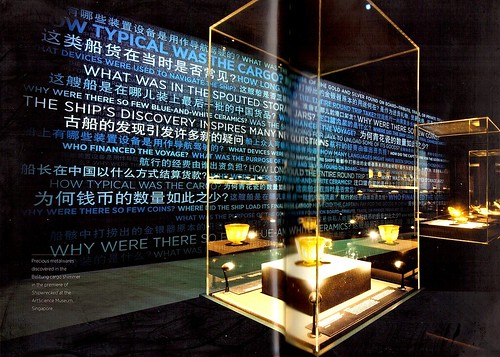
Rachel Leow, who runs a very thoughtful (and recently revived) history blog called A Historian's Craft, reviews the Singapore ArtScience Museum's exhibition of the Belitung shipwreck.  The Belitung wreck, found in 1998 off the Indonesian island of Bilitung, is an Arab dhow that was trading between the Abbasid empire of South Asia/Iraq and the Chinese empire. Wikipedia background here.  It is securely dated to about 830 CE.  830!  This must be the best 1170 year old shipwreck ever.

Wreck and cargo were found in an excellent state of preservation. The find has been kept intact and in the control of archaeologists and museologists rather than looter/collectors. The museum display sounds absolutely riveting.

Nevertheless Leow's review focusses on museological politics.  The exhibition, she argues, is skillfully used to reinforce Singapore's image as a cross-roads of trade and of culture.  Yet ... the wreck took place far from Singapore at a time when Singapore did not exist.

Robert Morgan 1938-2011 RIP

Robert Morgan, the historian of Cape Breton Island and instigator of many remarkable achievements in Cape Breton historical commemoration and heritage preservation -- and my old friend and colleague -- died at home in Sydney on June 4 and his funeral is today.  I wrote about some of his achievements here.  Obituary notice here.

Saturday, June 04, 2011

Museum politics: Terracotta Warriors and jailed artists

An opinion piece in the Guardian Online asks why the Montreal Museum of Fine Arts, currently showing "The First Emperor and the Terracotta Warriors" (I saw in in Toronto and was wowed), can remain silent on the Chinese regime's illegal imprisonment of artist Ai Weiwei.

Thursday, June 02, 2011

NiCHE goes visual

From Sean Kheraj, the following announcement:

This week the Network in Canadian History and Environment launches a new video project called, EHTV: Live from the Field. This mini-documentary series looks at different aspects of environmental history research in Canada from conferences to archives to field work. Each month we will feature one short documentary video from one of our many NiCHE members, showcasing research in environmental history from across Canada.

Episode One looks at the recent EH Plus workshop held last month in Burlington, Ontario.

Viewers can catch all of the episodes here at:
http://niche-canada.org/ehtv

They can subscribe to the video series in iTunes:http://itunes.apple.com/ca/podcast/ehtv-live-from-the-field/id439587705

Last minute reprieve for Reviews in History

By me, for me, that is--Reviews in History still quite popular in general and there are no plans to discontinue it that I know of.  But I was starting to despair of finding reviews of books I was interested in enough to read, let alone blog about. There never seem to be any reviews of works of Canadian history, and rarely any legal history. I was about to cancel my email alert when I saw this one, a review by James Jaffe of Christopher Frank's Master and Servant Law: Chartists, Trade Unions, Radical Lawyers and the Magistracy in England, 1840-1865, published in 2010 by Farnham Ashgate.

Not Canadian, but concerned with 'low law' themes and institutions relevant to my work and that of many of the Canadian legal historians I admire (too many to list here, but each member of my supervisory committee--Eric Tucker, Paul Craven and Doug Hay--falls into this Venn intersection.)

The review is too long to reproduce here, but Jaffe's conclusion is of the one thumb up variety:

In conclusion, Frank offers an often useful and sometimes very valuable discussion of Roberts, his trade union litigation, and the summary jurisdiction of magistrates in master and servant case in several northern counties during the 1840s. The detailed recovery of these master and servant cases in the local press is to be much commended. However, broader questions concerning the impact of the law upon industrial relations more generally, the role of ideology, and the manifold differences in the regional and local application of the law still remain for others to answer.
When you are thinking of reading a book, that's what you need to know, I think. What isn't there is as important as what is.

This month in Canada's History

My subscription copy of Canada's History June-July 2011 has beaten the strike to my mailbox, so it's out there and on the magazine stands too, if you can find one.  Over several issues the mag is following the centenary of Parks Canada, and this month there's a look at its founding head, Bernard Harkin, by his biographer, Ted Hart of Banff.  Also the history of Trivial Pursuit, fires in St. John's, and a Terry Fox cover story, and as they say, much more.   Details here, all to suggest why Canada's History is up for a Magazine of the Year award at the National Magazine Awards next week   And ... I don't usually say this, but that columnist Christopher Moore they have  (Actually, he's up for a magazine award too), he's damn good this month too.
With his Gollum-like cunning, Mackenzie King at once grasped the magical power he had been granted. Clutching his precious leadership, he had suddenly become immune to his MPs. He told the people’s elected representatives he was no longer accountable to them; they had to do what he told them. Mr. Harper’s often-deplored practice of treating backbenchers and cabinet ministers as gofers and water boys is just the blossoming of the seed Mackenzie King planted. Under Canada’s new idea of party leadership, MPs became nobodies long before Pierre Trudeau was mean enough to say so.
It's about how coalitions became so unpopular in Canadian politics.  .

Wednesday, June 01, 2011

History of Civilization

Much-cited story of the month seems to be Charles Mann's National Geographic article on Gobekli Tepe, an extraordinarily large and complicated ruin in Turkey that is nearly 12,000 years old -- vastly older than Stonehenge and, he thinks, soon to become more famous.

The argument Mann takes from the excavator of Gobekli Tepe is that it proves that religion precedes agriculture.  The old theory, he reports, was that agriculture and complex  societies came first, then complex religions, probably crop- and fertility-based cults, as befitted an agricultural society.  No farming, no complex religion.  But Gobekli Tepe is older than early agriculture, and it looks like the mother of all temples. So Gobekli Tepe suggests that religion and even the building of massive places of worship precede agriculture.

Gobekli Tepe is amazing.  But I'm not sure the lesson is so new. At Catal Heyuk, also in Turkey, excavators long since found a relatively large city that existed, probably as a centre of trade, before agriculture had developed anywhere nearby.  Jane Jacobs, in her Economy of Cities, used this to argue that cities came first and that the techniques of tending seeds and keeping livestock probably began in cities and were later outsourced to the countryside (rural life being too dumb for such great invention, is her subtext).  And Stephen Mithen, in Before the Ice, a fine survey of prehistory, summarizes the argument that in particularly bountiful environments, previously migratory hunters and gathers had settled into semi-permanent communities well before developing agriculture.

So there are prior suggestions for permanent settlement and relatively complex societies coming into being before agriculture.  And if that is so, it's not surprising they would have complicated religions and even complicated temples like Gobekli Tepe --before they took to developing substantial agriculture.  This new site deserves its superlatives, that is, but archaeological thinking on prehistory need not be overturned completely by it.

See, you write the history of the world, even for kids, and you get intrigued by questions like these....

(Gobekli Tepe image from National Geographic)
 
Follow @CmedMoore