Tuesday, August 30, 2011

Prize Watch: Kate Beaton

Quill & Quire reports that Kate Beaton, the funny and often historically-inspired internet cartoonist, has won the Harvey Prize for comics and sequential art.

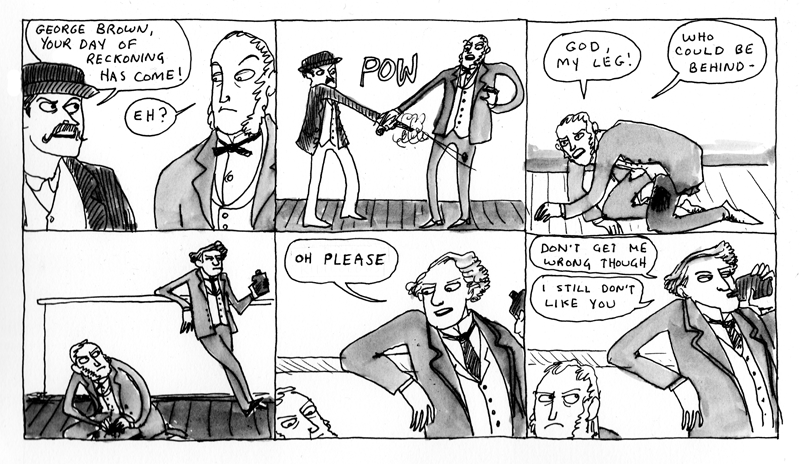
Random historical Kate Beaton here.  Or here (who else does George Brown comics?).

Monday, August 29, 2011

Active History - Death, politics and the memory of Jack Layton

Another article from activehistory.ca:

http://activehistory.ca/2011/08/death-politics-and-the-memory-of-jack-layton/


Thomas D'Arcy McGee funeral procession through Montreal

Prior to reading the article I had already been toying with ideas of the history of Canadian public mourning. My mind turned to the funeral of Thomas D'Arcy McGee and the tremendous outpouring of Victorian grief that followed his assassination. It then turned to the funeral of John A. MacDonald, the funeral train of Diefenbaker as it travelled across the country and most recently the state funerals for Pierre Trudeau and, of course, Jack Layton. I'm too young to remember too many other public mourning events but I would encourage an historian to write on this subject (if one has not already done so) and to give us a perspective against the American example of public mourning so often entered into due to the many political assassinations suffered by a number of political and social leaders in that country. As we all know, nationalism is quite often acutely defined by the 'other' in the Canadian case that other is so often our neighbour to the South. Surely, Canadian nationalism has been shaped, perhaps more subtely, by the deaths of our public figures. Stephen Lewis eulogized Layton in saying, "Never in our collective lifetime have we seen such an outpouring, so much emotional intensity, from every corner of this country. There have been occasions, historically, when we've seen respect and admiration but never so much love, never such a shocked sense of personal loss."

Diefenbaker funeral train


It would be most interesting to compare the public mourning for Layton against the past deaths of our public figures in the light of their own historical and political contexts.


CBC Archives Clips:

Farwell Dief - the death of John Diefenbaker - http://archives.cbc.ca/politics/prime_ministers/clips/13501/

Justin Trudeau eulogy at Pierre Trudeau funeral - http://archives.cbc.ca/society/family/clips/1620/

Tommy Douglas - http://archives.cbc.ca/politics/parties_leaders/clips/3045/ (Stephen Lewis again!)

Lester B. Pearson funeral "We are all Pearson's children" - http://archives.cbc.ca/politics/prime_ministers/topics/1265/

Sunday, August 28, 2011

New Shannon Lecture Series at Carleton University for Fall 2011


Once again a new school year begins and so does the annual Shannon Lecture Series at Carleton University. This year's theme explores the history of emotions, examining the historical and cultural experiences of emotions and society. A growing field, this historical study of the human emotion is a partnership between history and cognitive science.  Keith Oatley's lecture on the emotions of literary history and the history of emotions will begin the series September 23, 2011. Please check out the link for further dates for this event. 


Wednesday, August 24, 2011

Tuesday, August 23, 2011

Jack Layton

from Jack Layton's farewell letter
History in the making. It's a sad day for Canada. As a young NDP'er I'm horribly saddened for the Party and incredibly moved by Layton's farewell letter. You can find it just about anywhere online at the moment. In commemoration here are some clips of Jack.


In seeing the incredible determination to relentlessly and stubbornly fight for what he believed in over his political career I'm reminded of words by JS Woodsworth, another figurehead leader cut short from the public scene, "Every [NDP] member ought to be able to give a reason for the faith that is in him." Thanks for living that faith Jack and constantly bringing to light the reasons why the optimistic faith and hope for a better Canada must always be maintained.

http://archives.cbc.ca/politics/parties_leaders/clips/17578/

Monday, August 22, 2011

Literary Democracy CBC Readers Choice for the Giller

More Literary Democracy    More Voting fun

The ScotiaBank Giller Prize is adding a Readers Choice Contest through CBC - you can win pretty cool prizes just for entering! You choose a book to vote for and write a sentence or 2 about why you are voting for it. Mine is one of the choices.

The link is below to get to the CBC page with the info and link to voting. The deadline is Aug 28 - you have more chances of winning prizes the sooner you enter though. Perhaps you will consider voting for To the Edge of the Sea http://www.totheedgeofthesea.blogspot.com/  by me, Anne McDonald. There are a whole raft of wonderful books - and great prizes.

 http://www.cbc.ca/books/scotiabankgillerprize/contests/index.html

Much thanks and happy voting,
Anne

Friday, August 19, 2011

Blogger goes all you-ey tubey

I' m taking some R&R for the next ten days or so.  Blogging will be slim to none from me until August 30 or so.  Meanwhile Jordan, Kim, and Anne may fill in the gap as moves them.

But my video presence is newly available!  Historica-Dominion Institute is creating some teachable moments around John A. Macdonald's birthday, January 11. The package of materials includes some video chat about the first prime minister from, well, me.  Click on Video Lectures here at Sir John A Day  or try the "Français" tab at top right for my young handsome francophone alter ego.

Political or astute Daredevils

William Hunt, better known as Farini, the famous tightrope walker from Port Hope Ontario who offered during the Confederation Conference in Quebec in 1864 to wheel Governor General Monck across Momorency Falls, blindfolded, as long as George Brown checked the rope and George Etienne Cartier tied the blindfold, was stuck this month, August 1864, on Goat Island above Niagara Falls. He’d been rehearsing for a walk with stilts in the rapids above the American Falls. http://www.nytimes.com/1864/08/11/news/european-arrival-mail-hibernian-mexico-polish-insurrection-parliament-exciting.html?pagewanted=1

Of course this month, August 2011, there have been more daredevil walks – on tightropes, not through rapids, proposed above the falls. Supported by the US, denied by Canada.

(Oh by the way, Nik Wallenda, Farini wasn't allowed to either.)

Tuesday, August 16, 2011

History of War... and paying for it

American historian James Wright argues in Foreign Affairs that before the 21st century, every war in American history was matched by new taxation to pay the cost of war.  Suddenly that changed.
Since 9/11, no national leaders have proposed that the country actually pay for the current wars. In fact, the theme from the outset has been to reduce taxes -- a response without a wartime precedent in American history. And for the last two years or so, the mantra in Congress has been to not impose any additional or restored taxes on anyone. Only recently has the financial cost of the wars even been part of a public discussion.
The Canadian analogy seems striking. We are often reminded, for instance, that Canadian income tax was introduced in 1917, to pay the costs of World War I.  Since 2006, however we have had a Canadian government committed to military build-up and overseas military expeditions -- and committed to tax cuts and deficit financing at the same time.  The same government is now telling us that the troops are really the Queen's soldiers, not ours. But the Queen is not going to pay for them.

Update:  Ray Argyle observes:
Apropos of your post today, I think Lyndon Johnson waged the Vietnam War on the basis there would be no tax increase to pay for it. The result was the worst period of inflation and high interest rates in American history. We all paid for that war but in devalued bucks! Nixon also used inflatiuon to offset the OPEC oil price hikes of the 70s - it wasn't long before the price of oil was back to its pre-hike level, in current dollars.
Wright argues the US did increase taxes to pay for Vietnam: "In 1968, a bipartisan congressional vote also supported a surtax when President Lyndon Johnson belatedly asked for taxes to pay for the war in Vietnam." Too little too late, maybe, but an increase, not a tax cut. 

Monday, August 15, 2011

Canadian Sport and Leisure: Tourism

For this week I turn to a NFB film I found called "Capital City" by Fergus McDonell from 1957. This film is a comprehensive tour of the city of Ottawa, exploring key national and regional sites and experiences during this time.

Tour Guide from the McDonell 1957 film "Capital City".
The most interesting aspect of this short film is the promotion of Canadian nationalism and identity through the other. For example, American and British tourist in the capital laying out and defining the unique differences between Canadian culture verses American and British Culture. Much like music, art and other forms of recreation during this time, travel and tourism became a tool to promote a distinct Canadian culture. As Ryan Edwardson discusses in his book "Canadian Content: Culture and the Quest for Nationhood", during the early part of the 20th century Canada really began to try to define themselves away from what Edwardson calls 'American Imperialism'. American culture was in many ways flooding into Canadian homes through radio and later television. Canada in turn created strong rules and regulations to promote Canadian culture through various forms of popular culture.

 Tourism can be considered a form of popular culture and in this case this Canadian leisure activity is not just a representation of Canadian culture but promoting it as well. So take the time to watch this historical view of our Nation's Capital, "Capital City" and other great pieces on the NFB website.

‘On peut violer l’histoire à condition de lui faire de beaux enfants.’

Perry Anderson does some heavy thinking on the historical novel in the London Review of Books.  And the Globe and Mail profiles Wayne Johnston, who has a new one coming out.  “I believe that right from the beginning history and fiction were identical twins that somehow got separated after birth,” he says.  (The headline quote is Balzac's take on the whole thing.)

Wednesday, August 10, 2011

What have the historians got for us this fall? -- Cont'd

McGill-Queen's has a substantial list in Canadian history announced for this fall, including


  • The Codex Canadiensis and the Writings of Louis Nicolas, edited by Francois-Marc Gagnon et al.  Nicolas was a kind of 17th century Audubon in New France, but until now his work has mostly been known from illustrations torn from their context.  
  • Geographer-historian Arthur Ray has a kind of memoir Telling it to the Judge: Taking Native History to Court, about the travails of historical expert witnesses.
  • Newfoundland Modern: Architecture in the Smallwood Years by Robert Mellin -- it's not all tilt houses by the shore, m'bye.
  • In Search of R.B. Bennett by P.B Waite, a new study of the '30s prime minister by the elder statesman of Canadian political historians.
  • British Generals in the War of 1812 by Wesley B. Turner
  • Warren Elofson's Frontier Ranching in the Land and Times of Charlie Russell covers the ranching frontier on both sides of the border.
  • On to Civvy Street, by Peter Neary, on veterans and veterans' affairs post WWII.
  • Georges and Pauline Vanier, a dual biography by Mary Frances Coady
  • and David A Wilson's Thomas D'Arcy McGee, Volume Two, previously mentioned here.
 and other titles of potential interest, reprints, new editions, etc.  MGQUP Fall 2011 catalogue is available here

Tuesday, August 09, 2011

What have the historians got for us this fall?

[First in a series looking at some of the publishers and their lists of forthcoming history titles]

University of Toronto Press has a long and diverse list that seems to undermine the theory that Canadianists do not write about pre-twentieth century topics.  Titles forthcoming, and in some cases already published, include:
  • Jan Noel, The First French Canadian Women, examining the first couple of generations of daughters of the founding population of New France.
  • Debating Dissent: Canada and the Sixties, an essay collection on a booming subject, from Lara Campbell, Dominique Clement, and Greg Kealey (some of whom were dissenting in the sixties and some who were unborn, I'm guessing)
  • Elections in Oxford County 1838-75 by George Emery, a micro-analysis of politics in one Ontario county in the era of "open" (ie, no secret ballot) voting and democratic reform.
  • Carmela Patrias, Jobs and Justice: Fighting Discrimination in Wartime Canada, 1939-45
  • The Colonization of Mi'kmaw Memory and History 1794-1928 by William C. Wicken
  • Jerry Bannister's The Loyal Atlantic: Remaking the British Atlantic in the Revolutionary Era
  • A study of public history edited by Nicole Neatby and Peter Hodgins: Settling and Unsettling Memories: Essays in Canadian Public History.
  • Eli MacLaren's Dominion and Agency  -- a history of Canadian copyright and the role of the national government

-- plus many more studies relating to Canadian history, some Osgoode Society titles I'll pick up another time, biographies, autobiographies.  UTP's CanHist list is here.

Update, August 11:  Andrew Smith, whose recent observations about the shortage on pre-20th century Canadian history were indeed in my mind when I wrote this post, continues the discussion here.

Friday, August 05, 2011

Barbara Sears at the Geminis

Barbara Sears is best known among historians as Pierre Berton's most-trusted researcher.  No, she did not ghostwrite his books, but Berton warmly acknowledged her contributions in several of his books.  Barbara went on to become perhaps the country's leading researcher for visual materials, and much else as well, for historical programming by the National Film Board, CBC Television, and private filmmakers and broadcasters.  She was also a founder of The Visual Researchers" Society of Canada. I knew her only slightly, but I was a fan of her vast knowledge, common sense, and integrity. She died a couple of years ago.

Picture research and research for film generally are not areas of research much recognized by historians, perhaps, but the Geminis, the Canadian television awards, have just renamed their Editorial Research award The Barbara Sears Award.  This year's nominees are:

  • Jane Burgess, Jonathan Woodward for The Pig Farm CTV (Bell Media)
  • Jackie Carlos, Karine Guillemette, David Wells for  Meltdown: The Secret History of the Global Collapse - The Men Who Crashed The World  CBC (CBC)
  • Richard Longley Save My Lake CBC (CBC)
  • Gil Shochat  the fifth estate - Death at the Olympics CBC (CBC)
  • Rebecca Snow Museum Secrets - Inside the Vatican History Television (Shaw)

Website Update - The Canadian Committee on the History of Sexuality (CCHS)

I've come across this site before. It's a wonderful resource for Canadian LGBT history and sexuality history in general. I've linked it via a blog post from the Canadian Lesbian and Gay Archives.


A wonderful bibliography from the CCHS:
 http://www.chashcacommittees-comitesa.ca/cchs/resources/bib.htm

Thursday, August 04, 2011

Canadian Sport and Leisure: Summer Edition: "You are what you Drive"

For my short mini-series I looked back to my Canadian Culture course from last summer, which was instrumental in my interest in Canadian sports and leisure. When I was exploring some of my old resources I came across this amazing website that examines the North American car culture. "You are What You Drive" created by the Canadian Science and Technology Museum and a group of Carleton University grad students explores John DeBondt's collection of car advertisements. Exploring this collection of advertisements from four different angles: Luxury, Nature, Technology and life Journeys, this group was a able to present a cultural history that highlights key aspects of the mid 20th century of sports and leisure.

In terms of Canadian sports and leisure the website explores how the ability to drive and explore our own backyard was not only a benefit of having a car but was also a selling point. As stated on the website,
"Car print advertisements throughout the 20th century used elements of nature and the natural world not only as backdrops for their ads, but as a way through which a lifestyle could be marketed to consumers. The following ads characterize nature as a powerful element that can be harnessed and overcome, and at times it is represented as an escape or as a leisurely destination."

One of the advertisements found on "You are what you Drive"
A part of the DeBondt Collection.
Much like the video from last week, these car advertisements were portraying a certain type of outdoor experience, selling nature as well as the automobile. This advertisement from the website is analyzed as "reminiscent of disney" portraying travel as comfortable and luxurious and nature as tamed and controlled. These views on nature were a product of 20th century travel and tourism. As roads, provincial parks and hotels were build within the Canadian landscape,  the image of Canadian wilderness changed as well. Being the in the 'woods' was no longer feared, but rather with our everyday necessities became a place to relax and escape. Cars created a convenient and safe passage way through the Canadian Great Outdoors and became an essential tool as a part of the Canadian summer leisure experience.

So if you are interested in learning more about car culture or travel, check out the website, You Are What You Drive! and all the great advertisements and information on this interesting history.

Toronto public library debate - Actrivehistory - Carnegie to Atwood?

Another article from activehitory.ca ( I think I may have an addiction). With my love of libraries, Andrew Carnegie (his grants built the first free-use library in my hometown and his portrait still hangs in the building) and my softening to Margaret Atwood (sorry, Alias Grace is still boring) I couldn't resist posting this article.

Perhaps Margaret should spearhead a funding campaign to keep open the Toronto branches slated to be closed, at least until the next city council election....

From Andrew Carnegie to Margaret Atwood: Toronto’s “Unelected” Champions of Public Libraries.

Wednesday, August 03, 2011

History has a band?

The first volume of David Wilson's life of Thomas D'Arcy McGee was one of the best historical biographies of recent years. This fall the second volume will actually get McGee to Canada and all the good stuff, including that unpleasantness on Sparks Street.

But when Prof. Wilson promotes a book, he doesn't just drone on in bookstores and such.  This fall the McGee Band is hitting the road.  Check the website here -- but be warned: electro-Celtic fiddling may burst out when you least expect it.  That's Wilson on the left, with four tall Irishmen.

Thanks to the McGill-Queen's University Press blog for this and other newsy bits.  (Cannot help noticing the University of Toronto Press blog was last updated ... in March 2010.)

This month in Canada's History

This month in Canada's History, features on demon rum, underwater archaeology, women in the RCMP, the Nihilist Spasm Band, and the invention of crokinole. Try to find that lineup anywhere else.

Tina Loo's column gets kinda political, reflecting on forty years of multiculturalism as official policy.  And mine gets kinda apolitical on a related subject, reflecting on the long and now extinct tradition of immigration by ship.

Oh, and Jack Granatstein and Michael Bliss tear a strip of me in the letters column for observation I made in a previous column about their History Wars project at the Royal Ontario Museum.

If you subscribed, you would have it all already.

Sorry, no winners here

Thanks to all who voted, supported, and sent good wishes regarding the Best Canadian Political Books of the Last 25 Years contest.  But 1867 ain't the winner.

On the weekend, I hazarded the guess that, this being internet voting, the likeliest winners were Shakedown by Ezra Levant and On the Take by Stevie Cameron.  I have not read either, but they seemed like the most anti-government, anti-politics books on the list. I figured that might well fit the mood of the voters.

Sure enough, Levant's Shakedown (a critique of Human Rights Commission as overzealous, meddling and hostile to free speech) is the winner.  Cameron's On the Take (a critique of Brian Mulroney and all who surrounded him) is one of the runners-up.  Congratulations to Ezra Levant, Stevie C., and the other runners-up Lawrence Martin and John Duffy. Full details here.

In other book prize news, the Giller Prize has announced that one of its short- long-list titles will be determined by internet voting.  Good luck to Ezra Levant with that one too.  It's been fun, but on the whole being on the receiving end of an internet ballot sustains my faith in representative, rather than direct, democracy.

Monday, August 01, 2011

Vote Now Canada's Best Political Book of the past 25 Years

Today at midnight is the last day to vote for the best Canadian Political book of the past 25 years. Chris Moore’s 1867 How the Fathers Made a Deal is on the short list and you can vote by clicking on the link to the right.
            The thing to me that is so important with such a book is not only is it essential information for any thinking Canadian to be aware of, it is of crucial importance to all those of us writing of the past – fiction and poetry included. I think we forget that writers of the more nonfiction kind are indebted to and use primary and secondary sources to inspire and inform our work – and this one was crucial to the inspiring and informing of my novel about the beginning of Canada (http://www.totheedgeofthesea.blogspot.com/ ). Not only that, 1867 is elegantly and entertainingly written.
            To all those writing of the past, don’t forget to vote too.
 
Follow @CmedMoore