Explanation and Part 1 here.
4. The forties
In 1940, about to turn 30, my father was conscripted into the British forces and, like millions of his contemporaries, thrown head first into the Second World War.
He’d done some preparing. Seeing what was coming, he had enrolled in the Territorials, the British militia reserve. That, along with his 1930s transition from near-working-class apprentice to owner and proprietor, presumably helped get him into Officer Candidate School, to emerge and be posted as a new lieutenant to an old and aristocratic cavalry unit, mostly devoted in peacetime to riding to hounds and country house socials, now reorganized as an armoured regiment. Apparently a good many non-gentry officers like my father were added to the regiment for wartime service.
From the North African landings of November 1942 until the end of hostilities in Europe, the regiment and my father were pretty much continuously engaged in combat, in Tunisia and then in Italy, in armoured cars in the desert, in Sherman tanks up the Italian peninsula. Wounded in the Po Valley, he saw war’s end as a major on Sixth Armoured Division staff. He had a good war, people said in those days, meaning he saw action and came out with an impressive rank and a notable decoration. He had a good war, we’d say, in that he was not among the killed and was not left crippled or brutalized by his experiences – despite, as his citation says, “an almost reckless disregard for his own safety.” In 1943, that was high praise.
Like so many other young men in wartime, he also found a spouse whom he would never otherwise have encountered. Before going into combat, his regiment trained in Scotland, where he met my mother. My mother’s family was Presbyterian, Scots, and middle-class, a business and farming family; they farmed some of the land on which my father’s regiment trained. My father was a commissioned officer then, but he was still English-Irish, a Roman Catholic, a policeman’s son, in his early thirties, and about to be sent to war -- and she was barely twenty. What my grandparents may have thought of Lt. Moore and their daughter, I am unsure, but my mother had an adventurous streak. His first home leave was in the summer of 1945, and they were married on August 15 – the day Japan surrendered. He soon went back to his newspaper career. Like millions of others, they began contributing to the postwar baby boom.
I was much aware of “the war” as a child, but the thing my father seemed to bring away with him, more than the horrors he experienced, was a sense of the army as an organization – big, slow-moving, insensitive, and perfectly prepared to have you killed if it needed to but, if you could master it, ultimately just a big machine, and in its way a model for many other kinds of organization. Family trips, business plans, anything that needed organization – those were the occasions that brought out military memories and my father’s store of military slang. The army left him, you might say, curiously prepared for the ‘fifties.
Tuesday, November 30, 2010
Monday, November 29, 2010
Monday miscellany
1. Sheila Fitzpatrick remembers being a foreign bourgeois historian doing archival research in the Soviet Union:
2. Great show the other day by Rudyard Griffiths, late of the Dominion Institute, now debate impresario, who organized the Blair-Hitchens debate on religion in Toronto. YouTube has the opening stages here, including Hitchens's now famous crack about God as sort of a divine North Korea. The world was watching, Rudyard.
3.Kudos to Globe reporter Eric Reguly, who confesses how crazy he was in an opinion piece slamming Canadian banks for not being reckless enough -- shortly before the meltdown. Traditionally it used to be sports reporters who were presumed to be uncritical cheerleaders. Today most of them are pretty tough critics both of the games and the business enterprises of sport. Today it's business journalists who seem to form a claque, endlessly celebrating business's latest fashions against all critics and alternatives.
I became addicted to the thrill of the chase, the excitement of the game of matching your wits and will against that of Soviet officialdom. How boring it must be, I thought, to work on British history, where you just went to the PRO, and polite, helpful people gave you catalogues and then brought you the documents you wanted. What would be the fun of it?I once did a little research in the Archives Nationales in Paris, and it had a little of that frisson: blue-coated archival staff -- smoking constantly around heaps of ancient paper -- sullenly conspiring not to get whatever you wanted. "The revenge of the proletariat," it was called by French researchers who took it for granted.
2. Great show the other day by Rudyard Griffiths, late of the Dominion Institute, now debate impresario, who organized the Blair-Hitchens debate on religion in Toronto. YouTube has the opening stages here, including Hitchens's now famous crack about God as sort of a divine North Korea. The world was watching, Rudyard.
3.Kudos to Globe reporter Eric Reguly, who confesses how crazy he was in an opinion piece slamming Canadian banks for not being reckless enough -- shortly before the meltdown. Traditionally it used to be sports reporters who were presumed to be uncritical cheerleaders. Today most of them are pretty tough critics both of the games and the business enterprises of sport. Today it's business journalists who seem to form a claque, endlessly celebrating business's latest fashions against all critics and alternatives.


Grant Burke's Ottawa Queer History Blog
Hi Everyone,
So, I promised that I was done posting about queer Ottawa history but I can't pass up the opportunity to pass this along. I just stumbled across Grant Burke's blog on Ottawa Queer history. I didn't know he had one or it would have been on here ages ago! Grant is a masters student at Carleton University and actually helped me in the initial stages of my work on Queer Ottawa. I've only glanced at his blog but it looks as if he's got some fascinating stuff on it...including some of the pictures that I'm always complaining about losing! I won't summarize his work because I simply don't know enough about it and wouldn't want to misrepresent what he's doing, but do give his blog a visit learn about his ongoing research. Best of luck to him on his research.
I've heard he was recently interviewed by CBC Radio, but I wasn't able to find the link. However, he was interviewed by Xtra! newspaper on his work
I want to draw attention to two pictures that he's posted...
For reference, here are my previous posts on queer Ottawa history 1, 2, 3, 4.
Jordan Kerr
http://randomunistudent.blogspot.com/
So, I promised that I was done posting about queer Ottawa history but I can't pass up the opportunity to pass this along. I just stumbled across Grant Burke's blog on Ottawa Queer history. I didn't know he had one or it would have been on here ages ago! Grant is a masters student at Carleton University and actually helped me in the initial stages of my work on Queer Ottawa. I've only glanced at his blog but it looks as if he's got some fascinating stuff on it...including some of the pictures that I'm always complaining about losing! I won't summarize his work because I simply don't know enough about it and wouldn't want to misrepresent what he's doing, but do give his blog a visit learn about his ongoing research. Best of luck to him on his research.
I've heard he was recently interviewed by CBC Radio, but I wasn't able to find the link. However, he was interviewed by Xtra! newspaper on his work
I want to draw attention to two pictures that he's posted...
 |
| This is the same scene as a picture I posted from the Ottawa Citizen in an earlier post. A much better picture than mine! |
 |
| I've posted before about what I call the 'historical gaze', that being the attempt to picture and formulate past scenes and actions in a particular historical place when one is in that space. For me, this picture is the epitome of my queer Ottawa 'historical gaze'. It's taken across the street from the Lord Elgin Hotel (Elgin St. between Laurier and Slater streets) and appears in a GO Info issue from the 1970's. The two men are standing near the place where the memorial to Aboriginal veterans now stands. I cannot walk by that spot without picturing this scene and attaching to it my own historical imagination. Every time I walk by that spot my 'historical gaze' recreates the scene and all that it represents for the Gay Liberation era. |
For reference, here are my previous posts on queer Ottawa history 1, 2, 3, 4.
Jordan Kerr
http://randomunistudent.blogspot.com/
Friday, November 26, 2010
Good movie, bad history

Like pretty much every other movie ever, but it's good to see Roberts encouraging you to enjoy it nevertheless. It's a movie; if you wanted history you would do history instead.
Wednesday, November 24, 2010
Vincent Moore's History of the Twentieth Century, Ctd.
Part 3: the 1930s (Explanation and Part one here.)
I've been considering how my father's life, from a century later, seems to illustrate, even conform to, the historical trends of his times. His life in the 1930s, however, suggests not everybody is history's plaything, not all the time anyway.
The depression of the 1930s hit England, and particularly the north of England where he lived and worked, very hard. All its export-oriented industries, its mines, and its port cities were hit hard. Unemployment was very high, personal hardships widespread, and malnutrition not unknown. There was political upheaval, labour troubles, cultural strife. Looking back to the approach of the 1930s, my father, turning twenty in 1930, a junior employee of a Manchester newspaper business, without much in the way of personal resources or family backing, looks doomed.
Instead, my father and an older partner, sometime in the 1930s, became proprietors and operators of a chain of weekly newspapers in the industrial Potteries of northern England. This venture into ownership and entrepreneurship in the depths of the depression, without any apparent capital or resources behind him, rather amazes me. Did he actually quit a solid, respectable salaried newspaper job? Was he laid off from a job on a Manchester newspaper and obliged to scramble? Did he join a small paper and move into ownership gradually?
All I can say is I never thought to ask. But my father never struck me as the depression-survivor personality, really never seemed to conform to those cautious, frugal, defensive personality traits said to have become imbedded in many who spent their formative years in the depression.
Now in the '40s, history definitely gets hold of him again.
I've been considering how my father's life, from a century later, seems to illustrate, even conform to, the historical trends of his times. His life in the 1930s, however, suggests not everybody is history's plaything, not all the time anyway.
The depression of the 1930s hit England, and particularly the north of England where he lived and worked, very hard. All its export-oriented industries, its mines, and its port cities were hit hard. Unemployment was very high, personal hardships widespread, and malnutrition not unknown. There was political upheaval, labour troubles, cultural strife. Looking back to the approach of the 1930s, my father, turning twenty in 1930, a junior employee of a Manchester newspaper business, without much in the way of personal resources or family backing, looks doomed.
Instead, my father and an older partner, sometime in the 1930s, became proprietors and operators of a chain of weekly newspapers in the industrial Potteries of northern England. This venture into ownership and entrepreneurship in the depths of the depression, without any apparent capital or resources behind him, rather amazes me. Did he actually quit a solid, respectable salaried newspaper job? Was he laid off from a job on a Manchester newspaper and obliged to scramble? Did he join a small paper and move into ownership gradually?
All I can say is I never thought to ask. But my father never struck me as the depression-survivor personality, really never seemed to conform to those cautious, frugal, defensive personality traits said to have become imbedded in many who spent their formative years in the depression.
Now in the '40s, history definitely gets hold of him again.
The Heave: One Irish institution that is still working

No, it's the other way round. The government-side TDs, meeting in formal caucus, are deciding whether or not their leader should stay on as leader. For the moment, they've decided to keep him.
Taoiseach Brian Cowen threw down the gauntlet to his party critics last night, declaring that he had no intention of stepping down and pointing out that mechanisms were available to those who wished to launch a challenge against him.The meeting decided not to remove Cowan, for the moment at least. Meanwhile Cabinet Minister Mary Hanifin speculates openly about when she will ask caucus to replace Mr Cowan -- with her. Since caucus supports this kind of debate, she remains in caucus and cabinet:
A crowded meeting of the Fianna Fáil parliamentary party on the fifth floor of Leinster House heard approximately two dozen speeches, about half of them in favour of Mr Cowen, a half-dozen against him and another half dozen taking what one TD called a “neutral” tone.
Ms Hanafin threw her hat into the ring to become Fianna Fail leader, but insisted that she would not move against embattled Taoiseach Brian Cowen."The heave" (pronounced more or less "da hoive" - at least in rural Ireland) is the lovely Irish expression for that fundamental process of parliamentary democracy: a caucus removing a failed leader, in preparation for selecting a successor.
....
Ms Hanafin, who Mr Cowen has twice demoted, yesterday said she would not lead any heave against the Taoiseach. But she said if a vacancy arose she would run for the job.
(Photo source: Irish Times.)
What is it with Ottawa and military history?
 (Mandatory blog illustration: Student Richard Compton at the Soldiers' Tower, U of T, Remembrance Day, 2010. Photo by John R. Kennedy for Metro News)
Once again, an lecture on military history open to the public taking place in Ottawa. This one has nothing to do with the War Museum, but is a presentation of the Ottawa Historical Association,taking place at Carleton, given by a U of Zero* doctoral student (* A little friendly rival law school trashing there--no offense to the fine U of O history department.)
Here's the text of the announcement:
Here's the text of the announcement:
Please join the Ottawa Historical Association for its second public lecture of its 2010-2011 season. Anne Miller of the University of Ottawa will speak on "World War Memorials and Commemoration at Canadian Universities" on Thursday, November 25, at 8pm at the Faculty of Arts and Social Science Lounge, Dunton Tower Room 2017, Carleton University. The lecture is free and all are welcome to attend.
This talk will explore commemorative activity at Canadian universities during the world wars and interwar and post-war periods. The range and development of efforts to commemorate the First and Second World Wars speaks to the considerable attention given by a variety of individuals and groups associated with Canadian universities to adequately honour the sacrifices of their students, graduates, and faculty. From the central administration and university presidents to active alumni
associations and student organizations, universities poured financial and administrative resources into preserving and remembering the contributions of their academic communities, oftentimes during periods of economic difficulty. This talk will examine the history of these initiatives and situate them within the larger context of
commemorative activity in Canada.
Anne Millar is a doctoral candidate in History at the University of Ottawa. Her dissertation, which is being funded by the Ontario Graduate Scholarship Program, examines Canadian universities during the world wars, with a particular focus on central Canada. Her research has resulted in the erection of two commemorative plaques in honour of university students and graduates who fell in the world wars.
For more information, please e-mail contact@ottawahistoricalassociation.com
The Ottawa Historical Association gratefully acknowledges the support of the Department of History and the Dean of the Faculty of Arts and Social Science, Carleton University.
Just my luck that this one is being held this week, not next week when I will be in Zero-ville at the archives dying for something that doesn't involve staring at microfilm.
I confess that the issue of university student boosterism, while instrinsically interesting, would not be the big draw for me. I am more interested by the "larger context of commemorative history" referred to in the announcement. The history of public history, in essence.
During the lead up to Remembrance Day I was taken aback by the degree of ellision of Remembrance Day and the familiar 'support our troops' trope hypocritically (in my not so humble opinion) engaged in by the Conservative party and its supporters. This has been hinted at in the past, but rarely so explicitly. Don Cherry, in particular, seemed to equate the wearing of a poppy with the yellow ribbon car magnet.
I sure hope this doesn't remain uncontested: as a historian, a grand-daughter of a WWI vet and daughter of a WWII vet, and a member of the census-loving, gala-going, left-wing intelligentsia, I would hate to face a poppy-related tug of war for my soul.
I confess that the issue of university student boosterism, while instrinsically interesting, would not be the big draw for me. I am more interested by the "larger context of commemorative history" referred to in the announcement. The history of public history, in essence.
During the lead up to Remembrance Day I was taken aback by the degree of ellision of Remembrance Day and the familiar 'support our troops' trope hypocritically (in my not so humble opinion) engaged in by the Conservative party and its supporters. This has been hinted at in the past, but rarely so explicitly. Don Cherry, in particular, seemed to equate the wearing of a poppy with the yellow ribbon car magnet.
I sure hope this doesn't remain uncontested: as a historian, a grand-daughter of a WWI vet and daughter of a WWII vet, and a member of the census-loving, gala-going, left-wing intelligentsia, I would hate to face a poppy-related tug of war for my soul.
Tuesday, November 23, 2010
Vincent Moore's History of the Twentieth Century, Ctd.
[Part One and explanation here]
Part 2, The 1920s
Part 2, The 1920s
My father, born 1910, left school at fifteen or sixteen and was apprenticed to a trade. This would have been very much the norm for Britain in the 1920s. Something equivalent to high school graduation was a significant amount of schooling for an immigrant policeman’s son.
The trade he went into was not factory work or business clerking, say, or his father's police force. He became an apprentice journalist at the Manchester Evening Chronicle. Since his younger brother also became a journalist (and had a long career with BBC News), one might invent something like an Irish love of words and language in this essentially working-class family. But the newspapering career may simply have come through a parental connection or school connection, or merely from the hazards of the job market.
My father had joined a growing industry. Newspapers were booming in the early twentieth century in the developed countries of the world. At a moment when even radio was in its infancy, they benefited from rising levels of literacy, civic engagement, and mass culture. Even small British (and American and Canadian) cities often had many rival newspapers, and successful reporters were becoming celebrities.
Education had not yet been hived off entirely into schools, and my father's experience documents the losses that could accompany that ongoing process. One of the things he learned during his newspaper apprenticeship was shorthand. For the rest of his life he could write verbatim transcripts faster than anyone could talk, in a strange hen-scratching unreadable by anyone else. In the 1920s, this was standard training; all newspaper reporters seem to have leaned it as on-the-job training.
I'm sure university J-schools teach future journalists many skills. But I have never met a North American journalism graduate who can take verbatim notes. Sure, they have nifty little digital recorders -- but do you know how tedious it is to review recorded conversations?
Is The Authoritarian Model of Political Parties Collapsing?
I try not to comment too often on the disfunctionality of Canadian political leadership processes. Lately there have been almost too many stories of backbench MPs having their careers destroyed for the merest peep of independent thought -- the latest here features Alberta MLA Raj Sherman. Yet the public demand -- as in BC's recall and referendum fervour and Quebec's petition against Premier Charest -- for everyone, including MPs, to be made more accountable to the voters becomes ever stronger.
Can this last? Well, yes, probably it can. But it might not....
Meanwhile, here's a real leadmine on this subject from Britain -- though the phrase "party leadership is a leasehold, not a freehold" is charming. H/t Stephen MacLean.
Can this last? Well, yes, probably it can. But it might not....
Meanwhile, here's a real leadmine on this subject from Britain -- though the phrase "party leadership is a leasehold, not a freehold" is charming. H/t Stephen MacLean.
Monday, November 22, 2010
CRAN and Children's Rights History...
This past Saturday I had the pleasure of attending the annual CRAN (Child Rights Academic Network) conference held at Carleton University by the Landon Pearson Resource Centre for the Study of Childhood and Children’s Rights and led by Senator Landon Pearson. The conference is held as a follow up to ‘Shaking the Movers’, an annual youth participation conference which gathers children, teenagers and young adults from across Canada to discuss a number of articles from the UN Convention on the Rights of the Child in a manner applicable to current issues in their lives, such as the rights to information and protection in the age of the internet and social media. The CRAN conference is essentially an academic response to the Shaking the Mover’s report which compiles and summarizes the issues and perspectives put forth at the youth conference. Both conference approach issues from a children’s rights perspective. If anyone wants copies of the latest Shaking the Mover’s conference report or the upcoming 2010 CRAN report simply contact the Centre and they’ll be happy to send them to you.
Sadly, this is the last year that the conferences will be held out of the Centre at Carleton or led by Senator Pearson. Fortunately, this does not spell the end of either. They will continue, and hopefully flourish, at the Ryerson University School of Child and Youth Care under the direction of Prof. Judy Finlay.
For a history connection, Landon Pearson has focused much of her life’s work on promoting issues of children and youth from a child rights perspective. Indeed, she has been and continues to be one of the leading figures in the movement. The documents on children’s rights which Senator Pearson has collected in her work since the 1979 UN Year of the Child have been recently archived and catalogued. While a catalogue it available, it is not yet online. Regardless, if one is interested in researching the historical evolution of Children’s Rights in Canada and internationally there is now an accessible collection of documents to do so. The collection is located at the Landon Pearson Resource Centre for the Study of Childhood and Children’s Rights out of the Carleton University Department of Sociology and Anthropology.
Almost completely unrelated, though I suppose fitting with the above archival theme, I came across this passage while re-reading The Wars by Timothy Findlay. It struck me, as his books often do, and I thought it was worth sharing for those who haven’t read the book. While sitting in an archives looking over photographs and correspondence the voice muses:
"Spread over the table tops, a whole age lies in fragments underneath the lamps...As the past moves under your fingertips, part of it crumbles. Other parts, you know you'll never find. This is what you have."
Jordan Kerr
Vincent Moore's History of the Twentieth Century
[This past weekend marked what would have been my father's one hundredth birthday. Though he missed it by more than a quarter-century, the day had me thinking. Over the next several days, I plan on posting not so much his life story as a comparison of his life to that of the twentieth century.]
One: The 1910s
One: The 1910s
Martin Vincent Moore was born November 20, 1910 in a village in Cheshire, in northwestern England.(Not that anyone would have noticed the coincidence, but the same day is celebrated as the start of the Mexican Revolution.) His mother, born in nearby Liverpool and orphaned quite young, was English-born but of mostly Irish ancestry, and she worked briefly in the carding rooms of a cotton mill before her marriage. His father came to England about ten years earlier from a farm in Galway, Ireland, and became a policeman in the County Constabulary. Subsequently the family lived in a number of Cheshire communities where he was posted, particularly Sale, near Manchester.
My father was the eldest of three sons. A child during the First World War, he left three memories of it: his mother receiving news of the death of her cousin, a private soldier; the war’s interruption of visits to the family farm in Ireland; and the death of his younger brother Wilfred at age six in the postwar epidemics. In each of these things, his experiences must have paralleled those of a million other Britons and other Europeans.
Awareness of being Roman Catholic Irish immigrants in England seems to have been strong in his family. They remained in close touch with the Irish side of the family, and my father visited there several times in his youth. He recalled that for a time his father’s work included the pursuit of IRA men who were “burning haystacks around Cheshire,” but also that his father’s career may have been impeded by his Irishness, which raised doubts about his loyalties. Divided loyalties – another common symptom of mass immigration and the rise of the nation-state in the early twentieth century.
My father’s origins, that is, match closely many of the prominent trends of early twentieth-century British, European, and world history: industrialization, new gender roles, colonialism (the cotton for those mills, the IRA), and the migration from farms to cities and from agricultural labour to paid employment. Northern England, indeed, was at the leading edge of all these trends then, and the west of Ireland a typical source of out-migrants.
Friday, November 19, 2010
"Just not the right way to do government"
The continuing trainwreck that is British Columbia politics continues to fascinate.
A week ago, I was out on a limb a bit arguing that Premier Gordon Campbell's decision to resign was his own and that reports, notably in the Globe & Mail, that his caucus had removed him simply had to be wrong.
But confirmation for my sense of it continues to pile up, with Gordon Campbell, supposedly the victim of a "caucus revolt," still firing cabinet ministers who look beyond his leadership -- and the fired cabinet minister describing backbenchers and cabinet ministers as suffering something like "battered-wife syndrome." (He later asked if he could withdraw the remark, which seems tasteful.) Here's the Sun's Vaughan Palmer on the situation:
A week ago, I was out on a limb a bit arguing that Premier Gordon Campbell's decision to resign was his own and that reports, notably in the Globe & Mail, that his caucus had removed him simply had to be wrong.
But confirmation for my sense of it continues to pile up, with Gordon Campbell, supposedly the victim of a "caucus revolt," still firing cabinet ministers who look beyond his leadership -- and the fired cabinet minister describing backbenchers and cabinet ministers as suffering something like "battered-wife syndrome." (He later asked if he could withdraw the remark, which seems tasteful.) Here's the Sun's Vaughan Palmer on the situation:
The government, knowing Campbell was compromised, tried to persuade reporters that the cabinet had decided to eject Bennett from its midst. "It was absolutely a group decision by cabinet," said Hansen. "The premier was not even in the room."But even the fired minister acknowledges, "It's his right. He has the authority."(CBC-TV video here -- also the source of the title quote.) The understanding that a working parliamentary system requires caucuses to hold leaders to account simply has no traction in Canada, among journalists, among scholars, and sadly, among caucus members most of all. Even the poor schlub whose career goes down the toilet to sustain authoritarian leadership accepts it in the end.
Not so, said Bennett. "I was fired by Gordon Campbell. He's the only one who has the power to do that." He figured the scene inside the cabinet room was merely staged for effect.
Later in the day, the truth of the matter was confirmed by the premier himself. The order removing Bennett from cabinet was signed by none other than "Gordon Campbell." That's who fired Bill Bennett. The rest was spin.
Thursday, November 18, 2010
Tim Cook's 'Canada and the World Wars' Seminar
Sorry the delay in posting. I caught a nasty 24 hour flu bug. Avoid it if you can people!
I’m currently taking a course with Tim Cook of the Canadian War Museum, who is also a contract instructor at Carleton University. As his recent work has received him notable popularity and various literary awards I thought it might interest some to learn about his teaching work with a 4th year seminar at Carleton, in which I am a grateful student. The course description can be found here. For those of you who don't teach this might give insight into the type of history current undergrad and soon to be graduate students are pursuing.
I very much appreciate the balance in the course between traditional military history (using a book by J.L. Granastein and W.L. Morton as a key source for the course for example) and the social/cultural history of Canadian soldiers and citizens at war. As I read more of Prof. Cook’s own works my respect for him grows as I see his ability as an author to produce history in both the narrative and academic form. Now, I don’t profess to be an expert, or even an in depth student, in Canadian war history and hence I know little of the field. However, these are my surface observations. My comments may therefore be amateur and uniformed, so take from them what you will.
There are a variety of interesting ideas for research essays from the students in Cook’s seminar. I know one, for example, is looking at memory in the style of Jonathan Vance. I’ll be exploring the masculinity of First World War Canadian soldiers as seen in letters of condolence written to the family of deceased soldiers by a deceased soldier’s friend. I would also like to compare the expressions of masculinity in the diaries of the writers of the in comparison to that seen in the condolence letters. Perhaps this might show the writing soldier mediating between trench and home front perceptions of masculinity. However, the comparison may be a bit too ambitious for a 4th year research paper and of course it may be difficult to find enough sources that have both suitable condolence letters and diaries with corresponding entries about the lost friend.
There’s seems to be a scant amount of studies on Canadian First World War soldier masculinity but plenty of British sources. I wouldn’t be much of a nationalist if I assumed that the British and Canadian experiences were the same! I’d like to suggest a book by Jessica Meyer to any that are interested in war history from a gender history perspective. I’m finding it particularly fascinating as I haven't encountered gender history in any of my own research. It's untrodden terrain for me.


Enjoy,
Jordan Kerr
Wednesday, November 17, 2010
Prizes: History at the GGs

Elizabeth Abbott's History of Marriage and John English's Trudeau biography were history titles among the nominees. Main history winner seems to be the French-language nonfiction title, C’est ma seigneurie que je réclame: la lutte des Hurons de Lorette pour la seigneurie de Sillery, 1650-1900. by Michel Lavoie, who teaches (has taught?) history at the University of Sherbrooke. The citation says:
Supported by an enormous amount of archival research, this historical work by Michel Lavoie retraces the claims of the Huron of Sillery for the restitution of the only concession ever granted to a group of Aboriginal people, in 1651. The consequences of their failure to win this restitution – from the trusteeship of the Jesuits to their petition before the courts in the 19th century – shape the colonial history of Canada in a fascinating way.Anyone translating this, I wonder?
I sense the French-language nonfiction juries may privilege research and subject matter a little more than the English-language ones, where literary nonfiction criteria prevail more frequently, I think.
PS: On the other Governor General's Awards -- for history teaching -- the GG is making presentations this Friday. Canada's History Online announces the winners here.
Tuesday, November 16, 2010
From a kiss to the courts
Constance Backhouse is giving the 2010 Avie Bennett Historica-Dominion Institute Lecture on "From a Kiss to the Courts: Canada's First Capital L Lesbian Sexual Assault Trial."
Date: Tuesday, November 23, 2010
Where: Robert R. McEwen Auditorium, Schulich School of Business, York University, Toronto
When: 7:30pm, followed by a Q and A and reception
RSVP
 This picture is from the promotion for the lecture, not my private collection, I swear. A bit lurid perhaps, but it gets one's attention.
I have heard Constance Backhouse speak on this case before. It's a doozy.
She is described by the announcement as Distinguished University Professor and University Research Chair at the Faculty of Law, University of Ottawa and she's all of that. She's also the first non-American to head up the American Society for Legal History, a multiple-prize winning author for her three alliteratively titled legal histories: Petticoats and Prejudice, Colour-Coded, and Carnal Crimes and one of the movers and shakers of the Feminist History Society. And an exceptionally nice person. But more to the point, she is a heck of a story teller, and this is one she tells very well.
Date: Tuesday, November 23, 2010
Where: Robert R. McEwen Auditorium, Schulich School of Business, York University, Toronto
When: 7:30pm, followed by a Q and A and reception
RSVP
This picture is from the promotion for the lecture, not my private collection, I swear. A bit lurid perhaps, but it gets one's attention.I have heard Constance Backhouse speak on this case before. It's a doozy.
She is described by the announcement as Distinguished University Professor and University Research Chair at the Faculty of Law, University of Ottawa and she's all of that. She's also the first non-American to head up the American Society for Legal History, a multiple-prize winning author for her three alliteratively titled legal histories: Petticoats and Prejudice, Colour-Coded, and Carnal Crimes and one of the movers and shakers of the Feminist History Society. And an exceptionally nice person. But more to the point, she is a heck of a story teller, and this is one she tells very well.
Willimae Moore was charged with “indecent assault on a female” in the winter of 1955, when she attempted to kiss a fellow stenographer working in Yellowknife.
It was a romantic overture that was unreciprocated and resulted in what appears to be Canada’s first prosecution of a woman for sexually assaulting another woman.Renowned legal scholar Constance Backhouse will bring this fascinating historical case to life as part of this year’s Backhouse will provide a glimpse into sexual norms and gender roles at the time in the unusual context of Canada’s far north in the Cold War era. She’ll explore some of the most pressing questions about the case, such as: What forces came together in the Northwest Territories in the 1950s to make this possible? How did the police, the courts and the community respond? How did this case differ from the usual prosecution for sexual assault historically?
Book Notes: Hey, the War of 1812 involved Canada

Americans, whether refugee Loyalists or newly-minted republicans, were in the majority on both sides of the border. But their ideological division “within a cultural and demographic overlap made for a dangerously unstable compound’’ and led inexorably to civil war.
Who killed, uh, British history?
Along with Albania and Iceland, Britain is now one of the few countries in Europe not to require the study of history after the age of 14.Anthony Beevor in The Guardian Online today.
It's an amazing thing, how every country in the world has historians who can prove that their country teaches its young people less history than any other country in the world.
In the same issue, James Vernon takes issue with the British Education Minister's history-teaching plan, which he summarizes as:
If history is popular on TV, it can be made popular at school. With a better product, made accessible and exciting by narrative, the customers, aka pupils, will follow.
Monday, November 15, 2010
Cundill Prize

Apparently there's been a BBC TV series based on the book too.
Looking for some info, I was amused by the "review" in Britain's Telegraph that starts:
First let me say that I don’t think anyone is going to read this book. It’s 1,161 pages long, for goodness sake. If you missed out the “begat” bits, you could read the Bible in less time.Christianity may be history, but the philistines are eternal. Compare Adam Gopnik from the Cundill announcement:
Though all of the books in the short list seemed to us wonderful works of narrative history – and well written, too -- MacCulloch’s stands out. If any book could truly fulfill the charge of the Cundill Prize – to make first class history more potent to a wide reading public, and above all to remind us that history, even three thousand years worth, matters – this one does.
Thursday, November 11, 2010
The one next door

I found myself staggered by the sheer number of the poppies. In the older parts of the city, before postwar expansion took the city out across the farmlands, the poppies cover every neighbourhood, touch every street.
I zoomed in on my own part of town, and they were everywhere. All the streets I walk and drive all the time, thickly strewn with poppies. I do not know when I have seen such a demonstration of how the wars came home to Canadians. This is just one city, but I can imagine something similar for the quarter-sections of rural Saskatchewan. Or anywhere, indeed.
There's a poppy on the house next door to ours. He went down with HMCS Esquimalt, torpedoed off Halifax three weeks before the war ended. He was twenty.
Wednesday, November 10, 2010
Bilson Prize: Shane Peacock

The point for historians is that a lot of kids start getting their historical education, well, as kids. And despite all the crap you hear about history being boring and all, there is an enormous audience among young readers for both historical nonfiction and historical fiction.
The Bilson Prize for historical fiction last night went to Shane Peacock for The Vanishing Girl.

The Bilson Prize is named for (and originally endowed by) the late Geoffrey Bilson, history professor and novelist from Saskatchewan. I was a juror for Bilson Prize this year.
Coincidentally, England's Dr. Beachcoming, generally rather de haut en bas about things historical, has also been discovering the value of children's "information books."
(Clear-) Cutting Edge History

Time to highlight a great initiative, the Canadian Environmental History podcasts, "Nature's Past."
Hosted by Mount Royal University historian Sean Kheraj (who has his own blog) these monthly forays into environmental history research and teaching are really gathering steam, so to speak.
The latest, Episode 17: Virtual Field Trips, Automobiles and Global Commodity Chains, sounds quite fascinating.
The podcasts can be found and downloaded at NiCHE (Network in Canadian History and Environment), which is itself well worth a visit. The info says that they have stable SSHRCC funding until 2014. It's probably not only stable, but abundant: the site is stunning, in fact, and a model, in my opinion, of what a subdisciplinary website should be, with resources for academics, secondary teachers, students and the general public. You can also subscribe via iTunes.
I confess that the only one of these podcasts I have listened to to date is Episode 8 on Aboriginal Peoples and Resource Conflicts in Canada. I was initially interested because the Temagami Region, my favourite place in the world, was the focus of some of the discussion. But I was impressed by the quality--both as to content and production. Because I prefer music to exercise to and silence to travel by, I tend to avoid talky stuff. But the last few episodes sound like things I would stick with if I ran across them on the TV, radio or internet, so I intend to make a point of downloading some more.
Tuesday, November 09, 2010
History of billions and billions and ...

One for Remembrance

Well, no copy yet, but around here we don't need to be bought. It looks like an impressive addition to the substantial shelf of Canadian military history that is out there.
Update, November 16: Book arrives at the door, and handsome it is. Thanks, HDI.
Monday, November 08, 2010
Pioneers of 'It Get's Better'...
Following a string of recent gay teenage suicides that received national attention in the US and Canada the It Gets Better movement is attempting to assure LGBT teenagers that the prejudice they often encounter in high school does eventually ease up as one moves on in life. It's meant to assure them that they're not alone and that the pressures of life as a queer teenager will eventually ease. The movement began in the US (the website above is the American site) but has moved onto Canada...
It Gets Better Canada
YouTube "It Gets Better Canada"
CBC "Getting the Message Out"
CBC 'Connect With Mark Kelley' "Support for Gay Teens"
CBC "Rick Mercer joins It Gets Better campaign"
So, the Gays of Ottawa topic is getting old, so this will be my last post on them.
This project reminded me of an early method of getting help and encouragement to LGBT persons. Gays of Ottawa (I've been told but haven't substantiated) had the first LGBT helpline (the Gayline) in Canada that began in the early years of the gay liberation movement in the 1970's. Described as a peer counseling and information service rather than a distress line, the line continued until the groups folding in 1995. However, I'm sure a form of it continues in the organizations that are the product of Gays of Ottawa's work in the capital. Other similar help and counseling lines still exist today. I believe the Gay Line began cir. 1975, but once again because of lost files and missing issues of the online Ottawa Citizen archive I can't track the first time it appears in either paper. I have been able to find a few articles from both sources from the 1980's that at least show the nature of the Gay Line and its similar motives to the It Gets Better campaign.
Jordan Kerr
It Gets Better Canada
YouTube "It Gets Better Canada"
CBC "Getting the Message Out"
 | ||||||
| GO Info May 1986 |
CBC "Rick Mercer joins It Gets Better campaign"
So, the Gays of Ottawa topic is getting old, so this will be my last post on them.
This project reminded me of an early method of getting help and encouragement to LGBT persons. Gays of Ottawa (I've been told but haven't substantiated) had the first LGBT helpline (the Gayline) in Canada that began in the early years of the gay liberation movement in the 1970's. Described as a peer counseling and information service rather than a distress line, the line continued until the groups folding in 1995. However, I'm sure a form of it continues in the organizations that are the product of Gays of Ottawa's work in the capital. Other similar help and counseling lines still exist today. I believe the Gay Line began cir. 1975, but once again because of lost files and missing issues of the online Ottawa Citizen archive I can't track the first time it appears in either paper. I have been able to find a few articles from both sources from the 1980's that at least show the nature of the Gay Line and its similar motives to the It Gets Better campaign.
Other such helplines would become a key tool for gay liberation groups across the country to assist people in their personal struggles with their sexuality and to spread information about the LGBT community. These anonymous phone lines often provided a first step for men and women coming out of the closet or trying to become acquainted with the open and visible LGBT community.
 |
| April 1980 |
 |
| Ottawa Citizen Dec 15 1982 |
In an interview I did for my research the interviewee mentioned something about the Gayline that very much struck me. He noted that it was consistently listed in the Ottawa Citizen classified section. He spoke with emotion as he said that yes that Gayline was there as a counseling and information service but its real strength lay in the fact that week, after week, after week that number was consistently visible and showed, whether to LGBT persons or the wider community, that there was a visible queer community in Ottawa in a society still very much hostile to the gay fact. Indeed, it showed people struggling with their sexual orientation, even if they never called, that they were not alone.
Jordan Kerr
Friday, November 05, 2010
Not quite the right way -- sequel
In response to my post yesterday, Mark Reynolds writes:
But did-he-jump/was-he-pushed is very much to the point today, because today the Globe & Mail reporters Francine Bula, Justine Hunter and Robert Matas have a story that leads:
But it does not seem to be true. The Globe reporters' claim is not borne out by the well-connected reporters and columnists in the Vancouver Sun. Indeed, even the Globe's own story does not bear out its opening claim that the BC Liberal caucus was claiming the authority to remove and replace its leader. Further down in the story, "a Liberal caucus source" is quoted as saying talk of a caucus revolt
These details are important, because journalists (see the Globe reporters above) and political scientists in Canada do tend to inflate any tentative sign of caucus restiveness into evidence of a leader being "forced" out. I'd argue that in both the Dion and Campbell cases, the leader was only forced to the extent that he was willing to accept the message he was getting.
That matters, because it is a vast contrast from how accountability works in virtually every parliamentary democracy in the world. From last summer's removal of Australian Prime Minister Kevin Rudd back to the fall of Margaret Thatcher, by way of many prime ministers and party leaders in Japan, New Zealand, Ireland, and many other parliamentary governments, it is the rule in parliamentary systems around the world that leaders truly are removed when the caucus decides (no matter what the leader him- or herself is willing to do). It is the caucus and the caucus alone that makes the decision who the new leader will be. And that process is a keystone of the constant accountability of the executive to the parliamentary majority. Except in Canada.
I'd welcome evidence that the BC Liberals were groping toward the idea that they could depose and replace Premier Campbell by their own decision and on their own authority. Maybe some of them were. I think that would be a significant step forward for the Canadian political process. But on balance it does not look like that happened, and it didn't really happen in the Dion resignation either. If Gordon Campbell had wanted to stay on, he'd still be there. Those caucus members would grumble and submit.
November 8, 2010: Stephen MacLean responds:
In your post on Campbell's resignation, you said (paraphrasing) no leader had been forced out by caucus in living memory: but wasn't that how Stephane Dion left? Am I misremembering the circumstances, or does your readership skew much younger than I'd thought?Fair point. Dion does come close to being a leader forced out by his caucus's dissatisfaction. I'd add a few qualifications, however. Dion, having recently led an unsuccessful election campaign, was under pressure from more than the caucus. His successor, Michael Ignatieff, was installed not by the caucus but by the national executive of the party (later ratified by a party convention). Dion had not been chosen by the caucus, and caucus did not actually claim the authority either to remove him or to name his successor. His willingness to go was the crucial factor. I'd say that if Dion had chosen to stay, he could have successfully faced down the opposition at least until a full leadership review was imminent (just as Chretien did earlier). Dion wasn't getting much love from his caucus, I'll accept, but they had not supported him from the start, and that had not stopped him from accepting the leadership. I'd argue Dion chose to resign. In strict point of fact, he was not forced.
But did-he-jump/was-he-pushed is very much to the point today, because today the Globe & Mail reporters Francine Bula, Justine Hunter and Robert Matas have a story that leads:
A large part of the B.C. Liberal caucus was preparing to force Premier Gordon Campbell to step down as leader in a emergency meeting Thursday, but that move was headed off by the Premier’s snap resignation one day before.If this were true, I would say it would be historic: the first time in most of a century that a Canadian party political leader has been removed from office and replaced against his or her will by a vote of caucus.
But it does not seem to be true. The Globe reporters' claim is not borne out by the well-connected reporters and columnists in the Vancouver Sun. Indeed, even the Globe's own story does not bear out its opening claim that the BC Liberal caucus was claiming the authority to remove and replace its leader. Further down in the story, "a Liberal caucus source" is quoted as saying talk of a caucus revolt
“would be an exaggeration and premature” because it never got that far. “There was a heightened level of anxiety, but how that manifests itself in group settings is virtually impossible to predict.”They also quote Solicitor General Rick Coleman as saying of the caucus meeting:
he did not think there would have been a vote on Gordon Campbell’s leadership had he not resigned.Vaughn Palmer, the Sun's lead political columnist, reports that, despite having resigned, Campbell expects to continue playing an active role in BC politics until his replacement is chosen and maybe even beyond.
He's preparing to leave office and still trying to make them follow his policies down to the last jot and tittle. Indeed, he gives every indication of intending to dominate the coming legislature session with a Gordon Campbell-crafted throne speech and budget.According to Palmer, "Premier My Way or the Doorway" even believes the new leader must sign on to Campbell's own policy preferences, virtually as a condition of taking the job. That does not sound like a leader forced out by a caucus confident in its own authority.
No wonder some of the Liberals wish he would resign as premier sooner rather than later, allowing the caucus of government MLAs to name one of their number to take over as premier until the party holds a formal leadership convention.
These details are important, because journalists (see the Globe reporters above) and political scientists in Canada do tend to inflate any tentative sign of caucus restiveness into evidence of a leader being "forced" out. I'd argue that in both the Dion and Campbell cases, the leader was only forced to the extent that he was willing to accept the message he was getting.
That matters, because it is a vast contrast from how accountability works in virtually every parliamentary democracy in the world. From last summer's removal of Australian Prime Minister Kevin Rudd back to the fall of Margaret Thatcher, by way of many prime ministers and party leaders in Japan, New Zealand, Ireland, and many other parliamentary governments, it is the rule in parliamentary systems around the world that leaders truly are removed when the caucus decides (no matter what the leader him- or herself is willing to do). It is the caucus and the caucus alone that makes the decision who the new leader will be. And that process is a keystone of the constant accountability of the executive to the parliamentary majority. Except in Canada.
I'd welcome evidence that the BC Liberals were groping toward the idea that they could depose and replace Premier Campbell by their own decision and on their own authority. Maybe some of them were. I think that would be a significant step forward for the Canadian political process. But on balance it does not look like that happened, and it didn't really happen in the Dion resignation either. If Gordon Campbell had wanted to stay on, he'd still be there. Those caucus members would grumble and submit.
November 8, 2010: Stephen MacLean responds:
I agree entirely with your recent blog assessments of Stéphane Dion and BC's Gordon Campbell: it staggers imagination to think that they were rejected and forced out by their caucuses--telepathically, perhaps?November 9, 2010: West Coast history blogger Daniel Francis linked to these two posts of mine on BC politics and got a couple of comments. Since one is anonymous and the other pseudonymous, they probably would not have been published here, but if you are interested you can see them at Daniel's Know BC. BTW, Daniel has a big new book just out: Seeing Reds on the Red scare of c1919, in which Dan finds a precursor to today's anti-terrorism security state.
By that logic, both men were confirmed and endorsed by their caucuses during the time of their leaderships, and that was clearly not the case.
Thursday, November 04, 2010
Berton Prize to Desmond Morton
My friends at Canada's History Society have awarded the Pierre Berton prize to my friend Desmond Morton. Lest this all get too insiderish (Geez, I knew Pierre too), I'll leave the details to the CNS here. Congratulations, Des Morton.
Not quite the right way

Political scientist John Courtney has said there is one constant about Canadian political leaders: they all stay on too long. Stands to reason. Our Canadian political tradition is that party leaders are accountable to no one, except through a mass party revolt that takes years, costs millions, and leaves a party shattered and disorganized. Let leaders themselves determine their own fate, and they will generally tilt toward their own indispensability.
So BC premier Gordon Campbell's decision to go deserves respect. But we need to be clear about the reasons. The Globe & Mail's lead today:
A caucus rebellion among B.C. Liberals has pressured Premier Gordon Campbell to quit abruptly, leaving his party in disarray.is surely flat wrong. There was concern and criticism in the caucus, but if Campbell had decided to stay, the caucus would surely have backed down to await a mass-party leadership review. When did a Canadian caucus last force out a leader against his will? (Hint: not in your lifetime.) As BC Liberal Party caucus member John Van Dongen said of his premier on The National last night: "He makes the decisions." There speaks the Canadian backbencher.
Gordon Campbell accepted he was not semi-divine and went before the bitter end, but the polls (9% approval rating!) and the upcoming mass-party convention were surely more compelling than a paper-tiger threat from caucus members who do not really believe they have the right (the duty, really) to remove leaders and select their replacement.
Campbell's departure also highlights the problems with taking the timing of elections away from the legislature. With a fixed and distant election date, the new Liberal leader will be premier for as much as two years before meeting the electorate. How do you like that result, democracy wonks?
And recall? Recall is pretty crazy in the Canadian system: backbenchers will be removed from office by their leader if they do not obey the leader and simultaneously removed from office by their constituents if they do not follow the latest polls. Talk about double-jeopardy. Canadian backbenchers need to be empowered, not further weakened. Still, it is impossible to deny that the recall/referendum hoopla in BC did help keep up the pressure that killed Campbell's credibility and made his survival impossible.
Real parliamentary democracy, where leaders are accountable on a daily basis to the elected representatives of the people, would be more effective. In real parliamentary democracies, failed leaders are automatically held accountable, and so are their successors. Now the BC Liberals and the province will have no leader for several months. The party will blow all its funds on an expensive vote-buying war. And who knows who might sweep to (unaccountable) power as the new premier?
But until Canadians grasp the idea of accountability in a parliamentary system, we'll have to make to with the expedients at hand.
Wednesday, November 03, 2010
Lawyers like history
Chris has graciously given me leave to post about an event we both attended (I on Monday and Tuesday, he on Tuesday): The Chief Justice of Ontario's Advisory Committee on Professionalism's 13th Colloquium on the Profession. The theme of this year's colloquium was History of the Profession: Lawyers, Legends, Legacies and Lessons from Ontario Legal History. I have a number of reflections, so will go the hail o' bullets route:
- Lawyers like history. Is this as true of other professions? I don't think so. Just one of the many good things about lawyers. :)
- In his introduction, Jim Phillips, Professor of Law at U of T and editor in chief of the Osgoode Society for Canadian Legal History made clear the professional (historically speaking) approach of the colloquium. This was not going to be an exercise is hagiography. There is plenty that is good in our professional past, and plenty not so much, but in either case to say that we are heirs to the past does not mean we are its prisoners. As I like to think of it, the general public perception is that the present is an end point, and to some extent it is, but it is simulataneously a middle point, and a beginning as well.
- The alliterative subtitle did not include 'losers' on the list, but three of the lawyers who were the subject of the presentations were disbarred. Moreover the presentations on several 'heroes' of the profession such as Clara Brett Martin, Bora Laskin, and Cecil A. 'Ceasar' Wright were of the 'warts and all' variety.
- Public history is not a thing. Or at least not one thing, but many things. As there are many publics, so there are many public histories. The audience for the first day of the colloquium was mostly lawyers and judges, for the second mainly students--U of T first year law students for whom the day was part of a week devoted to professionalism. Interestingly and perhaps ironically, I found the presentations for day one to be more traditionally 'academic' in tone and content.
- I was impressed with how well the presenters were able to add novelty and engaging detail to lives about which I in my arrogance thought I already knew all there was to know. Most of the papers, which will be available on the part of the Law Society of Upper Canada website dedicated to the Advisory Committee on professionalism, were entertaining and enlightening. A particular shout-out goes to Schulich School of Law Dalhousie Professor Philip Girard, biographer of the late Chief Justice Bora Laskin, for two thought provoking takes on Laskin. The first dealt with Laskin's identity and self-identification as a jewish lawyer/judge, or lawyer/judge who happened to be jewish, the second with Laskin as a moonlighting academic. Girard's questions regardng the challenge to the status and integrity of the legal professoriate presented by the extracurricular actiivities of academics like Laskin, and the prerequisite for much of this public glory in the gendered division of labour in Laskin's private life were diplomatically but incisively posed.
- The colloquium ended with a celebration of the career of former Attorney General and Chief Justice of Ontario (and a bunch of other things) R. Roy McMurtry, who is truly a national treasure for many reasons, not least of which is his not-well-enough-known contribution to history. The Chief (as many of us think of him) founded the Osgoode Society in 1979 and is its current president. He is a cheerleader for the Osgoode Hall Law School History and Archives Project. When he retired as Chief Justice, his interest in promoting legal history was recognized by his many fans with donations to establish the R. Roy McMurtry Fellowship in Legal History to support graduate and post graduate students studying aspects of Ontario legal history (of which I am a past fortunate and grateful recipient.) Something else a lot of people don't know about him is that he's a talented artist. Here he is with a painting he did of Osgoode Hall.

History thin at the Writers' Trust Awards.. or does it just seem that way?

But the nonfiction winner, James FitzGerald's family memoir What Disturbs Our Blood, is also a study of medical and scientific history and of attitudes to work, mental health, and much more in early 20th century Toronto.
Michael Winter's nonfiction novel The Death of Donna Whalen did not win the fiction prize (Emma Donoghue's Room did), but it's a novel historians might take note of. Donna Whalen was the victim of a brutal murder in St John's some years ago, and Winter has followed the transcripts of the trial very closely, almost verbatim, in order not only to create a dramatic crime drama but also to evoke the language and imagery of working-class urban Sinjanners. I have not read it yet, but I heard Winter speak and read from the book recently. He's is a smart and inventive writer, and this is an impressive and creative use of sources worth the time of anyone working with trial records as social history sources.

So political history is officially back?
Or does this signify it is now a niche interest like all the others?
The political history committee of the Canadian Historical Association announces prizes for "outstanding, well written" books and articles, in English and in French, that make "an original, significant, and meritorious contribution to the field of Canadian political history." Details start here. Blue-ribbon juries, including history blogger Andrew Smith, are looking for nominations from authors or their publishers.
Update, November 12: Matthew Hayday, University of Guelph historian and Pample the Moose blogger, comments:
The political history committee of the Canadian Historical Association announces prizes for "outstanding, well written" books and articles, in English and in French, that make "an original, significant, and meritorious contribution to the field of Canadian political history." Details start here. Blue-ribbon juries, including history blogger Andrew Smith, are looking for nominations from authors or their publishers.
Update, November 12: Matthew Hayday, University of Guelph historian and Pample the Moose blogger, comments:
My main interest in getting this group set up was to try to pull the political historians back into the fold at the Canadian Historical Association [....] I always went to the CHA, but wanted more of the type of history that I care most about to be present on the panels, and so started the group to try to revive some presence. We've got about 70+ members so far, including a lot of grad students and early- and mid-career faculty as members, so I'd say that we're not quite a niche interest. But mostly I wanted us to at least be a visible presence in the academic community, rather than completely marginalized and (self-)excluded. The drive for the group came from a number of younger scholars who were tired of the 1990s Canadian history wars.
Tuesday, November 02, 2010
History of American elections

[R]ather than these meetings being a foreign experience, it was familiar. I never tried to persuade people; I always wanted them to persuade me. People called me “Jane Goodall” because I took notes furiously and furrowed my brow. It’s not a move that a lot of scholars would make, to go and just listen.It's not?
Monday, November 01, 2010
Eww nationalism...
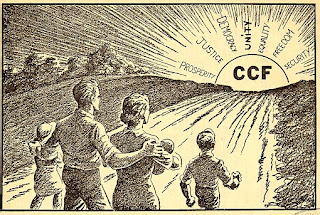
So, this week I thought I'd do a bit of personal reflection. As noted in previous posts I'm doing some research on the nationalism of the League for Social Reconstruction which has me reading on the history of Canadian socialism. While reading Ian McKay's article* I came across these passages:
"The charismatic aura which surrounds the great stars, especially the CCFers, suggests that they now figure in a nationalist myth-symbol complex, that they have become 'national figures' and not mere leftists" (p. 96)
"In highly selective CCF-NDP invented traditions the entire rationale of the party is, and always will be, the same: the provision to Canadians of compassionate and effective social programs through a liberal democratic regime. But, clearly, as we have seen, the paradigm of national management was never so narrowly bound..." (p. 107).
While reading them I realized...my god...I'm a...nationalist! (how very frightening). Isn't it strange when you realize that you're intimately bound up with and a part of the subject that you're studying? It just seems odd, as if you've stepped back and are looking at yourself from an outside perspective. How deflating to realize that you've bought into the very myths that you're studying. I suppose this is the whole point? This isn't a new occurrence by any means and it happens frequently in university and life in general, but this one hit me with a but more gusto. Hopefully, and perhaps this is the point, this will let me look at the LSR in a much more open and intellectually critical light. Idealism...I shall miss you! All this is likely the product of Norman Hillmer's seminar. What angst you're causing me Dr. Hillmer!
 J.S. Woodsworth - perhaps the most mythical of them all.


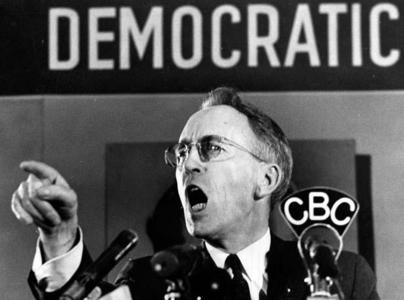
 Tommy Douglas
 Federal CCF Caucus, 1942
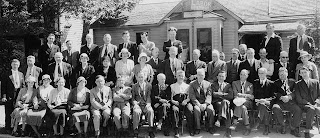 Founding of the CCF - Calgary, 1932
Best,
Jordan Kerr
http://randomunistudent.blogspot.com/
*"For a New Kind of History: A Reconnaissance of 100 Years of Canadian Socialism" (Labour / Le Travail, Vol. 46, Special Millennium Issue (Fall, 2000), pp. 69-125).
"The charismatic aura which surrounds the great stars, especially the CCFers, suggests that they now figure in a nationalist myth-symbol complex, that they have become 'national figures' and not mere leftists" (p. 96)
"In highly selective CCF-NDP invented traditions the entire rationale of the party is, and always will be, the same: the provision to Canadians of compassionate and effective social programs through a liberal democratic regime. But, clearly, as we have seen, the paradigm of national management was never so narrowly bound..." (p. 107).
While reading them I realized...my god...I'm a...nationalist! (how very frightening). Isn't it strange when you realize that you're intimately bound up with and a part of the subject that you're studying? It just seems odd, as if you've stepped back and are looking at yourself from an outside perspective. How deflating to realize that you've bought into the very myths that you're studying. I suppose this is the whole point? This isn't a new occurrence by any means and it happens frequently in university and life in general, but this one hit me with a but more gusto. Hopefully, and perhaps this is the point, this will let me look at the LSR in a much more open and intellectually critical light. Idealism...I shall miss you! All this is likely the product of Norman Hillmer's seminar. What angst you're causing me Dr. Hillmer!



Best,
Jordan Kerr
http://randomunistudent.blogspot.com/
*"For a New Kind of History: A Reconnaissance of 100 Years of Canadian Socialism" (Labour / Le Travail, Vol. 46, Special Millennium Issue (Fall, 2000), pp. 69-125).
Subscribe to:
Posts (Atom)